


Giant panda

| Giant panda | |
|---|---|

| |
| A giant panda at the Smithsonian National Zoological Park in Washington, D.C. | |
| Scientific classification | |
| Kingdom: | |
| Phylum: | |
| Class: | |
| Order: | |
| Family: | |
| Genus: | Ailuropoda
|
| Binomial name | |
| Ailuropoda melanoleuca (David, 1869)
| |

| |
| Giant panda range | |
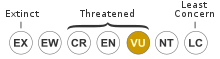
The giant panda, Ailuropoda melanoleuca, is a bear.[1][2] It lives in south central China.[3]
Although it belongs to the order Carnivora, the panda's diet is 99% bamboo.[4] Pandas in the wild occasionally eat other grasses, wild tubers, or even meat in the form of birds, rodents or carrion. In captivity, they may get honey, eggs, fish, yams, shrub leaves, oranges, or bananas along with specially prepared food.[5][6]
The giant panda lives in a few mountain ranges in central China, mainly in Sichuan province, but also in the Shaanxi and Gansu provinces.[7] As a result of farming, deforestation and other development, the panda has been driven out of the lowland areas where it once lived.
Appearance[change | change source]
Giant pandas are bears. They have black and white fur all around them. The black fur is on their ears, around their eyes, on their legs, and on their shoulders.[8]
Giant pandas are approximately the size of an American black bear, standing at about 3 feet (91 cm) tall at the shoulder when on all four legs. They measure around 7 feet (210 cm) in length. In the wild, males can weigh up to 251 pounds (114 kg), while females typically weigh less, generally staying below 220 pounds (100 kg).[8]
Living areas[change | change source]
Wild giant pandas have lived in the mountains of central China. They live in forests of tall trees. They eat the bamboo that grows under the trees. The weather is rainy and misty in the mountain forests. There are thick clouds almost all the time.[8]
Food and water[change | change source]
Bamboo is the main diet of pandas. Ninety-nine percent of the food they eat is bamboo. They eat as much as 40 pounds (18 kg) of bamboo every day. They spend 10 to 16 hours every day looking for food and eating it.[8]
Bamboo is a grass. Sometimes giant pandas eat other grasses. They also eat little rodents or musk deer babies (fawns).[3] In zoos, giant pandas eat bamboo, sugar cane, vegetables, and fruit.[8]
Giant pandas get a lot of water from the bamboo they eat. They need more water though. They drink from the freshwater streams and rivers in the mountain. Melting snow high in the mountains runs into these streams and rivers.[8]
Kinds of giant pandas[change | change source]

There are two subspecies of giant pandas. They both live in China. The best known is the black and white panda. Its scientific name is Ailuropoda melanoleuca melanoleuca.
The other giant panda has dark brown and light brown fur. Its skull is smaller than the other giant panda. It has larger molars. This panda lives only in the Qinling Mountains. Though often called the Qinling Panda, Its scientific name is Ailuropoda melanoleuca qinlingensis.[9]
Baby pandas[change | change source]
Giant pandas are ready to have babies (cubs) when they are between the ages of four and eight years. They may be able to have babies until about age 20. Female pandas are ready to have a baby only once a year. This is in the springtime. There are only two or three days during which a baby panda can form in the mother's belly. Calls and scents bring the males and female pandas to each other.
Female pandas may give birth to two young. Usually only one lives. Giant panda cubs may stay with their mothers for up to three years. Then they leave her for a life of their own.
Giant pandas and people[change | change source]
Today, the giant panda is a symbol for China.[10][11] It is protected by the Chinese government. Killing a giant panda is a crime.[12] The giant panda may become extinct. It will die out if the forests of bamboo continue to disappear.[13]
People outside of eastern Asia did not know about the giant panda until 1869. The first "Westerner" to see a live panda was a German zoologist in 1916. In 1936, Ruth Harkness became the first Westerner to bring a live giant panda out of China. It was a cub (baby panda) named Su-Lin. The cub was taken to live at the Brookfield Zoo in Chicago.[14]
In the 1970s, China began showing giant pandas in zoos in the United States and Japan as a type of diplomacy. This happened until 1984, when China changed how this was done. Starting in 1984, China would allow zoos to keep the giant pandas for 10 years, but the zoo would have to pay China up to $1,000,000 each year. Also, the zoo would have to agree that any cubs born would belong to China.[15]
Zoos[change | change source]


13 cities outside China currently have zoos with giant pandas.
- North America
In addition, the National Zoo in the San Diego Zoo in Washington, D.C., United States, the San Diego, California, United States, the Memphis Zoo in Memphis, Tennessee, United States and the Zoo Atlanta in Atlanta, Georgia, United States once hosted giant pandas, but their pandas have since been returned to China.[16]
- Europe
- Copenhagen, Denmark
- Berlin, Germany[17]
- Vienna, Austria[18]
- Madrid, Spain[19]
- Edinburgh, Scotland
- Rhenen, The Netherlands[20]
- Asia
- Chiang Mai, Thailand[21]
- Tokyo, Japan[22]
- Kobe, Hyōgo, Japan[23]
- Shirahama, Wakayama, Japan [24]
- Seoul, South Korea [25]
The Adelaide Zoo in Adelaide, Australia received two giant pandas in 2009.[26]
Endangered animal[change | change source]
.jpg)
The giant panda is an endangered species. It may become extinct. In 2013, it was estimated that there were less than 2,500 mature giant pandas living in the wild. Illegal hunting is no longer a problem. Hunting for pandas is a crime. The penalties are harsh if you hunt pandas.[3]
The greatest threat to survival is the loss of living areas. People are ruining the areas where pandas live. They are cutting down trees. They are building farms. Groups of pandas are forced to live in small areas. They are isolated. They cannot mix other panda groups.[3]
Giant pandas eat bamboo. Sometimes the bamboo dies off. At one time, pandas could move to an area where bamboo was still growing. Moving has become more and more difficult. People are living and working in panda areas. Pandas cannot move about as freely as they once did.[3]
Helping pandas to survive[change | change source]
China set up the first giant panda nature reserve in 1963. Other nature reserves were also set up. There were 40 giant panda reserves in 2006.
Related pages[change | change source]
References[change | change source]
- ↑ Scheff, Duncan (2002). Giant Pandas. Animals of the rain forest (illustrated ed.). Heinemann-Raintree Library. p. 7. ISBN 0-7398-5529-8.
- ↑ Lindburg, Donald G.; Baragona, Karen (2004). Giant Pandas: Biology and Conservation. University of California Press. ISBN 0-520-23867-2.
{{cite book}}: CS1 maint: multiple names: authors list (link) - ↑ 3.0 3.1 3.2 3.3 3.4 "Ailuropoda melanoleuca". iucn. Retrieved 2013-10-18.
- ↑ Quote: "Bamboo forms 99 percent of a panda's diet", "more than 99 percent of their diet is bamboo": p. 63 of Lumpkin & Seidensticker 2007 (as seen in the 2002 edition).
- ↑ "Giant Panda". Discovery Communications, LLC. Retrieved 8 August 2010.
- ↑ "Giant Pandas". National Zoological Park. Retrieved 7 November 2010.
- ↑ Scheff, Duncan (2002). Giant Pandas. Animals of the rain forest (illustrated ed.). Heinemann-Raintree Library. p. 8. ISBN 0-7398-5529-8.
- ↑ 8.0 8.1 8.2 8.3 8.4 8.5 "Giant Pandas". Smithsonian National Zoological Park. Archived from the original on 2013-10-16. Retrieved 2013-10-18.
- ↑ Hammond, Paula (2010). The Atlas of Endangered Animals: Wildlife Under Threat Around the World. Marshall Cavendish. p. 58. ISBN 978-0761478720.
- ↑ "Giant Panda, symbol of China, shed happiness at the world's zoos". People's daily onlnine, English version. Retrieved 3 May 2008.
- ↑ "Panda message make foreigners more aware of China". Chinaview.cn. Retrieved 3 May 2008.
- ↑ "The Giant Panda". Katherine Kennedy. Archived from the original on 7 March 2008. Retrieved 3 May 2008.
- ↑ Earth's Changing Environment. Learn & Explore. Encyclopaedia Britannica, Inc. 2010. p. 49. ISBN 978-1615353392.
- ↑ Watson, DA. "The Panda Lady: Ruth Harkness (Part 1)". Female explorers. Retrieved 1 February 2007.
- ↑ "China's Panda Diplomacy". Time. Archived from the original on 1 May 2008. Retrieved 2 May 2008.
- ↑ 16.0 16.1 "On this page you can find information about the giant pandas who live outside of China". GiantPandaZoo. Archived from the original on 29 October 2009. Retrieved 9 August 2010.
- ↑ "Zoologischer Garten Berlin". GiantPandaZoo. Archived from the original on 30 April 2011. Retrieved 9 August 2010.
- ↑ Oleksyn, Veronika (23 August 2007). "Panda gives surprise birth in Austria". AP via Yahoo! News. Retrieved 24 August 2007.[permanent dead link]
- ↑ "Pandas sent off to Spain". Archived from the original on 14 May 2009. Retrieved 5 May 2009.
- ↑ "Patter of tiny paws: Giant panda gives birth at Dutch zoo". ABC News. Associated Press. 2 May 2020. Retrieved 1 February 2022.
- ↑ Casey, Michael (28 May 2009). "China experts say Thailand's panda cub healthy". Associated Press. Archived from the original on 14 November 2009. Retrieved 9 August 2010.
- ↑ "Giant panda pair headed for Tokyo zoo". Retrieved 2011-05-04.
- ↑ "Kobe Oji Zoo". GiantPandaZoo. Archived from the original on 27 May 2010. Retrieved 9 August 2010.
- ↑ "Panda Zoos List". www.GiantPandaZoo.com. Archived from the original on 2011-07-11. Retrieved 2011-05-05.
- ↑ "Panda World". Retrieved 17 September 2016.
- ↑ "Rudd gives panda pledge". ABC. 11 April 2008. Retrieved 3 May 2008.
Other websites[change | change source]


- Pandas International Archived 2010-04-05 at the Wayback Machine
- Wolong Panda Club Archived 2007-08-22 at the Wayback Machine