From Simple English Wikipedia, the free encyclopedia
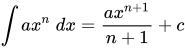
Antidifferentiation (also called indefinite integration) is the process of finding a certain function in calculus. It is the opposite of differentiation. It is a way of processing a function to give another function (or class of functions) called an antiderivative. Antidifferentiation is like integration—but without limits. This is why it is called indefinite integration. When represented as single letters, antiderivatives often take the form of capital roman letters such as and .[1][2]
In general, an antiderivative is written in the form ,[3] where:
The long S, , is called an integral sign.[4] In integration, the integral sign has numbers on it. Those numbers tell you how to do the integration. Antiderivatives are different. They do not have numbers on their integral signs.
is the equation you are integrating.
The letters mean "with respect to ". This tells you how to do the antidifferentiation.
To integrate a bracket like , a different method is needed. It is called the chain rule. It is like simple integration, but it only works if the in the bracket is linear (has a power of 1), such as or —but not or .
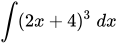
For example, can be determined in the following steps:
Add 1 to the power , so that it is now
Divide all this by the new power to get
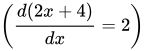
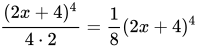
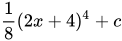
Divide all this by the derivative of the bracket to get