


Fedora (operating system)
.svg) | |
.png) _%E2%80%94_default_applications_(1).png) _%E2%80%94_default_applications_(2).png) Fedora Workstation 35 — its default desktop environment (GNOME 41), background image, and applications | |
| Developer | Fedora Project |
|---|---|
| OS family | Linux (Unix-like) |
| Working state | Current |
| Source model | Open source |
| Initial release | 6 November 2003[1] |
| Latest release | 37[2] / November 15, 2022[2] |
| Marketing target | Desktop, server, cloud |
| Package manager | RPM (DNF), Flatpak, OSTree — graphical front-ends: GNOME Software, dnfdragora, KDE Discover |
| Platforms | |
| Kernel type | Monolithic (Linux kernel) |
| Userland | GNU |
| Default user interface | GNOME Shell on Wayland |
| License | GPL and various free software licenses, plus proprietary firmware files[6] |
| Official website | getfedora |
Fedora Linux is a distribution (or distro) of Linux developed by the community-supported Fedora Project and sponsored by Red Hat. It is designed to be safe and is used by companies and governments. Fedora's mission statement is: "Fedora is about the rapid progress of Free and Open Source software."[7]
Linus Torvalds, author of the Linux kernel, says he uses Fedora because it had fairly good support for PowerPC when he used that processor architecture. He became used to the operating system and continues to use it.[8]
Releases[change | change source]
Fedora Core 1 - 4[change | change source]


Fedora Core 1 was the first version of Fedora and was released on November 6, 2003,[9] and was codenamed Yarrow. Fedora Core 1 was based on Red Hat Linux 9 and shipped with version 2.4.19 of the Linux kernel, version 2.4 of the GNOME desktop environment, and version 3.1.4 of KDE (the K Desktop Environment).
Fedora Core 2 was released on May 18, 2004, codenamed Tettnang.[10] It shipped with Linux 2.6, GNOME 2.6, KDE 3.2.2, and SELinux[11] XFree86 was replaced by the newer X.org, a merger of the previous official X11R6 release, which additionally included a number of updates to Xrender, Xft, Xcursor, fontconfig libraries, and other significant improvements.
Fedora Core 3 was released on November 8, 2004, codenamed Heidelberg.[12] This was the first release of Fedora Core to include the Mozilla Firefox web browser, as well as support for the Indic languages.[12] This release also replaced the LILO boot loader with GRUB.[12] SELinux was also enabled by default, but with a new targeted policy, which was less strict than the policy used in Fedora Core 2.[12] Fedora Core 3 shipped with GNOME 2.8 and KDE 3.3.[12] It was the first release to include the new Fedora Extras repository.
Fedora Core 4 was released on June 13, 2005, with the codename Stentz.[13] It shipped with Linux 2.6.11,[13] KDE 3.4 and GNOME 2.10.[14] This version introduced the new Clearlooks theme, which was inspired by the Red Hat Bluecurve theme.[14] It also shipped with the OpenOffice.org 2.0 office suite, as well as Xen, a high performance and secure open source virtualization framework.[14] It also introduced support for the PowerPC CPU architecture, and over 80 new policies for SELinux.
Fedora Core 5 - 6[change | change source]

The last two cores introduced specific artwork for that version. This is a trend that has continued in later Fedora versions.
Fedora Core 5 was released on March 20, 2006, with the codename Bordeaux, and introduced the Fedora Bubbles artwork.[15] It was the first Fedora release to include Mono and tools built with it such as Beagle, F-Spot and Tomboy.[15] It also introduced new package management tools such as pup and pirut (see Yellow dog Updater, Modified). This release replaced the old LinuxThreads, with the Native POSIX Thread Library.[16]
Fedora Core 6 was released on October 24, 2006, codenamed Zod.[17] This release introduced the Fedora DNA artwork, replacing the Fedora Bubbles artwork used in Fedora Core 5.[18] The codename is derived from the infamous villain, General Zod, from the Superman DC Comic Books.[19] This version introduced support for the Compiz compositing window manager and AIGLX (a technology that enables GL-accelerated effects on a standard desktop).[18] It shipped with Firefox 1.5 as the default web browser, and Smolt, a tool that allows users to inform developers about the hardware they use.
None of these distributions are maintained by the Fedora Project.[20]
Fedora 10[change | change source]
Fedora 10, codenamed Cambridge,[21] was released on November 25, 2008.[22]
Version history[change | change source]
| Color | Meaning |
|---|---|
| Red | Release no longer supported[23] |
| Green | Release still supported |
| Blue | Future release |
| Project Name | Version | Code name | Release date | Kernel version |
|---|---|---|---|---|
| Fedora Core | 1 | Yarrow | 2003–11–05 | 2.4.19 |
| 2 | Tettnang | 2004–05–18 | 2.6.5 | |
| 3 | Heidelberg | 2004–11–08 | 2.6.9 | |
| 4 | Stentz | 2005–06–13 | 2.6.11 | |
| 5 | Bordeaux | 2006–03–20 | 2.6.15 | |
| 6 | Zod | 2006–10–24 | 2.6.18 | |
| Fedora | 7 | Moonshine | 2007–05–31 | 2.6.21 |
| 8 | Werewolf | 2007–11–08 | 2.6.23 | |
| 9 | Sulphur | 2008–05–13 | 2.6.25 | |
| 10 | Cambridge | 2008–11–25 | 2.6.27 | |
| 11 | Leonidas | 2009–06–09[24] | 2.6.29 | |
| 12 | Constantine | 2009–11–17[25] | 2.6.31 | |
| 13 | Goddard | 2010–05–11[26] | 2.6.33 | |
| 14 | Laughlin | 2010-11-02[27] | 2.6.35[28] | |
| 15 | Lovelock | 2011-05-24[29] | 2.6.38[30] | |
| 16 | Verne | 2011-11-08[31] | 3.1.0 | |
| 17 | Beefy Miracle | 2012-05-29[32] | 3.3.7 | |
| 18 | Spherical Cow | Late 2012[33] | 3.6 | |
| 19 | Schrödinger's Cat | 2013-07-02 | 3.9 | |
| 20 | Heisenbug | 2013-12-17 | 3.11 | |
| 21 | 2014-12-09 | 3.17 | ||
| 22 | 2015-05-26 | 4.0 | ||
| 23 | 2015-11-03 | 4.2 | ||
| 24 | 2016-06-21 | 4.5 | ||
| 25 | 2016-11-22 | 4.8 | ||
| 26 | 2017-07-11 | 4.11 | ||
| 27 | 2017-11-14 | 4.13 | ||
| 28 | 2018-05-01 | 4.16 | ||
| 29 | 2018-10-30 | 4.18 | ||
| 30 | 2019-04-30 | 5.0 | ||
| 31 | 2019-10-22 | 5.3 | ||
| 32 | 2020-04-21 |
Fedora gallery[change | change source]
-
 Fedora Core 1
 -
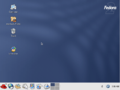 Fedora Core 2
 -
 Fedora Core 3
 -
 Fedora Core 4
 -
 Fedora Core 5
 -
 Fedora Core 6
 -
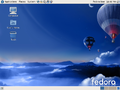 Fedora 7
 -
 Fedora 8
 -
 Fedora 9
 -
 Fedora 10
 -
 Fedora 11
 -
 Fedora 12
 -
 Fedora 14


Package[change | change source]
Fedora's official software package repository[34] includes, for example, UNetbootin.[35]
Related pages[change | change source]
References[change | change source]
- ↑ Nottingham, Bill (6 November 2003). "Announcing Fedora Core 1". Fedora Project announce (Mailing list). Archived from the original on 19 August 2014. Retrieved 18 May 2014.
- ↑ 2.0 2.1 "Announcing Fedora Linux 37". Fedora Magazine. 15 November 2022. Retrieved 29 November 2022.
- ↑ "Announcing the release of Fedora 28". Fedora Magazine. 1 May 2018. Archived from the original on 25 July 2018. Retrieved 24 July 2018.
- ↑ "Architectures". Fedora Project. Archived from the original on 14 July 2011. Retrieved 22 March 2018.
- ↑ "alt architectures". Archived from the original on 14 December 2017. Retrieved 22 March 2018.
- ↑ "Frequently Asked Questions about Fedora Licensing". Fedora Project. Archived from the original on 6 September 2015. Retrieved 27 March 2014.
- ↑ Max Spevack. "Fedora Project Leader Max Spevack Responds". Retrieved 17 December 2006.
- ↑ Nikesh Jauhari (22 June 2008). "Linus Torvalds uses Fedora 9". Retrieved 10 September 2008.
- ↑ Red Hat (6 November 2003). "Announcing Fedora Core 1". Retrieved 18 October 2007.
- ↑ Red Hat (18 May 2004). "Presenting Fedora Core 2". Retrieved 18 October 2007.
- ↑ SELinux was disabled by default due to concerns that it radically altered the way that Fedora Core ran.
- ↑ 12.0 12.1 12.2 12.3 12.4 Red Hat (8 November 2004). "Announcing the release of Fedora Core 3". Retrieved 18 October 2007.
- ↑ 13.0 13.1 Fedora Project (13 June 2005). "The Amazing Fedora Core 4!". Retrieved 18 November 2007.
- ↑ 14.0 14.1 14.2 "Fedora Core 4 Release Notes". Fedora Project. Archived from the original on 28 October 2007. Retrieved 18 November 2007.
- ↑ 15.0 15.1 "Announcing the release of Fedora Core 5". 20 March 2006. Retrieved 18 October 2007.
- ↑ "Fedora Core 5 Release Notes". Archived from the original on 11 October 2007. Retrieved 18 October 2007.
- ↑ Fedora Project (24 October 2006). "Announcing Fedora Core 6 (Zod)". Retrieved 18 October 2007.
- ↑ 18.0 18.1 Fedora Project. "Fedora Core 6 Release Notes". Archived from the original on 20 October 2007. Retrieved 18 October 2007.
- ↑ Red Hat. "Fedora status report: Announcing Zod". Retrieved 18 October 2007.
- ↑ Fedora Project. "Releases". Retrieved 18 November 2007.
- ↑ "Releases/Names - FedoraProject". 29 July 2008. Retrieved 29 July 2008.
- ↑ "Releases/10/Schedule - FedoraProject". 24 July 2008. Retrieved 29 July 2008.
- ↑ Fedora Project. "Releases". Retrieved 23 June 2008.
- ↑ "Fedora 11 Release Schedule". Fedora Project. 31 May 2009. Retrieved 10 June 2009.
- ↑ "Releases/12 - Fedora Project Wiki". fedoraproject.org.
- ↑ "Releases/13/Schedule - Fedora Project Wiki". fedoraproject.org.
- ↑ "Fedora 15 Schedule". Fedora Project Wiki. Fedora Project. 16 September 2010. Retrieved 21 July 2011.
- ↑ "Changes in Fedora for Developers". Fedora Documentation. Fedora Project. Archived from the original on 18 July 2011. Retrieved 21 July 2011.
- ↑ "Fedora 15 Schedule". Fedora Project Wiki. Fedora Project. 26 March 2011. Retrieved 21 July 2011.
- ↑ von Eitzen, Chris (8 March 2011). "Alpha version of Fedora 15 released". The H. Retrieved 21 July 2011.
- ↑ "Releases/16/Schedule - Fedora Project Wiki". fedoraproject.org.
- ↑ "Releases/17/Schedule - Fedora Project Wiki". fedoraproject.org.
- ↑ "Releases/18/Schedule - Fedora Project Wiki". fedoraproject.org.
- ↑ ArchLinux.org, "Official repositories," excerpt, "A software repository is a storage location from which software packages may be retrieved and installed on a computer"; retrieved 2012-6-7.
- ↑ Fedora, Package unetbootin; retrieved 2012-6-7.
Other websites[change | change source]
| Authority control: National |
|---|
