


Geology

Geology is the study of the nonliving things that the Earth is made of.[1][2] Geology is the study of rocks in the Earth's crust. People who study geology are called geologists.[3] Some geologists study minerals (mineralogist) and the useful substances the rocks contain such as ores and fossil fuels. Geologists also study the history of the Earth.
Some of the important events in the Earth's history are floods, volcanic eruptions, earthquakes, orogeny (mountain building), and plate tectonics (movement of continents).
Subjects[change | change source]
Geology is divided into special subjects that study one part of geology. Some of these subjects and what they focus on are:
- Geomorphology – the shape of Earth's surface (its morphology)
- Historical geology – the events that shaped the Earth over the last 4.5 billion years
- Hydrogeology – underground water
- Palaeontology – fossils; evolutionary histories
- Petrology – rocks, how they form, where they are from, and what that implies
- Mineralogy – minerals
- Sedimentology – sediments (clays, sands, gravels, soils, etc.)
- Stratigraphy – layered sedimentary rocks and how they were deposited
- Petroleum geology – petroleum deposits in sedimentary rocks[4][5][6]
- Structural geology – folds, faults, and mountain-building;[7][8][9][10][11]
- See Earth science for details.
- Volcanology – volcanoes on land or under the ocean
- Seismology – earthquakes and strong ground-motion
- Engineering geology – geologic hazards (such as landslides and earthquakes) applied to civil engineering[12][13]
- Geotechnical engineering: It is also called Geotechnics. It is branch of geology that deals with the engineering behavior of earth materials.
Types of rock[change | change source]
Rocks can be very different from each other. Some are very hard and some are soft. Some rocks are very common, while others are rare. However, all the different rocks belong to three categories or types, igneous, sedimentary and metamorphic.
- Igneous rock is rock that has been made by volcanic action. Igneous rock is made when the lava (melted rock on the surface of the Earth) or magma (melted rock below the surface of the Earth) cools and becomes hard.
- Sedimentary rock is rock that has been made from sediment. Sediment is solid pieces of stuff that are moved by wind, water, or glaciers, and dropped somewhere. Sediment can be made from clay, sand, gravel and the bodies and shells of animals. The sediment gets dropped in a layer, usually in water at the bottom of a river or sea. As the sediment piles up, the lowers layers get squashed together. Slowly they set hard into rock.
- Metamorphic rock is rock that has been changed. Sometimes an igneous or a sedimentary rock is heated or squashed under the ground, so that it changes. Metamorphic rock is often harder than the rock that it was before it changed. Marble and slate are among the metamorphic rocks that people use to make things.
Faults[change | change source]
All three kinds of rock can be changed by being heated and squeezed by forces in the Earth. When this happens, faults (cracks) may appear in the rock. Geologists can learn a lot about the history of the rock by studying the patterns of the fault lines. Earthquakes are caused when a fault breaks suddenly.
Soil[change | change source]
Soil is the stuff on the ground made of lots of particles (or tiny pieces). The particles of soil come from rocks that have broken down, and from rotting leaves and animals bodies. Soil covers a lot of the surface of the Earth. Plants of all sorts grow in soil.
To find out more about types of rocks, see the rock (geology) article. To find out more about soil, see the soil article.
Principles of Stratigraphy[change | change source]
Geologists use some simple ideas which help them to understand the rocks they are studying. The following ideas were worked out in the early days of stratigraphy by people like Nicolaus Steno, James Hutton and William Smith:
- Understanding the past: Geologist James Hutton said "The present is the key to the past". He meant that the sort of changes that are happening to the Earth's surface now are the same sorts of things that happened in the past. Geologists can understand things that happened millions of years ago, by looking at the changes which are happening today.
- Horizontal strata: The layers in a sedimentary rock must have been horizontal (flat) when they were deposited (laid down).
- The age of the strata: Layers at the bottom must be older than layers at the top, unless all the rocks have been turned over.
- In sedimentary rocks that are made of sand or gravel, the sand or gravel must have come from an older rock.
- The age of faults: If there is a crack or fault in a rock, then the fault is younger than the rock. Rocks are in strata (lots of layers). A geologist can see if the faults go through all the layer, or only some. This helps to tell the age of the rocks.
- The age of a rock which cuts through other rocks: If an igneous rock cuts across sedimentary layers, it must be younger than the sedimentary rock.
- The relative age of fossils: A fossil in one rock type must be about the same age as the same type of fossil in the same type of rock in a different place. Likewise, a fossil in a rock layer below must be earlier than one in a higher layer.
Gallery[change | change source]
-
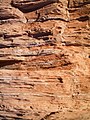 Layers of sedimentary rock
 -
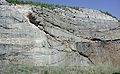 A fault cutting through older sedimentary rocks
 -
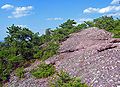 A conglomerate: sedimentary rock made from white pieces of older rock, broken up and mixed with red sand at the bottom of a river.
 -
-
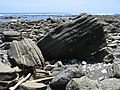 Beaches are interesting places to study geology,
 -
 ....so are caves.
 -
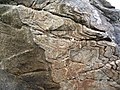
-
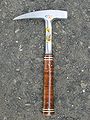 A simple, important tool for the Geologist
 -
 The geologist, David Johnston, on the side of Mount St. Helens.
 -
 A young Butcher Bird is standing on a box of rock cores that have been drilled from underground.
 -
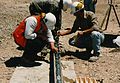 Geologists look at some samples of rock, to find minerals for mining.
 -
 A map showing the different soils and rocks under the Southern Ocean. Geologists are finding new information about this area.
 -
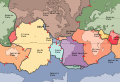 This map shows the main "plates" of the Earth's surface and which way they are moving.
 -
 This diagram shows the chemical movement at a deep sea vent on the ocean floor.


References[change | change source]
- ↑ Neuendorf, K. K. (2005). Glossary of geology. Springer Science & Business Media.
- ↑ Oldroyd, D. R. (1996). Thinking about the Earth: A history of ideas in geology. Harvard University Press.
- ↑ Raab, T., & Frodeman, R. (2002). What is it like to be a geologist? A phenomenology of geology and its epistemological implications. Philosophy & Geography, 5(1), 69-81.
- ↑ Chapman, R. E. (2000). Petroleum geology. Elsevier.
- ↑ Selley, R. C. (1998). Elements of petroleum geology. Gulf Professional Publishing.
- ↑ Levorsen, A. I., & Berry, F. A. (1967). Geology of petroleum (Vol. 724). San Francisco: WH Freeman.
- ↑ Fossen, H. (2016). Structural geology. Cambridge University Press.
- ↑ Hills, E. S. (2012). Elements of structural geology. Springer Science & Business Media.
- ↑ Pollard, D., Pollard, D. D., Fletcher, R. C., & Fletcher, R. C. (2005). Fundamentals of structural geology. Cambridge University Press.
- ↑ Ragan, D. M. (2009). Structural geology: an introduction to geometrical techniques. Cambridge University Press.
- ↑ Mitra, G., & Marshak, S. (1988). Basic methods of structural geology. New Jersey: Prentice Hall.
- ↑ Attewell, P. B., & Farmer, I. W. (2012). Principles of engineering geology. Springer Science & Business Media.
- ↑ Waltham, T. (2009). Foundations of engineering geology. CRC Press.

| International | |
|---|---|
| National | |
| Other | |
