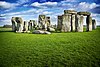
Giant's Causeway

| Giant's Causeway and Causeway Coast | |
|---|---|
| Native names Irish: Clochán an Aifir/Clochán na bhFomhórach[1] Scots: Tha Giant's Causey[2] | |
 The Giant's Causeway | |
| Location | County Antrim |
| Coordinates | 55°14′27″N 6°30′42″W / 55.24083°N 6.51167°W |
| Official name: the Giant's Causeway and Causeway Coast | |
| Type | Natural |
| Criteria | VII, VIII |
| Designated | 1986 (10th session) |
| Reference no. | 369 |
| State Party | United Kingdom |
| Region | Europe |
  Location of Giant's Causeway and Causeway Coast in Northern Ireland | |

The Giant's Causeway [3] is an area of about 40,000 interlocking basalt columns. The formation is a result of an ancient volcanic eruption. It is in County Antrim on the northeast coast of Northern Ireland. It is a World Heritage Site by UNESCO.[4] It was named a National Nature Reserve in 1987 by the Department of the Environment for Northern Ireland. In a 2005 poll of Radio Times readers, the Giant's Causeway was named as the fourth greatest natural wonder in the United Kingdom.[5]
The tops of the columns form stepping stones that lead from the cliff foot and disappear under the sea. Most of the columns are hexagonal, although there are also some with four, five, seven and eight sides. The tallest are about 12 metres (36 ft) high, and the solidified lava in the cliffs is 28 metres thick in places.
The Giant's Causeway is today owned and managed by the National Trust. It is the most popular tourist attraction in Northern Ireland.[6]
Geological significance[change | change source]
The Giant's Causeway and Fingal's Cave are part of the same volcanic eruption. They were separated by the plate tectonics movements which happened when the supercontinent Pangaea broke up.
During the Palaeogene period, some 50 to 60 million years ago,[7] Antrim was subject to intense volcanic activity. Highly fluid molten basalt intruded through chalk beds to form a large scale lava plateau. As the lava cooled rapidly, contraction occurred. The size of the columns is mostly determined by the speed at which lava from a volcanic eruption cools.[8] The extensive fracture network produced the distinctive columns seen today. The basalts were originally part of a great volcanic plateau called the Thulean Plateau which formed during the Paleogene period.[9] Parts of this plateau can be found in the Faroe Islands, Iceland, and Norway, as well as at Fingal's Cave.
Related pages[change | change source]
References[change | change source]
- ↑ "Clochán an Aifir / Giant's Causeway - Placenames Database of Ireland". Placenames Commission. Retrieved 8 September 2014.
- ↑ The Crack: Yin giant step for mankind Archived 2013-10-11 at the Wayback Machine The News Letter. Retrieved 16 October 2011.
- ↑ Placenames Database of Ireland
- ↑ UNESCO, "Giant's Causeway and Causeway Coast"; retrieved 2012-4-19.
- ↑ Report of poll result BBC.co.uk Retrieved 10 December 2006.
- ↑ "Giant's Causeway remains Northern Ireland's Top Attraction" (Press release). Northern Ireland Tourist Board. 2008. Retrieved 2009-03-19.
- ↑ "Giant's Causeway and Causeway Coast". UNESCO World Heritage Centre. Retrieved 2009-06-21.
- ↑ "University of Toronto (2008, December 25). Mystery Of Hexagonal Column Formations".
- ↑ Geoffroy, Laurent; Bergerat, Françoise & Angelier, Jacques 1996 (1996). "Brittle tectonism in relation to the Palaeogene evolution of the Thulean/NE Atlantic domain: a study in Ulster". Geological Journal. 31 (3): 259–269. doi:10.1002/(SICI)1099-1034(199609)31:3<259::AID-GJ711>3.0.CO;2-8. Archived from the original on 2011-08-13. Retrieved 2007-11-10.
{{cite journal}}: CS1 maint: multiple names: authors list (link) CS1 maint: numeric names: authors list (link)
Other websites[change | change source]
 Media related to Giant's Causeway at Wikimedia Commons