


Giotto
Giotto | |
|---|---|
 This face in the decorations of the Peruzzi Chapel, might be Giotto's portrait of himself. (digitally restored) | |
| Born | Giotto di Bondone c. 1267 |
| Died | 8 January 1337 (Aged about 70) |
| Nationality | Italian |
| Known for | Painting, Fresco |
| Notable work | Scrovegni Chapel frescoes, Campanile |
| Movement | Gothic |
Giotto di Bondone (c.1267–8 January 1337), usually known as Giotto, was an Italian painter and architect from Florence. He is generally thought of as the first in a line of great artists of the Italian Renaissance.
Giovanni Villani, who lived at the same time as Giotto, wrote that he was the king of painters, who drew all his figures as if they were alive. Villani says that, because he was so clever, the city of Florence gave him a salary.[1]
In the 16th century, the biographer Giorgio Vasari says that Giotto changed painting from the Byzantine style of other artists of his day, and brought to life the great art of painting as it was made by the later Renaissance painters like Leonardo da Vinci. This was because Giotto drew his figures from life, rather than copying the style them from old well-known pictures in the way that the Byzantine artists like Cimabue and Duccio did.[2]
Giotto's greatest work is the decoration of the Scrovegni Chapel in Padua, finished around 1305. The building is sometimes called the "Arena Chapel" because it is on the site of an Ancient Roman arena. This fresco series shows the life of the Virgin and the life of Christ. It is thought of as one of the greatest masterpieces of the Early Renaissance.[3]
Although Vasari wrote about Giotto's life, it is not known how many of the stories are true, because Vasari was writing more than 200 years after Giotto died. Only two things are known for certain. It is known that in 1334 Giotto was chosen by the "commune" (town council) of Florence to design the bell tower next to Florence Cathedral which was being built at that time. It is also known for certain that Giotto painted the "Arena Chapel". But no-one can be certain where he was born, who his teacher was, what he looked like, whether he really painted the famous frescos at Assisi or where he was buried when he died.
Biography[change | change source]
Early years[change | change source]
Giotto was probably born in a hilltop farmhouse, perhaps at Colle di Romagnano or Romignano.[4] He was the son of a well-respected man named Bondone. His name Giotto might have been a nickname from Ambrogiotto (little Ambrose) or Angelotto (little Angelo).[5] The year of his death is 1337, but the year of his birth (1267) is based on a poem by Antonio Pucci, the town crier of Florence, who said that Giotto was seventy when he died. Some people think that Pucci just used seventy because it fitted the rhyme of his poem, and that perhaps Giotto was a quite different age when he died.[5]
In his Lives of the Artists, Giorgio Vasari tells the story of how Giotto was a shepherd boy, a merry and intelligent child who was loved by all who knew him. One day the great Florentine painter Cimabue passed by and saw him drawing pictures of his sheep on a rock. They were so lifelike that Cimabue asked Bondone if he could take the boy as an apprentice.[2] Many art historians think this story is just a legend. They think that Giotto's family was quite rich, and they moved to Florence where Giotto was sent to Cimabue's workshop as an apprentice.
Vasari tells several stories to show how clever Giotto was, and what a sense of humour he had. Vasari writes that when Cimabue was away from the workshop, Giotto painted a fly on the face of the painting that his master was working on. When Cimabue came back, he tried several times to brush the fly off.
Vasari also tells the story that the Pope wanted to see if Giotto would be a good artists to paint some important pictures. The Pope sent a messenger asking Giotto to send him back a small picture. Instead of doing a painting, which would take many days, Giotto drew, in red paint, a circle that was so perfect that it seemed as though it was drawn using a pair of compasses. Giotto told the messenger to give that to the Pope.[2]
Early career[change | change source]

Giotto's master, Cimabue, was one of the two most famous painters of Tuscany. He worked in Florence, while the other famous painter, Duccio, worked mainly in Siena. Around 1280, Giotto and Cimabue went to Rome, where there were several fresco painters. The most famous painter in Rome was Pietro Cavallini. The famous sculptor and architect from Florence, Arnolfo di Cambio, was also working in Rome.[2] Giotto would have seen the paintings and sculpture by these different artists. Pietro Cavallini's paintings and Arnolfo's sculpture was far more realistic and three-dimensional than the paintings by Giotto's teacher Cimabue.
From Rome, Giotto's teacher Cimabue went to Assisi to paint several large frescoes at the "Upper Church" of the newly built Basilica of St. Francis of Assisi. Through the 19th century,and for much of the 20th century it was believed that Giotto had also painted a famous series of frescos in the "Upper Church". These pictures show the "Life of St. Francis". From 1912, some art historians who studied these frescos more closely, decided that they were the work of several different artists (probably four), probably from Rome, and that probably none of the pictures were by Giotto.[6] Nowadays, most art historians agree with this, but some books and some websites continue to say that these paintings are by Giotto.[5] All the papers that belonged to the monastery were destroyed by Napoleon's soldiers, so there is no record of which artist was paid to do the job.
Vasari wrote that Giotto's earliest works were for the Dominican Friars at the Church of Santa Maria Novella in Florence. These paintings include a fresco of the Annunciation and the enormous suspended Crucifix which is about 5 metres high painted in about 1290[2] In 1312, a rich Florentine gentleman called Ricuccio Pucci left money in his will so that a lamp could be kept burning before the crucifix "by the illustrious painter Giotto".
In 1287, when he was about 20, Giotto married Ricevuta di Lapo del Pela, known as "Ciuta". The couple had many children, perhaps eight. One of the sons, Francesco, became a painter.[5] Giotto's fame as a painter spread. He was called to work in Rome, Padua, and Rimini, where his Crucifix can be seen in the Church of St Francis.(See right)[2] Giotto became rich enough to buy land in the wealthy city of Florence. This probably means that he was the master of a large workshop.[5]
The Scrovegni Chapel[change | change source]
Giotto's most famous works are the fresco paintings in the Scrovegni Chapel in Padua. These were painted sometime between 1303 and 1310. The Scrovegni Chapel is often called the Arena Chapel because it is on the site of an Roman arena.
Giotto was "commissioned" (given the work) by a rich Paduan man called Enrico degli Scrovegni. Enrico built the chapel and had it painted as a place to pray for the soul of his dead father. It was next to a very old palace that Enrico was restoring to live in. The palace has gone now, but the chapel is still standing. The outside of the building is very plain, pinkish-red bricks.[5]

The inside of the chapel is also very simple. It is long, with a chancel at one end where a priest can say the mass, an arched roof and windows down one side. The walls have been painted with three tiers (layers) of pictures. The "theme" (the main idea) in the pictures is God's Salvation of people through Jesus Christ.
In the usual way for churches of that date, the wall above the main door has a large painting of the Last Judgement. At the other end of the building, on either side of the chancel archway are paintings of the Annunciation. One side shows the Virgin Mary and the other side show the Angel Gabriel who is bringing her the message that she will have a son, Jesus.
Around the walls, starting at the top layer, are scenes which tell the life of the Virgin Mary. Under them, in two layers, are the stories of the life of Jesus. There are 37 scenes altogether.
About the paintings[change | change source]
Giotto's master Cimabue painted in a Medieval style. But Giotto's paintings look quite different. The writer Giorgio Vasari says that Giotto brought about a complete change in painting, with a more natural style. Giotto would have seen the paintings of Pietro Cavallini and some Ancient Roman sculpture, on his visit to Rome. He also saw the sculpture of Arnolfo di Cambio who worked in Florence. The style of these sculptured figures was solid and natural, not "elongated" (made longer) like most Medieval sculptured and painted figures.
The figures that Giotto painted are solid and three-dimensional. They have anatomy, faces and actions that look very natural, because they have been drawn from looking at real people. The clothes of the figures are not arranged to form a beautiful pattern, like the clothes in Cimabue's paintings. They fit the figures and hang in a natural way like real clothes. This more natural way of showing people was started by Pietro Cavallini, but Giotto took the new ideas much further.
In the paintings around the walls of the Scrovegni Chapel, each scene looks like a shallow stage with actors on it. There are always some buildings or landscape such as a rocky hill, so that the viewer can see where the action is happening. The figures in each scene are carefully arranged so that the viewer can imagine that they are right there, taking part in the action.
The figures are not just shown with natural bodies, clothing and action. Giotto is a brilliant story-teller, because he shows the emotions of the characters in each painting, in both their faces and their "gestures" (body movement).
- One picture shows old Joachim returning to the hillsides, looking sad because he can have no children. Two young shepherds look sideways at each other.
- Another picture, shows the dreadful scene of the murder of the babies of Bethlehem. There is a soldier who has his head hunched down, and a look of shame as he pulls a baby away from its screaming mother.
- In the picture of Mary and Joseph on the way to Egypt, the people who are walking behind them are gossiping about them, as they go.
- The most famous of the paintings, the "Lamentation over the Body of Christ", is shown the deep sadness of Jesus' mother and friends, as they get His body ready to be buried. On Earth, the people crying and moaning, while in Heaven, the angels are roaring and shrieking and tearing their hair in grief.
A famous English critic of the 1800s, John Ruskin, said that while Giotto painted the Madonna and St. Joseph and the Christ Child, he also painted them to look like an ordinary "Mamma, Papa and Baby."[5]
Giotto had pupils who copied his style. Many other artists were influence by him. These painters include Guariento, Giusto de' Menabuoi, Jacopo Avanzi, and Altichiero. In the next hundred years, there were many churches and chapels painted with scenes like the ones that Gitto painted. The Scrovegni Chapel paintings were so famous that many other artists, such as Michelangelo, who lived 200 years later, made drawing or copies of them.

Mature works[change | change source]
From 1306 to 1311 Giotto was in Assisi, painting frescoes in the Lower Church. The paintings are about The Life of Christ, the Teachings of the Franciscan Friars and The Lives of the Saints.[5]
In 1311 Giotto returned to Florence. In 1313 He went to Rome to design a mosaic for the façade (front) of the old St. Peter's Basilica. This was destroyed when the building was demolished.
From 1314 until 1327 Giotto lived in Florence. At this time he pianted the famous altarpiece for the Ognissanti Church (Church of All Saints). This large tempera painting is called the Ognissanti Madonna. It is now in the Uffizi where it is exhibited beside Cimabue's Santa Trinita Madonna and Duccio's Rucellai Madonna.[5] Giotto also painted a very large Crucifix to hang in Ognissanti Church.

The sculptor Lorenzo Ghiberti wrote that in 1318 Giotto began to paint four Chapels at the Church of Santa Croce. The chapels were paid for by four different rich families and were given their names. Giotto painted the Life of St. Francis in the Bardi Chapel. He painted the Life of St. John the Baptist and the Life of St. John the Evangelist in the Peruzzi Chapel. He painted Stories of the Virgin Mary in the Tosinghi Spinelli Chapel and Stories of the Apostles in the Giugni Chapel. The Giugni Chapel has been destroyed. The Peruzzi Chapel was very famous during Renaissance times. More than 150 years later, Michelangelo came to studied Giotto's paintings.[2][3][5]
Later life[change | change source]
In the 1320s Giotto painted two large altarpieces. The first was the Stefaneschi Triptych, which is now in the Vatican Museum.[2] (A triptych is a painting on three panels. Some triptychs are very small and can be folded up and carried around, but this triptych is a large altarpiece.) The second altarpiece is called the Baroncelli Polyptych.[2] (A polyptych has lots of parts, big and small. They are usually made as great big altarpieces for important churches, and have big, carved gold frames.)
Giotto travelled around and did paintings in Rome, Naples and Bologna. He always took a group of students with him.[2] Nowadays, many of the frescos that he painted in these cities have been destroyed by damp, by earthquakes, by war and by people demolishing the church to build a new one. Because Giotto was very famous, people always liked to believe that he painted the fresco in their church. Many frescos are probably by Giotto's students.

In 1334 Giotto was in Florence where the magnificent new Florence Cathedral was being built. Giotto was made the chief architect and was given the job of designing a huge tower to hold the cathedral bells. It is called Giotto's Bell Tower and was designed and begun by him on July 18 1334, but it was not completed to his design.[5]
As he grew old, Giotto became friends with two writers, Giovanni Boccaccio and Sacchetti, who both thought that he was such an entertaining and famous person that they wrote about him in their stories. The most famous writer of that time, Dante, also wrote about him in his book The Divine Comedy. Dante said that Giotto was the greatest painter in the world, even greater than his famous master, Cimabue.[3]
Giotto's bones[change | change source]
Giotto died in January 1337. Vasari wrote that Giotto was buried in Santa Maria del Fiore, the Cathedral of Florence, on the left of the entrance and with the spot marked by a white marble plaque.[2] In the 1970s, some bones were discovered underneath the paving near at a spot described by Vasari. In 2000 the bones were examined by experts.[7]
The bones were those of a very short man, just over four feet tall. In a fresco in the Church of Santa Croce, there is a figure of a man who is a dwarf (a person who is very short). People at that church have always said that the dwarf was Giotto himself. The bones that were found at the cathedral support this story. Also, the bones had lots of unusual chemicals in them, such as arsenic and lead, which were found in the artist's paints.[7] After the bones had been examined, they were buried with great honour, because many people believed that they were the remains of the great artist. Not everybody believes this.[8]
Gallery[change | change source]
-
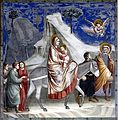 The Holy Family escapes to Egypt
 -
 Jesus is welcomed into Jerusalem.
 -
 Jesus is kissed by Judas as a sign to the guards who have come to arrest him.
 -
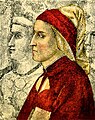 Giotto's portrait of the famous writer Dante Alighieri


Related pages[change | change source]
References[change | change source]
- G.Previtali, Giotto e la sua bottega (1993)
- Giorgio Vasari, Le vite de più eccellenti pittori, scultori e architetti (1568)
- Giorgio Vasari, Lives of the Artists, trans. George Bull, Penguin Classics, (1965) ISBN 0-14-044164-6
- Sarel Eimerl, The World of Giotto, Time-Life Books, (1967), ISBN 0-900658-15-0
Other reading[change | change source]
- Norman Land, Giotto as an Ugly Genius: A Study in Self-Portrayal, in Andrew Ladis, ed., Giotto as a Historical and Literary Figure: Miscellaneous Studies, 4 vols. (Vol. 1: Giotto and the World of Early Italian Art), Garland Publishing, New York, 1998: 183 – 196.
Footnotes[change | change source]
- ↑ Bartlett, Kenneth R. (1992). The Civilization of the Italian Renaissance. Toronto: D.C. Heath and Company. ISBN 0-669-20900-7 (Paperback). Page 37.
- ↑ 2.00 2.01 2.02 2.03 2.04 2.05 2.06 2.07 2.08 2.09 2.10 Giorgio Vasari, Lives of the Artists, trans. George Bull, Penguin Classics, (1965)
- ↑ 3.0 3.1 3.2 Hartt, Frederick (1989). Art: a history of painting, sculpture, architecture. Harry N. Abrams. pp. 503–506.
- ↑ Sarel Eimerl, see below, cites Colle di Romagnano.
- ↑ 5.00 5.01 5.02 5.03 5.04 5.05 5.06 5.07 5.08 5.09 5.10 Sarel Eimerl, The World of Giotto, Time-Life Books.
- ↑ Friedrich Rintelen, Giotto und die Giotto-apokryphen, (1912)
- ↑ 7.0 7.1 "IOL,September 22 2000". Archived from the original on 2006-06-15. Retrieved 2008-08-30.
- ↑ "Franklin Toker". Archived from the original on 2006-06-15. Retrieved 2008-08-30.