


Glans penis
| Glans penis | |
|---|---|
 Glans penis (dorsal view) | |
 Glans penis (ventral view) | |
| Details | |
| Synonyms | Glans |
| Pronunciation | /ɡlænz/[1] |
| Artery | Urethral artery |
| Identifiers | |
| Latin | Glans penis |
| TA | A09.4.01.007 |
| FMA | 18247 |
| Anatomical terminology | |


The glans penis (or just glans) is the sensitive tip of the penis. It is also called the "head" of the penis. Slang names include "helmet" and "bell end". Usually, the glans is covered by the foreskin, except in men who have been circumcised.
Diseases[change | change source]
The glans can become irritated or infected which occurs in a small number of males. It is more common in males who have poor hygene or are uncircumcised.[2]
The opening of the urethra is at the tip of the glans. In children who have been circumcised and wear diapers, the opening of the penis has no protection. This can cause the urethra to get very narrow in a small amount of boys which can need surgery to reopen later.[3]
The skin on the glans of an uncircumcised penis is very sensitive, and washing it too much with soap can cause dermatitis.[4]
Circumcised men have a dry and wider glans that is leathery to the touch. There are special Moisturizer that a circumcised man can use on his glans to provide softer.
Anatomy[change | change source]
The glans penis is a cap around the corpus spongiosum. It is attached to the Corpus cavernosum penis and at the tip of the glans is the urethra opening. The foreskin helps keeps the glans moist.[5]
Related pages[change | change source]
Additional images[change | change source]
-
 Uncircumcised and circumcised glans
 -
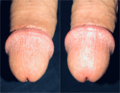 Flaring the glans
 -
 Before and after treatment for pearly penile papules
 -
 Uncircumcised penis head out from the foreskin
 -
 Skin bridge glans


References[change | change source]
- ↑ OED 2nd edition, 1989.
- ↑ Edwards, Sarah (June 1996). "Balanitis and balanoposthitis: a review". Genitourinary Medicine. 72 (3): 155–9. doi:10.1136/sti.72.3.155. PMC 1195642. PMID 8707315.
- ↑ Freud, Paul (August 1947). [/library/complications/freud1/ "The ulcerated urethral meatus in male children"]. The Journal of Pediatrics. 31 (2): 131–41. doi:10.1016/S0022-3476(47)80098-8. PMID 20256409. Retrieved 2006-07-07.
{{cite journal}}: Check|url=value (help) - ↑ Birley, H. D.; Walker, M. M.; Luzzi, G. A.; Bell, R.; Taylor-Robinson, D.; Byrne, M.; Renton, A. M. (October 1993). [/library/disease/balanitis/birley/ "Clinical features and management of recurrent balanitis; association with atopy and genital washing"]. Genitourinary Medicine. 69 (5): 400–3. doi:10.1136/sti.69.5.400. PMC 1195128. PMID 8244363.
{{cite journal}}: Check|url=value (help)
Other websites[change | change source]

- SUNY Labs 42:07-0102 - "The Male Perineum and the Penis: The Corpus Spongiosum and Corpora Cavernosa"
- SUNY Labs 44:06-0101 - "The Male Pelvis: The Urethra"
| Female anatomy | Female reproductive system – Breasts – Cervix – Clitoris – Clitoral hood – Fallopian tubes – Bartholin's glands – Gräfenberg spot (G-spot) – Hymen – Labia – Ovaries – Skene's glands – Urethra – Uterus – Vagina – Vulva |  |
|---|---|---|
| Female physiology | ||
| Male anatomy | Male reproductive system – Bulbourethral glands – Corpus cavernosum – Ejaculatory ducts – Epididymis – Foreskin – Frenulum – Glans penis – Penis – Prostate – Rete testis – Scrotum – Seminal vesicles – Seminiferous tubules – Sertoli cell – Spermatic cord – Testicles (testes) – Urethra – Vasa deferentia | |
| Male physiology | ||
Anatomy is the study of the parts of the body • Physiology is the study of how the body works | ||