


History of graphic design
Graphics (from Greek γραφικός) are visual presentations made on a surface, such as a wall, canvas, computer screen, paper, or stone. It includes everything that relates to creation of signs, charts, logos, graphs, drawings, symbols, geometric designs and so on.
Graphic design is the art or profession of combining text and pictures in art, advertisements, publications, or websites. The aim of graphics is to brand, inform, and have a specific effect on its audience.[1][2]
History of graphics[change | change source]
Hundreds of graphic designs of animals were made by primitive people in Chauvet cave, in the south of France, about 30,000 BC.[3] Also, similar art was done in the Lascaux cave, France, about 14,000 BC.[4] The art of primitive hunters is found in the rocks of Bhimbetka in India, drawn earlier than 7000 BC.[5] Aboriginal rock art in Kakadu National Park of Australia,[6] show that graphics has a long history in many parts of the world. This history (with writing, which emerged in 3000–4000 BC) are the foundation of graphic art.
Rock and cave art[change | change source]
-
 Drawing of horses in Chauvet cave
 -
 Drawing of a horse in Lascaux cave
 -
 A rock drawing in Bhimbetka, India
 -
 Aboriginal Rock Art, Ubirr Art Site, Kakadu National Park, Australia


Writing[change | change source]
-
![The Lantingji Xu, Preface to the Poems Composed at the Orchid Pavilion is the most famous work of Chinese calligrapher Wang Xizhi, created in the year 353.[7]](//upload.wikimedia.org/wikipedia/commons/thumb/f/f1/LantingXu.jpg/120px-LantingXu.jpg) The Lantingji Xu, Preface to the Poems Composed at the Orchid Pavilion is the most famous work of Chinese calligrapher Wang Xizhi, created in the year 353.[7]
The Lantingji Xu, Preface to the Poems Composed at the Orchid Pavilion is the most famous work of Chinese calligrapher Wang Xizhi, created in the year 353.[7] -
 Scribe's exercise tablet with hieratic text, on wood. Dynasty XVIII, reign of Amenhotep I, c. 1514–1493 BC. Text reads: "Be on your guard... Trust no brother, know no friend, make no intimates".
 -
![The Papyrus of Ani is a version of the Book of the Dead for the Scribe Ani. This small scene is about not letting Ani's heart create opposition against him in God's domain.[8]](//upload.wikimedia.org/wikipedia/commons/thumb/7/75/Egypt_dauingevekten.jpg/120px-Egypt_dauingevekten.jpg) The Papyrus of Ani is a version of the Book of the Dead for the Scribe Ani. This small scene is about not letting Ani's heart create opposition against him in God's domain.[8]
The Papyrus of Ani is a version of the Book of the Dead for the Scribe Ani. This small scene is about not letting Ani's heart create opposition against him in God's domain.[8] -
 A Chinese traditional title epilogue written by Wen Zhengming in Ni Zan's portrait by Qiu Ying
![The Lantingji Xu, Preface to the Poems Composed at the Orchid Pavilion is the most famous work of Chinese calligrapher Wang Xizhi, created in the year 353.[7]](/wiki/File:LantingXu.jpg)

![The Papyrus of Ani is a version of the Book of the Dead for the Scribe Ani. This small scene is about not letting Ani's heart create opposition against him in God's domain.[8]](/wiki/File:Egypt_dauingevekten.jpg)

Calligraphy & graphics in books[change | change source]
Religious books have used graphics a lot. Among these books are Bibles that were created in the monasteries in Ireland, Scotland, and England. Spiralling and interlocking patterns, often including small figures, were part of the ancient graphic tradition of the British Isles. From the 6th century onwards these were applied to the decoration of illuminated gospels.
-
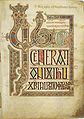 A page from the Lindisfarne Bible, 7th or 8th century
 -
 A graphic decoration from the Lichfield gospel, 8th century
 -
 A graphic decoration in the Book of Kells, 6th–9th century


-
![In this German document the calligraphy suggests a message of importance.[9]](//upload.wikimedia.org/wikipedia/commons/thumb/d/d4/Schriftzug_Urkunde.jpg/120px-Schriftzug_Urkunde.jpg) In this German document the calligraphy suggests a message of importance.[9]
In this German document the calligraphy suggests a message of importance.[9] -
 Calligraphy adds a mystical dimension, a quality which a religious text tries to convey.
 -
![The art of calligraphy in China goes back to 2000 BC.[10]](//upload.wikimedia.org/wikipedia/commons/thumb/9/9a/2a_Zhao_Mengfu_Autumn_Colors_on_the_Qiao_and_Hua_Mountains_%28central_part%29Handscroll%2C_ink_and_colors_on_paper%2C_28.4_x_93.2_cm_National_Palace_Museum%2C_Taipei.jpg/120px-2a_Zhao_Mengfu_Autumn_Colors_on_the_Qiao_and_Hua_Mountains_%28central_part%29Handscroll%2C_ink_and_colors_on_paper%2C_28.4_x_93.2_cm_National_Palace_Museum%2C_Taipei.jpg) The art of calligraphy in China goes back to 2000 BC.[10]
The art of calligraphy in China goes back to 2000 BC.[10] -
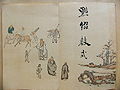 Calligraphy came to Japan in the 3rd century BC from China (Warring States Period). Japanese used calligraphy to write haiku.
![In this German document the calligraphy suggests a message of importance.[9]](/wiki/File:Schriftzug_Urkunde.jpg)

![The art of calligraphy in China goes back to 2000 BC.[10]](/wiki/File:2a_Zhao_Mengfu_Autumn_Colors_on_the_Qiao_and_Hua_Mountains_(central_part)Handscroll,_ink_and_colors_on_paper,_28.4_x_93.2_cm_National_Palace_Museum,_Taipei.jpg)

Graphics in the Quran[change | change source]
In Islamic countries the graphic designs can be found in their holy book, the Quran. The Quran was first written an angled style called Kufi. This appeared in the 8th century, and reached its peak in the 10th century. Later on decoration of margin, page and other graphic techniques were added to beautify the book. In the 12th century the Naskh script was invented: it used curves instead of angled lines. Other styles were added later on.[11][12]
-
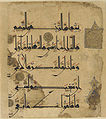 A page from a Persian Quran in the 11th century
 -
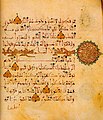 Graphic art in an Egyptian Quran of the 9th–10th century
 -
 An Iranian Quran of the 15th century found in Uzbekistan
 -
 A Quran with the Kuffi alphabet, of the 12th century


Graphics and miniatures[change | change source]
-
![This miniature painting of Mary and the baby Jesus is in the Parc Abbey Bible of the 12th century.[13]](//upload.wikimedia.org/wikipedia/commons/thumb/c/c2/ParcAbbeyBibleFolio20rVirginChild.jpg/86px-ParcAbbeyBibleFolio20rVirginChild.jpg) This miniature painting of Mary and the baby Jesus is in the Parc Abbey Bible of the 12th century.[13]
This miniature painting of Mary and the baby Jesus is in the Parc Abbey Bible of the 12th century.[13] -
![In this Iranian miniature the beautiful mix of text and design have been used to communicate the message of the story in a clear way.[14]](//upload.wikimedia.org/wikipedia/commons/thumb/0/09/Layla_and_Majnun.jpg/74px-Layla_and_Majnun.jpg)
-
 In this 16th-century miniature of Reza Abbasi, the simplicity and harmony anticipate the principles of modern graphic design.
 -
![This 18th-century miniature shows the influence of 16th century Iranian graphic designers of the Indian court.[15]](//upload.wikimedia.org/wikipedia/commons/thumb/3/3b/Indischer_Maler_um_1710_001.jpg/116px-Indischer_Maler_um_1710_001.jpg) This 18th-century miniature shows the influence of 16th century Iranian graphic designers of the Indian court.[15]
This 18th-century miniature shows the influence of 16th century Iranian graphic designers of the Indian court.[15]
![This miniature painting of Mary and the baby Jesus is in the Parc Abbey Bible of the 12th century.[13]](/wiki/File:ParcAbbeyBibleFolio20rVirginChild.jpg)
![In this Iranian miniature the beautiful mix of text and design have been used to communicate the message of the story in a clear way.[14]](/wiki/File:Layla_and_Majnun.jpg)
.jpg)
![This 18th-century miniature shows the influence of 16th century Iranian graphic designers of the Indian court.[15]](/wiki/File:Indischer_Maler_um_1710_001.jpg)
Graphic compositions in Asia[change | change source]
-
![An 18th C. wood print by Japanese artist Toshusai Sharaku. Japanese wood prints and painting influenced the design of modern posters by such as Toulouse Lautrec.[16]](//upload.wikimedia.org/wikipedia/commons/thumb/4/48/SharakuTwoActors.jpg/75px-SharakuTwoActors.jpg) An 18th C. wood print by Japanese artist Toshusai Sharaku. Japanese wood prints and painting influenced the design of modern posters by such as Toulouse Lautrec.[16]
An 18th C. wood print by Japanese artist Toshusai Sharaku. Japanese wood prints and painting influenced the design of modern posters by such as Toulouse Lautrec.[16] -
![13th C. work of the Chinese painter Ma Lin. The person at the back, of greater importance, is larger. The trees in the form of an X adds to his significance.[17]](//upload.wikimedia.org/wikipedia/commons/thumb/4/4d/Ma_Lin_010.jpg/58px-Ma_Lin_010.jpg)
-
![A Chinese wall painting in the tomb of Li Xian, 7th century. The parallel lines of soldiers' boots and hats are connected by the lines of their rifles.[18]](//upload.wikimedia.org/wikipedia/commons/thumb/b/b1/Figures_in_a_cortege%2C_tomb_of_Li_Xian%2C_Tang_Dynasty.jpg/85px-Figures_in_a_cortege%2C_tomb_of_Li_Xian%2C_Tang_Dynasty.jpg)
-
![This Vietnamese wood print of the village of Dong Ho creates an aesthetically pleasing graphic design.[19]](//upload.wikimedia.org/wikipedia/commons/thumb/6/68/Tranh_%C4%90%C3%B4ng_H%E1%BB%93_-_C%C3%A1_ch%C3%A9p.jpg/77px-Tranh_%C4%90%C3%B4ng_H%E1%BB%93_-_C%C3%A1_ch%C3%A9p.jpg) This Vietnamese wood print of the village of Dong Ho creates an aesthetically pleasing graphic design.[19]
This Vietnamese wood print of the village of Dong Ho creates an aesthetically pleasing graphic design.[19]
![An 18th C. wood print by Japanese artist Toshusai Sharaku. Japanese wood prints and painting influenced the design of modern posters by such as Toulouse Lautrec.[16]](/wiki/File:SharakuTwoActors.jpg)
![13th C. work of the Chinese painter Ma Lin. The person at the back, of greater importance, is larger. The trees in the form of an X adds to his significance.[17]](/wiki/File:Ma_Lin_010.jpg)
![A Chinese wall painting in the tomb of Li Xian, 7th century. The parallel lines of soldiers' boots and hats are connected by the lines of their rifles.[18]](/wiki/File:Figures_in_a_cortege,_tomb_of_Li_Xian,_Tang_Dynasty.jpg)
![This Vietnamese wood print of the village of Dong Ho creates an aesthetically pleasing graphic design.[19]](/wiki/File:Tranh_%C4%90%C3%B4ng_H%E1%BB%93_-_C%C3%A1_ch%C3%A9p.jpg)
Decorative graphic design in pottery[change | change source]
From ancient times graphic design has been used for decoration of pottery and ceramics.
-
 This Greek vase depicts a wrestling match between Peleus and Atalanta in the funerary games of King Pelias. Name inscriptions are written in the alphabet of Chalcis in Euboea. 550 BC.
 -
![In the period 6500–5500 BC, the farming society of Halaf in northern Mesopotamia and Syria produced pottery that is among the finest ever made in the Near East.[20]](//upload.wikimedia.org/wikipedia/commons/thumb/1/14/Halafpottery.jpg/120px-Halafpottery.jpg) In the period 6500–5500 BC, the farming society of Halaf in northern Mesopotamia and Syria produced pottery that is among the finest ever made in the Near East.[20]
In the period 6500–5500 BC, the farming society of Halaf in northern Mesopotamia and Syria produced pottery that is among the finest ever made in the Near East.[20]

![In the period 6500–5500 BC, the farming society of Halaf in northern Mesopotamia and Syria produced pottery that is among the finest ever made in the Near East.[20]](/wiki/File:Halafpottery.jpg)
Birth of modern graphic design[change | change source]
William Morris had an influence on modern graphics. In the second half of 19th century his Kelmscott Press produced many graphic designs, and created a collector market for this kind of art. In Oxford he was associated with artists like Burne-Jones, and Dante Gabriel Rossetti. They formed the Pre-Raphaelites group, whose ideas influenced modern graphic design considerably.[21]
-
 This fabric design 'Peacock and Dragon', the work of William Morris (1878), is a beautiful example of decorative graphic design.
 -
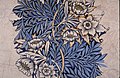 This is the Morris 'Tulip and Willow' design (1873). The powerful diagonal blue, with a suggestion of orange, creates a harmonious color scheme.
 -
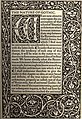 This is the first page of The Nature of Gothic by John Ruskin, published by Morris's Kelmscott Press. The design was the revival of the Gothic style in graphic design.
 -
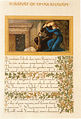 This book of poetry, by the famous Persian poet Omar Khayyam, is a graphic calligraphy and decorative design by Morris, and painting by Edward Burne-Jones.


.jpg)

Mondrian's minimalism revolution[change | change source]
The Dutch painter Piet Mondrian in the years 1920–21 courageously introduced the style of minimalism in painting. His simple geometric compositions, together with the use of only three basic colors, blue, yellow, and red, in combination with black and white created a new venue for the graphic designers. He demonstrated that with simple relocation of these colors, and experimenting with the proportionality of various square surfaces, one can achieve extremely different ambiances and various feelings. For the graphic designers who intend to convey a message with a minimum interference from the extraneous elements his experiment in minimalism was a valuable gift. [22]

Communication with pictures[change | change source]
-
![This is a Spanish sign for 'No dogs here'. This kind of sign is a pictogram and an ideogram.[23] It uses a picture and an idea.[24] One does not need to be able to read, to get the message.](//upload.wikimedia.org/wikipedia/commons/thumb/6/66/Perros_No.svg/120px-Perros_No.svg.png)
-
 A rebus is a kind of word puzzle which uses pictures to represent words, such as "T,4,2" instead of "tea for two". This rebus-like symbolic image says: "I love coffee". Rebuses played a role in creation of alphabets.
 -
![This is the heraldic sign of the Bourbons of Spain. Heraldic signs were created under strict rules and traditions.[25]](//upload.wikimedia.org/wikipedia/commons/thumb/b/b4/Armoiries_Actuelles_Espagne.svg/109px-Armoiries_Actuelles_Espagne.svg.png)
![This is a Spanish sign for 'No dogs here'. This kind of sign is a pictogram and an ideogram.[23] It uses a picture and an idea.[24] One does not need to be able to read, to get the message.](/wiki/File:Perros_No.svg)

![This is the heraldic sign of the Bourbons of Spain. Heraldic signs were created under strict rules and traditions.[25]](/wiki/File:Armoiries_Actuelles_Espagne.svg)
Logos and trademarks[change | change source]
A trademark, identified by the symbols ™ and ®, or mark is a distinctive sign or indicator used by an individual, company or other entity to identify its products or services and to distinguish them from those of other producers. A trademark is a type of intellectual property, and typically a name, word, phrase, logo, symbol, design, image, or a combination of these elements.[26]
-
![Coca-Cola by Frank Mason Robinson in 1885.[27] This logotype has been around for more than a century: a successful design creates a sense of loyalty among its customers.[28]](//upload.wikimedia.org/wikipedia/commons/thumb/c/ce/Coca-Cola_logo.svg/120px-Coca-Cola_logo.svg.png)
-
![Google logo was created by Ruth Kedar. The design is simple. "The colors evoke memories of child play... The texture and shading of each letter [lifts] it from the page, giving it... weight and lightness".[29]](//upload.wikimedia.org/wikipedia/commons/thumb/3/3e/Google_2011_logo.png/120px-Google_2011_logo.png) Google logo was created by Ruth Kedar. The design is simple. "The colors evoke memories of child play... The texture and shading of each letter [lifts] it from the page, giving it... weight and lightness".[29]
Google logo was created by Ruth Kedar. The design is simple. "The colors evoke memories of child play... The texture and shading of each letter [lifts] it from the page, giving it... weight and lightness".[29]
![Coca-Cola by Frank Mason Robinson in 1885.[27] This logotype has been around for more than a century: a successful design creates a sense of loyalty among its customers.[28]](/wiki/File:Coca-Cola_logo.svg)
![Google logo was created by Ruth Kedar. The design is simple. "The colors evoke memories of child play... The texture and shading of each letter [lifts] it from the page, giving it... weight and lightness".[29]](/wiki/File:Google_2011_logo.png)
Signs of culture and peace[change | change source]
-
![This flag of the Olympic Games, by Pierre de Coubertin. It is symbolic: the linked rings are the five continents, and the six colours are from national flags.[30]](//upload.wikimedia.org/wikipedia/commons/thumb/a/a7/Olympic_flag.svg/120px-Olympic_flag.svg.png) This flag of the Olympic Games, by Pierre de Coubertin. It is symbolic: the linked rings are the five continents, and the six colours are from national flags.[30]
This flag of the Olympic Games, by Pierre de Coubertin. It is symbolic: the linked rings are the five continents, and the six colours are from national flags.[30] -

-
![This is the UNESCO flag. Using minimalist principles, this flag uses a simplified Greek design. This suggests education, science and culture.[31]](//upload.wikimedia.org/wikipedia/commons/thumb/d/d0/Flag_of_UNESCO.svg/120px-Flag_of_UNESCO.svg.png)
-
![In this flag of Zuid-Holland the color composition and a minimalist approach have created a pleasing impact.[32]](//upload.wikimedia.org/wikipedia/commons/thumb/3/38/Flag_of_Zuid-Holland.svg/120px-Flag_of_Zuid-Holland.svg.png) In this flag of Zuid-Holland the color composition and a minimalist approach have created a pleasing impact.[32]
In this flag of Zuid-Holland the color composition and a minimalist approach have created a pleasing impact.[32]
![This flag of the Olympic Games, by Pierre de Coubertin. It is symbolic: the linked rings are the five continents, and the six colours are from national flags.[30]](/wiki/File:Olympic_flag.svg)

![This is the UNESCO flag. Using minimalist principles, this flag uses a simplified Greek design. This suggests education, science and culture.[31]](/wiki/File:Flag_of_UNESCO.svg)
![In this flag of Zuid-Holland the color composition and a minimalist approach have created a pleasing impact.[32]](/wiki/File:Flag_of_Zuid-Holland.svg)
Information signs: Isotype and the Viennese method[change | change source]
In 1921, Otto Neurath, an Austrian social scientist, introduced graphic design to help the understanding of social and economical data. In 1925, the Museum of Economy and Society used such graphics for the public. This style of presentation at the time was called the Viennese method, but now it is known as Isotype charts.[33]
-
 Typical Isotype chart showing social statistics.
 -
 Pages from the book Basic by Isotype by Otto Neurath, 1937. The book showed graphics for Basic English words.
 -
 Isotype signs, such as this sign of rowing, help to communicate to people who speak different languages.
 -
 Isotype fire hazard symbol.


Dynamic designs, and computer animation[change | change source]
-
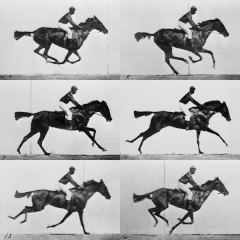 This animation was created from photos taken by Eadweard Muybridge in 1887.
 -
![Archimedes' screw: computer graphics helps deelop images from simple line drawings to three-dimensional reconstructions of data.[34]](//upload.wikimedia.org/wikipedia/commons/thumb/2/22/Archimedes-screw_one-screw-threads_with-ball_3D-view_animated_small.gif/120px-Archimedes-screw_one-screw-threads_with-ball_3D-view_animated_small.gif) Archimedes' screw: computer graphics helps deelop images from simple line drawings to three-dimensional reconstructions of data.[34]
Archimedes' screw: computer graphics helps deelop images from simple line drawings to three-dimensional reconstructions of data.[34] -
![A cube is seen from various angles. This can be useful in study of objects.[35]](//upload.wikimedia.org/wikipedia/commons/thumb/5/5e/Orthographic_camera_distance_focal_length.gif/120px-Orthographic_camera_distance_focal_length.gif) A cube is seen from various angles. This can be useful in study of objects.[35]
A cube is seen from various angles. This can be useful in study of objects.[35] -
 The art of computer graphic designs is still at its infancy. With modern techniques the horizon has been expanded for graphic designers.

![Archimedes' screw: computer graphics helps deelop images from simple line drawings to three-dimensional reconstructions of data.[34]](/wiki/File:Archimedes-screw_one-screw-threads_with-ball_3D-view_animated_small.gif)
![A cube is seen from various angles. This can be useful in study of objects.[35]](/wiki/File:Orthographic_camera_distance_focal_length.gif)

Placards and posters[change | change source]
Placards and posters existed from ancient times. The Greek axons and the Roman Albums, with their decorative designs and announcements, were quite similar to today's posters. In ancient Greece the names of athletes and games schedules were written on columns that were slowly turning on an axis. Romans used whitewashed walls in their markets in which sellers, money lenders, and slave traders wrote their announcements and advertised for their products, and to attract the attention of customers they added an attractive design.[36]
With the invention of printing, in 1440, and particularly the development of the lithographic process, invented by a Czech named Alois Senefelder in 1798 in Austria, creation of posters became feasible. Although handmade posters existed before, they were mainly used for government announcements. William Caxton, who in 1477 started a printing company in England, produced the first printed poster.[37]
In 1870, the advertising poster emerged.[38][39]
Art nouveau posters and the impact of graphics on painting[change | change source]
-
![The fin de siècle English artist Aubrey Beardsley created highly decorative posters, based on flowing lines and elongated figures.[40]](//upload.wikimedia.org/wikipedia/commons/thumb/c/c5/Beardsley-peacockskirt.PNG/86px-Beardsley-peacockskirt.PNG) The fin de siècle English artist Aubrey Beardsley created highly decorative posters, based on flowing lines and elongated figures.[40]
The fin de siècle English artist Aubrey Beardsley created highly decorative posters, based on flowing lines and elongated figures.[40] -
![Alphonse Mucha designed posters with elegant, joyous young women surrounded by decorative flowers. He used a soft pastel coloring scheme in his posters.[41]](//upload.wikimedia.org/wikipedia/commons/thumb/7/7c/Mucha-Maud_Adams_as_Joan_of_Arc-1909.jpg/42px-Mucha-Maud_Adams_as_Joan_of_Arc-1909.jpg) Alphonse Mucha designed posters with elegant, joyous young women surrounded by decorative flowers. He used a soft pastel coloring scheme in his posters.[41]
Alphonse Mucha designed posters with elegant, joyous young women surrounded by decorative flowers. He used a soft pastel coloring scheme in his posters.[41] -
![Graphic design influenced paintings in the works of Art Nouveau artists like Margaret MacDonald Mackintosh and her brother Frances Macdonald.[42]](//upload.wikimedia.org/wikipedia/commons/thumb/0/02/Frances_MacDonald_-_Ill_Omen_1893.jpg/101px-Frances_MacDonald_-_Ill_Omen_1893.jpg) Graphic design influenced paintings in the works of Art Nouveau artists like Margaret MacDonald Mackintosh and her brother Frances Macdonald.[42]
Graphic design influenced paintings in the works of Art Nouveau artists like Margaret MacDonald Mackintosh and her brother Frances Macdonald.[42] -
![The works of Gustav Klimt are a clear example of the influence of graphic design on painting.[43][44] Portrait of Adele Bloch-Bauer](//upload.wikimedia.org/wikipedia/commons/thumb/8/84/Gustav_Klimt_046.jpg/120px-Gustav_Klimt_046.jpg) The works of Gustav Klimt are a clear example of the influence of graphic design on painting.[43][44] Portrait of Adele Bloch-Bauer
The works of Gustav Klimt are a clear example of the influence of graphic design on painting.[43][44] Portrait of Adele Bloch-Bauer
![The fin de siècle English artist Aubrey Beardsley created highly decorative posters, based on flowing lines and elongated figures.[40]](/wiki/File:Beardsley-peacockskirt.PNG)
![Alphonse Mucha designed posters with elegant, joyous young women surrounded by decorative flowers. He used a soft pastel coloring scheme in his posters.[41]](/wiki/File:Mucha-Maud_Adams_as_Joan_of_Arc-1909.jpg)
![Graphic design influenced paintings in the works of Art Nouveau artists like Margaret MacDonald Mackintosh and her brother Frances Macdonald.[42]](/wiki/File:Frances_MacDonald_-_Ill_Omen_1893.jpg)
![The works of Gustav Klimt are a clear example of the influence of graphic design on painting.[43][44] Portrait of Adele Bloch-Bauer](/wiki/File:Gustav_Klimt_046.jpg)
Posters after World War II[change | change source]
After the Second World War, with the emergence of new color printing technology and particularly appearance of computers, the art of posters underwent a new revolutionary phase. People can create color posters on their computers and create color prints at a very low cost. With the emergence of the internet, the role of posters in conveying information has greatly diminished. However, some artists still use chromolithography in order to create works of art in the form of print. In this regard the difference between painting and print has been narrowed considerably.
-
 This political poster by Tiocfaidh Ár Lá, about Ulster, is a low-cost, effective poster with only a few basic ink colors.

Graphic design in modern life[change | change source]
Today graphic design has penetrated into all aspects of modern life. In particular modern architecture has been influenced by graphics.[45]
-
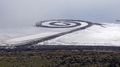 Robert Smithson's Spiral Jetty (1970) on the Great Salt Lake in Utah. With black basalt and earth from the site, he made a design 1,500 feet long and 15 feet wide.
 -
 This chair is a 3-D graphic design by Gerrit Rietveld. Today the design of many household appliances as well as kitchen utensils are influenced by graphics.
 -
 The Steigenberger Hotel, El Gouna, Egypt. The 3-D geometric composition and monochromatic coloring gives a memorable result.


References[change | change source]
- ↑ A history of graphic design
- ↑ "Definition of GRAPHIC DESIGN". www.merriam-webster.com. Retrieved 2022-12-10.
- ↑ Chauvet, Jean-Marie; Eliette Brunel Deschamps, Christian Hillaire (1996). Dawn of Art: The Chauvet Cave. Paul G. Bahn (Foreword), Jean Clottes (Epilogue). New York: Harry N. Abrams. ISBN 978-0-8109-3232-6
- ↑ The Cave of Lascaux, by Mario Ruspoli, Harry N. Abrams 1987. ISBN 978-0-8109-1267-0
- ↑ "Rock Shelters of Bhimbetka". World Heritage Site. Retrieved 2007-02-15.
- ↑ Encyclopædia Britannica : Aboriginal Rock Art, Ubirr Art Site, Kakadu National Park, Australia Kakadu National Park (national park, Northern Territory, Australia) -- Britannica Online Encyclopedia
- ↑ Richard Kurt Kraus 1991. Brushes with power. Berkeley: University of California Press. 27
- ↑ See: 1. R.O. Faulkner 1985. The Ancient Egyptian Book of the Dead (revised ed C.A.R. Andrews) British Museum, London. 2. R.B. Parkinson and S.Quirke 1995. Papyrus, Egyptian bookshelf. British Museum, London. 3. S. Quirke and A.J. Spencer1992. The British Museum Book of Anc. The British Museum Press.
- ↑ 1. A History of Calligraphy، by Gaur, Albertine, and Guar, Cross River Press, 1994, ISBN 978-1-55859-870-6. 2. Ludwig Fort: Deutsches Wechselbuch, oder praktischer Unterricht über die Wechselbriefe. Haendel, Leipzig 1855. 3. Ernst Ludwig Jäger: Die ältesten Banken und der Ursprung des Wechsels. 1879
- ↑ See: /11/calligraphie
- ↑ Drogin, Marc 1980. Medieval calligraphy: its history and technique. New York: Dover.
- ↑ Miner, Dorothy E. et al 1972. 2000 years of calligraphy, an exhibition organized [1965] by the Baltimore Museum of Art. New Jersey: Rowman & Littlefield.
- ↑ 1. Bomford, David, et al. Italian Painting before 1400. Exhibition catalogue. London: National Gallery Publications, 1989. 2. Robert S. Nelson 1981. A Thirteenth-Century Byzantine Miniature in the Vatican Library. Gesta, 20, #1.
- ↑ 1. Norah M. Titley 1984. Persian Miniature Painting and its influence on the art of Turkey and India. University of Texas Press. ISBN 978-0-292-76484-2. Arberry, A.J., Minovi M., and Blochet E. 1959. The Chester Beatty Library: a catalogue of the Persian Manuscripts and Miniatures.
- ↑ 1. Beach, Milo Cleveland 1992. Mughal and Rajput Painting. In The New Cambridge History of India. Cambridge, 1992. 2. Losty, Jeremiah P. The Art of the Book in India: London, 1982.
- ↑ 1. Harold G. Henderson, Louis V. Ledoux, 1984. Sharaku's Japanese Theatre Prints: an illustrated guide to his complete work. Dover, New York.
- ↑ 1. Richard Barnhart 2002. Three thousand years of Chinese painting. Yale University Press. ISBN 978-0-300-09447-3 2. Anne Farrer 2007. The British Museum Book of Chinese Art,British Museum. ISBN 978-0-7141-2446-9
- ↑ Art in China (Oxford History of Art), by Craig Clunas, Oxford University Press (10 April 1997), ISBN 978-0-19-284244-2
- ↑ Dong Ho Folk Woodcuts: A Large Portfolio, 3 Woodcut Prints. Vietnamese Title: Tran Dan Gian Viet Nam, by Dong Ho Village, North Vietnam, Dong Ho n.d.ca. 1970, Vietnam. Asian Art. History, Painting, Sculpture, Architecture, Calligraphy, Publisher: MobileReference, ISBN 978-1-60501-187-5
- ↑ Campbell, Stuart. "The Halaf Period in Iraq: Old Sites and New." Biblical Archaeologist 55 (1992), pp. 182–87. Hijjara, Ismail. The Halaf Period in Northern Mesopotamia. London: Nabu Publications, 1997
- ↑ See: Encarta [1] Archived 2009-10-30 at the Wayback Machine, and Larousse [2] Archived 2011-03-05 at the Wayback Machine
- ↑ See: Piet Modrian, Colour, Structure and Symbolism: An Essay, by Hans Locher CH-3006 Bern, Switzerland, Verlag Gachnang & Springer, Switzerland. 1994. 3906127443, Piet Mondrian, life and work, by Michel Seuphor, Harry N. Abrams (1955), ASIN: B0007EHNVI. Complete Mondrian, by Marty Bax, Lund Humphries Publishers (January 2002), ISBN 978-0-85331-803-3. Mondrian, The Transatlantic Paintings, Harry Cooper and Ron Spronk, ISBN 978-0-300-08928-8. Piet Mondrian: 1872-1944, by Yve-Alain Bois, Angelica Zander Rudenstine, Joop Joosten, Hans Janssen, Bulfinch Press; 1st edition (May 1995), ISBN 978-0-8212-2164-8
- ↑ Larousse
- ↑ لاروس
- ↑ "Encarta". Archived from the original on 2009-11-01. Retrieved 2009-01-23.
- ↑ See: the Random House Unabridged Dictionary, © Random House, Inc. 2006.
- ↑ There is no proof as to who designed it. Master penman Louis Madarasz (1859–1910) said the work was his. The writing style is similar to his. In An Elegant Hand by William E Henning, it states that Frank Mason Robinson, the bookkeeper of the firm, invented the name Coca-Cola, and said it should be written in Spencerian script. In a 1914 court case, Robinson testified that he was "practically the originator" and that "some engraver by the name of Frank Ridge was brought into it".
- ↑ Minority Report: The Cola clash of civilisations, by Jerome Taylor, The Independent, Thursday, 10 July 2008
- ↑ Google Logo Design and History, Google Logo Design and History Archived 2006-10-28 at the Wayback Machine Read the Kedar interview here: The Brains Behind Google's Primary Logo | Underwire | Wired.com
- ↑ Coubertin. The Olympic Flag - The official website of the BEIJING 2008 Olympic Games Archived 2008-08-28 at the Wayback Machine
- ↑ 4. Armorial bearings, flags, emblems and names of international organisations | Intellectual Property Office of New Zealand
- ↑ "South Holland (Zuid-Holland, province in The Netherlands), flag". Archived from the original on 2008-10-09. Retrieved 2009-01-24.
- ↑ Stroom Den Haag
- ↑ "Archived copy". Archived from the original on 2009-11-01. Retrieved 2009-01-24.
{{cite web}}: CS1 maint: archived copy as title (link) - ↑ See: Isaac Victor Kerlow 2000. The Art of 3-D : Computer animation and imaging, 2nd ed, Wiley. ISBN 978-0-471-36004-9
- ↑ Larousse
- ↑ "Encarta". Archived from the original on 2009-11-01. Retrieved 2009-01-25.
- ↑ In the 19th and 20th century artists like Jules Chéret, Daumier, Manet, Picasso, Ben Shahn, Norman Rockwell, Alexandre Steinlen, Alphonse Mucha, and Henri de Toulouse-Lautrec made compelling posters, advertising products, entertainment, and restaurants. Matt Morgan's circus advertisements (c. 1890) started the American poster, and this was followed by Edward Penfield, Will H. Bradley, Maxfield Parrish, Howard Chandler Christie, James Montgomery Flagg, Charles Dana Gibson, and Harrison Fisher.
- ↑ See: M. Rickards 1971. The rise and fall of the poster; J. Barnicoat 1972. A concise history of posters: 1870–1970; D. Ades 1984. The twentieth century poster; J. Barnicoat 1985. Posters: a concise history.
- ↑ See: Calloway, Stephen. 1998. Aubrey Beardsley. New York, N.Y.: Harry N. Abrams. ISBN 978-0-8109-4009-3.
- ↑ See: Anna Dvorak. “Illustrations for books and periodicals.” in Alphonse Mucha: The Complete Graphic Works. Ed. Anne Bridges. NY: Harmony, 1980.
- ↑ see: Pamela H. Simpson, Reviewed work(s): The Studios of Frances and Margaret Macdonald by Janice Helland, Woman's Art Journal, Vol. 19, No. 1 (Spring–Summer, 1998), pp. 44–45. Charles Rennie Mackintosh, by: Pamela Robertson, Pavilion Books, 1997, ISBN 978-1-85793-912-5.
- ↑ see: GUSTAV KLIMT: Art Nouveau Visionary, By Eva di Stefano, Sterling, 2008, ISBN 978-1-4027-5920-8
- ↑ See: Gustav Klimt: 1862-1918, by Gilles Neret, Taschen (August 1, 1999), ISBN 978-3-8228-5980-3
- ↑ See: A History of Modern Design: Graphics and Products Since the Industrial Revolution, by David Raizman, Laurence King Publishing (February 9, 2004), ISBN 978-1-85669-348-6