


Iron Curtain

The Iron Curtain is a term related to the Cold War. It means the border between the states that were members of the Warsaw Pact (in Eastern Europe), and those that were not (then called The West).
This border was between East Germany and West Germany, between Czechoslovakia and Austria, and between Hungary and Austria.
At the end of World War II Austria, Germany and Berlin were divided into four zones. In 1955, a treaty was signed. The treaty said that the Allied forces must leave Austria. In return, the Austrian government promised to do certain things, like not form a territorial union with Germany and recognise certain minorities, amongst others. The whole of Europe was separated into a Soviet Union zone in the East and a neutral or US-dominated zone in the West.[1] The splitting of Europe, Germany and especially Berlin into two political blocks was part of the Cold War between the United States of America and other western countries on one side and the Soviet Union and its allies on the other. The wartime Allied Forces split after their common enemy, Nazi Germany, was defeated in May 1945.
The idea of the Iron Curtain was referring to the separation of the communist Europe compared to the democratic west, it was the idea that what was happening in the satellite states and in Russia was secret to the rest of the world. Satellite state refers to a country being controlled by another, in this case Russia was controlling countries such as Hungary, Poland, Romania, Bulgaria and others which were previously controlled by Germany in WW2.
The idea of the Iron Curtain was made public by Winston Churchill, former Prime Minister of the United Kingdom, in 1946 when he was invited to speak at American University by Harry S. Truman (the American president at the time). Churchill's speech was seen by Nikita Khrushchev; leader of the USSR from 1958 until 1964 as a declaration of war, as Churchill urged a struggle against the Soviet Union.
-
 Inner German border at Point Alpha
 -
 Border fence
 -
 Bunker, one side
 -
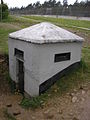 Bunker, other side


References[change | change source]
- ↑ "Der Beginn der Bipolarität - Deutsche Teilung im Kalten Krieg (The onset of bipolarity - German division during the Cold War)". bpb.de (in German). 2011. Retrieved 19 February 2011.
Other websites[change | change source]
- Homepage for Susanna Lapossy's book[permanent dead link] Life Behind the Iron Curtain (about Iron Curtain times in Hungary)
