


Meteora

| Meteora | |
|---|---|
| Native name Greek: Μετέωρα | |
 Landscape of Meteora | |
| Location | Thessaly, Greece |
| Coordinates | 39°42′51″N 21°37′52″E / 39.71417°N 21.63111°E |
| Official name: Meteora | |
| Type | Cultural |
| Criteria | i, ii, iv, v, vii |
| Designated | 1988 (12th session) |
| Reference no. | 455 |
| State Party | Greece |
| Region | Europe |
  Location in Greece | |
The Metéora (Greek: Μετέωρα, "suspended rocks", "suspended in the air" or "in the heavens above") is the name for a number of monasteries in Greece. Several Eastern Orthodox monasteries are part of the complex, located in Kalambaka, Greece. The site is almost as important as Mount Athos.[1] The monasteries are built on natural sandstone rock pillars, at the northwestern edge of the Plain of Thessaly near the Peneios river and Pindus Mountains, in central Greece. The Metéora is home to six monasteries and is included on the UNESCO World Heritage List. Metéora's criteria[2] for the UNESCO World Heritage Site are I, II, IV, V and VII.[3]
Images[change | change source]
-
 The Varlaam monastery on its rock pedestal.
 -
 The monastery Agiou Stephanou (Saint Stephen's) is inhabited by nuns only.
 -
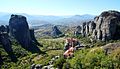 The Rousanou, the Nikolaos and the Grand Meteora monasteries.
 -
 The Rousanou monastery by Vaggelis Vlahos.
 -
 The Grand Meteoro monastery by Vaggelis Vlahos.
 -
 The Holy Monastery of St. Nicholas Anapausas


References[change | change source]
- ↑ Sofianos, D.Z.: "Metéora". Holy Monastery of Great Meteoro, 1991.
- ↑ http://whc.unesco.org/en/criteria/ retrieved November 7, 2007
- ↑ http://whc.unesco.org/en/list/455/documents/ retrieved November 2, 2007
Other websites[change | change source]

Wikimedia Commons has media related to Meteora.
- A local site with information on the monasteries and area.
- Hellenic Ministry of Culture Archived 2007-04-12 at the Wayback Machine
