


Proportions
In mathematics, the word "proportions" means two ratios put into an equation.[1] Some examples of proportions are:
- 50⁄100 = 1⁄2
- 75⁄100 = 3⁄4
- x⁄100 = 3⁄4, where x = 75.
In algebra, proportions can be used to solve many common problems about changing numbers. As an example, for the increase in a $40 purchase of gasoline (petrol), if the price rose 35 cents, from $3.50 to $3.85, then the proportion would be:
- x⁄3.85 = $40⁄3.50
The solution is simply:
- x = $40/3.50 x 3.85 = $44.00, or $4 more when $0.35 higher.
Many other common calculations can be solved by using proportions to show the relationships between the numbers.
In statistics, a proportion is a number which measures the extent to which a specific characteristic is in a sample or a population. It can be thought of as a percentage. To represent a sample proportion, the letters can be used. To represent a population proportion, the letter can be used.[2]


Proportionality constant[change | change source]
A proportionality constant is a number that is used to convert a measurement in one system to the equivalent measurement in another system. For instance, people who are familiar with the traditional system of units used in the United States (pounds, feet, inches, etc.) may need to find out the metric equivalent for these measures in grams and meters. To make these calculations, they would need some proportionality constants.
One way to write a formula showing how to use a proportionality constant K is:
KX = Y
For example, people may know that they have 100 eggs and want to know how many dozen eggs they have. The proportionality constant K is then 1 dozen/ 12 eggs.
100 eggs × (1 dozen / 12 eggs) = 8 dozen eggs + 4 eggs
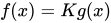
In general, given two functions and , if there is a constant such that , then we say that " is directly proportional to ". In symbols, this can be written as .[3]




Examples of proportionality constants[change | change source]
- The Planck constant puts the energy of a photon of a given frequency into a commonly used unit of energy, the joule.
Related pages[change | change source]
References[change | change source]
- ↑ "Proportion". www.learnalberta.ca. Retrieved 2020-10-07.
- ↑ "Greek/Hebrew/Latin-based Symbols in Mathematics". Math Vault. 2020-03-20. Retrieved 2020-10-07.
- ↑ "Comprehensive List of Algebra Symbols". Math Vault. 2020-03-25. Retrieved 2020-10-07.