


Przewalski's horse
| Equus ferus przewalskii | |
|---|---|

| |
| Przewalski's horse | |
Scientific classification 
| |
| Domain: | Eukaryota |
| Kingdom: | Animalia |
| Phylum: | Chordata |
| Class: | Mammalia |
| Order: | Perissodactyla |
| Family: | Equidae |
| Genus: | Equus |
| Species: | |
| Subspecies: | E. f. przewalskii
|
| Trinomial name | |
| Equus ferus przewalskii (I. S. Polyakov, 1881)
| |

| |
| Przewalski's horse range (reintroduced; missing distribution in Russia, Belarus, and Ukraine) | |
| Synonyms | |
|
hagenbecki Matschie, 1903 | |
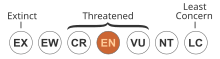
Przewalski's horse (Equus przewalskii or E. ferus przewalskii), the Mongolian wild horse, is a close relative of the domestic horse. The two are the only equids that can cross-breed and produce fertile offspring. Przewalski's horse is a rare and endangered subspecies of the wild horse, Equus ferus. It is native to the steppes of central Asia, especially Mongolia.[2]
At one time extinct in the wild,[3] it has been reintroduced to its native habitat in Mongolia from stock in zoos. It is now in several nature reserves and national parks.[1] As of 2002, the world population of these horses was about 1,000.
Relationships between horses[change | change source]
Most "wild" horses today, such as the American mustang or the Australian brumby, are feral horses descended from domesticated animals which escaped and adapted to life in the wild. In contrast, Przewalski's horse has never been successfully domesticated, and remains a truly wild animal today.
Przewalski's horse is one of three known subspecies of Equus ferus, the others being the domesticated horse, Equus ferus caballus and the extinct tarpan, Equus ferus ferus. Przewalski's horse is the only remaining truly wild "horse" in the world. There are still a number of other wild equines, including three species of zebra and various subspecies of the African wild ass, onager (including the Mongolian wild ass) and kiang.
Relation to domestic horse[change | change source]
Although Przewalski's horse can hybridize with domestic horses to produce fertile offspring, it has an extra pair of chromosomes.
- "Mitochondrial DNA research has shown that Przewalski's horse is not the ancestor of modern domestic horses. [There are] a number of consistent differences in their appearance. Przewalski's horses, unlike domestic horses, shed their tail and mane hair once per year. Thus it is clear that Przewalski's and domestic horses are very closely related and have in the past interbred, but the fixed chromosomal number difference between them indicates that they are distinct populations".[1]
In zoos[change | change source]
According to ISIS, about 480 Przewalski's were reported in captivity.
References[change | change source]
- ↑ 1.0 1.1 1.2 Boyd L. & King S.R.B. 2011. Equus ferus
- ↑ Grubb P. 2005. Order Perissodactyla. In Wilson D.E & Reeder D.M. Mammal species of the world. 3rd ed, Johns Hopkins University Press. p. 630-631. ISBN 978-0-8018-8221-0
- ↑ in Mongolia (the last wild Przewalski's horses had been seen in 1966