


Relief

Relief is a type of sculpture or carving. The worker creating the piece starts with a flat base, usually stone or wood, and takes small parts of the surface away until the desired image has been made.
Reliefs are found around the world. They can be used to decorate buildings, such as temples. Usually the artist makes reliefs of figures, such as people or animals.

In bas-relief, only a bit of the base is taken away. The figure is quite flat and this is especially common in friezes. An alto-relief is where the artist takes away a lot of the base material. This can be very detailed.
Famous reliefs[change | change source]
Famous reliefs include:
- Great Altar of Pergamon, now at the Pergamon Museum, Berlin
- Lions and dragons from the Ishtar Gate, Babylon
- Temple of Karnak in Egypt
- Angkor Wat in Cambodia
- Lion Capital of Ashoka, the national symbol of India
- glyphs and artwork of the Maya civilization
- The monument to the Confederacy at Stone Mountain, Georgia
- Borobudur temple, Java, Indonesia
- The Elgin Marbles from the Parthenon now housed at the British Museum.
- The representation of Monticello on a US nickel.
Gallery[change | change source]
-
 Greek couple in high relief
 -
 Palmyra Figure in British Museum
 -

-
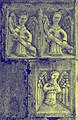 Angels from Clonfert Cathedral, Co Galway, Ireland (adjusted to highlight relief)


_20006-06-21.jpg)

Wikimedia Commons has media related to Relief.