


Sundarbans National Park

| Sunderban National Park | |
|---|---|
IUCN category II (national park) | |
  Location in West Bengal, India  Sundarbans National Park (India) | |
| Location | South 24 Parganas, West Bengal, India |
| Nearest city | Kolkata |
| Coordinates | 21°50′17″N 88°53′07″E / 21.8380°N 88.8852°E |
| Established | 1984 |
| Governing body | Government of India |
| Criteria | Natural: (ix), (x) |
| Reference | 452 |
| Inscription | 1987 (11th Session) |
| Area | 133,010 ha (513.6 sq mi) |
| Official name | Sundarban Wetland |
| Designated | 30 January 2019 |
| Reference no. | 2370 [1] |
The Sunderbans National Park is a National Park, tiger reserve, and a Biosphere Reserve in the Sunderban delta. It is in the Indian state of West Bengal. This area is densely covered by mangrove forests. It is one of the largest reserves for the Bengal tiger. It is also home to a variety of bird, reptile and invertebrate species, including the salt-water crocodile. On May 4, 1984 it was made a National Park.
There are seven main rivers and many watercourses forming a network of channels at this delta. They all run southward towards the sea. The coastal area has many mudflats. They are the right environment for mangroves.
Flora[change | change source]
The mangrove vegetation of Sundarbans has 64 plant species.[2] They can withstand estuarine conditions and large amounts of saline. In the months of April and May the flaming red leaves of the genwa (Excoecaria agallocha) the crab-like red flowers of the kankra (Bruguiera gymnorrhiza) and the yellow flowers of khalsi (Aegiceras corniculatum) can be seen. Some of the other commonly found plants and trees in the park are dhundal (or cannonball mangrove, Xylocarpus granatum), passur (Xylocarpus mekongensis), garjan (Rhizophora spp.), sundari (Heritiera fomes) and goran (Ceriops decandra).
Fauna[change | change source]
The Sundarbans forest is home to more than 400 tigers. The Royal Bengal Tigers have developed a unique characteristic of swimming in the saline waters. They are famous for their man-eating tendencies. Tigers can be seen on the river banks sunbathing between November and February.
Apart from the Bengal tiger there are also many fishing cats, leopard cats, macaques, wild boar, Indian grey mongoose, fox, jungle cat, flying fox, pangolin, chital.
Birds[change | change source]
Some of the birds commonly found in this region are red junglefowls, spot-billed pelicans, great egrets, cormorants, seagulls, common kingfishers, peregrine falcons, woodpeckers, northern pintails, and whistling teals.
Water life[change | change source]
Some of the fish and amphibians found in the park are Sawfish, Butter Fish, Electric rays, Silver carp, Star Fish, Common Carp, King Crabs, Prawn, Shrimps, Gangetic Dolphins, Skipping Frogs, Common Toads and Tree Frogs.
Reptiles[change | change source]
The Sundarbans National Park houses a large number of reptiles as well, including estuarine crocodiles, chameleons, monitor lizards, turtles, including Olive Ridley, hawksbill, and green turtles. Snakes include pythons, King Cobras, rat snakes, Russell's vipers, Dog Faced Water Snakes, Chequered Killbacks, and Common Kraits.
Endangered species[change | change source]
The endangered species that live in the Sundarbans are Royal Bengal Tiger, Saltwater Crocodile, River Terrapin, Olive Ridley Turtle, Gangetic dolphin, Ground Turtle, Hawks Bill Turtle and Mangrove horseshoe crab.
Ecosystem[change | change source]
In 2001, Sunderban became a Biosphere Reserve. The ecosystem is recognized as part of UNESCO's Man and the Biosphere (MAB) Programme.[3]
Gallery[change | change source]
-
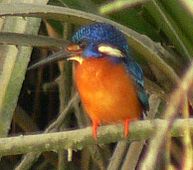 Blue-eared Kingfisher sighted in the Sundarbans
 -
 A crocodile at Sundarbans


Related pages[change | change source]
References[change | change source]
- ↑ "Sundarban Wetland". Ramsar Sites Information Service. Retrieved 14 February 2019.
- ↑ "Natural site datasheet from WCMC" (PDF). World Conservation Monitoring Centre. Archived from the original (PDF) on 2010-02-02. Retrieved 2012-06-28.
- ↑ World Network of Biosphere Reserves (WNBR), "Sunderban"; retrieved 2012-7-18.
Other websites[change | change source]
- Sundarbans National Park India
- Official UNESCO website entry
- List of biosphere reserves which are wholly or partially world heritage sites
| Authority control: National |
|---|
