


Timber rattlesnake
| Timber rattlesnake | |
|---|---|

| |
| At Zollman Zoo | |
Scientific classification 
| |
| Domain: | Eukaryota |
| Kingdom: | Animalia |
| Phylum: | Chordata |
| Class: | Reptilia |
| Order: | Squamata |
| Suborder: | Serpentes |
| Family: | Viperidae |
| Genus: | Crotalus |
| Species: | C. horridus
|
| Binomial name | |
| Crotalus horridus | |

| |
| Timber rattlesnake range[2] | |
| Synonyms[3] | |
| |
The timber rattlesnake (Crotalus horridus) is a species of venomous Pit vipers. It lives in eastern United States of America. There are no subspecies currently recognized. It is the 2nd largest venomous snake found in the eastern United States.
Description[change | change source]
.jpg)
Adults usually grow up to the length of 91–152 cm (35.8-59.8 in). The longest to be reported was 189.2 cm (74.5 in) long. The large timber rattlesnakes weigh about 4.5 kg (9.9 Ib), but most weigh about 580-900 g (20-32 oz). Their scales are usually yellowish-brown or gray with dark brown or black stripes.
Where they live[change | change source]
They are found in woodlands and forests of eastern United States of America, from southern Minnesota and southern New Hampshire, south to east Texas and north Florida. During the summer pregnant females prefer open, rocky ledges, where the temperature is higher, while males and non-pregnant females spend more time in cooler woodlands with a closed forest canopy. Females usually bask in the sun before having babies in open rocky areas, known as "basking knolls". In the winter Timber Rattlesnakes hibernate in dens and caves.
Feeding[change | change source]
They mainly eat small mammals but they also eat birds, frogs, and other snakes like rattlesnakes. The most common snake they eat is the garter snake.
Venom[change | change source]
The timber rattlesnake is one of North America's most dangerous snakes. Before biting, they usually warn people by shaking their rattle at the end of their tail.[4][5]
Its venom contains a neurotoxin known as canebrake toxin, and is a phospholipase A2. It also contains a small basic peptide that works as a myotoxin, a fibrinogen-clotting enzyme that can produce defibrination syndrome, and a bradykinin-releasing enzyme.[4]
CroFab antivenom is used to treat envenomations from the timber rattlesnake.[5]
Conservation status[change | change source]
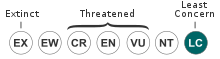
The timber rattlesnake is classified as least concern on the IUCN Red List.[6]
The timber rattlesnake is endangered in New Jersey, Vermont, Massachusetts, Virginia, New Hampshire, Indiana, and Ohio. It is threatened in New York, Connecticut, Illinois, Minnesota, and Texas.[7][8]
Timber rattlesnakes are extinct in Maine and Rhode Island. Only one population remains in New Hampshire. They are protected in many of the Appalachian states but their populations are still declining.[6]
Sources[change | change source]
- ↑ Hammerson GA (2007). Crotalus horridus. In: IUCN 2012. IUCN Red List of Threatened Species. Version 2012.2.
- ↑ U.S. Geological Survey (2017). "Timber Rattlesnake (Crotalus horridus) rTIRAx_CONUS_2001v1 Range Map". Gap Analysis Project. doi:10.5066/F7BR8R5P.
- ↑ McDiarmid RW, Campbell JA, Touré T (1999). Snake Species of the World: A Taxonomic and Geographic Reference, Volume 1. Washington, District of Columbia: Herpetologists' League. ISBN 1-893777-00-6 (series). ISBN 1-893777-01-4 (volume).
- ↑ 4.0 4.1 Campbell, Jonathan A. (2004). The venomous reptiles of the Western Hemisphere. Lamar, William W., 1950-. Ithaca: Comstock Pub. Associates. ISBN 0-8014-4141-2. OCLC 52047308.
- ↑ 5.0 5.1 Poisonous snakes of the world. New York: Dover Publications. 1991. ISBN 0-486-26629-X. OCLC 22597231.
- ↑ 6.0 6.1 Hammerson, G. A. (2007-03-01). "IUCN Red List of Threatened Species: Crotalus horridus". IUCN Red List of Threatened Species. Retrieved 2020-09-18.
- ↑ "Massachusetts List of Endangered, Threatened and Special Concern Species". Mass.gov.
- ↑ "Indiana General Assembly - Indiana Register". iac.iga.in.gov. Retrieved 2020-09-18.