


Woodward's wallaroo
(Redirected from Woodward's Wallaroo)
| Woodward's wallaroo [1] | |
|---|---|

| |
| Scientific classification | |
| Kingdom: | |
| Phylum: | |
| Class: | |
| Infraclass: | |
| Order: | |
| Family: | |
| Genus: | |
| Binomial name | |
| Macropus bernardus Rothschild, 1904
| |
Woodward's wallaroo (Macropus bernardus), also called the black wallaroo and Bernard's wallaroo, is the smallest of the wallaroos. The male is black or dark brown and the female is a grey colour. It is a shy nocturnal grazer and does not live in big groups. It uses the rocky cliffs where it lives to shelter and hide from danger.[3]
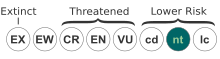
It is only found in a small, mountainous area in Arnhem Land, Northern Territory, between South Alligator River and Nabarlek. It classified as near threatened, because it is only found in this small area.[3] The name wallaroo means a "rock kangaroo."[4]
References[change | change source]
- ↑ Groves, Colin (2005). Wilson, D. E.; Reeder, D. M. (eds.). Mammal Species of the World (3rd ed.). Johns Hopkins University Press. p. 64. ISBN 0-801-88221-4.
- ↑ Australasian Marsupial & Monotreme Specialist Group (1996). Macropus bernardus. 2006 IUCN Red List of Threatened Species. IUCN 2006. Retrieved on 30 December 2006.
- ↑ 3.0 3.1 Menkhorst, Peter (2001). A Field Guide to the Mammals of Australia. Oxford University Press. pp. 118.
- ↑ Animal Diversity Web. University of Michigan.
Other websites[change | change source]

Wikispecies has information on: Macropus bernardus.