


Homo naledi
| Homo naledi | |
|---|---|

| |
| The 737 known elements of H. naledi | |
Scientific classification 
| |
| Domain: | Eukaryota |
| Kingdom: | Animalia |
| Phylum: | Chordata |
| Class: | Mammalia |
| Order: | Primates |
| Suborder: | Haplorhini |
| Infraorder: | Simiiformes |
| Family: | Hominidae |
| Subfamily: | Homininae |
| Tribe: | Hominini |
| Genus: | Homo |
| Species: | †H. naledi
|
| Binomial name | |
| Homo naledi Berger et al., 2015
| |

| |
| Location of Rising Star Cave in the Cradle of Humankind, South Africa | |
Homo naledi is a species of archaic human found in the Rising Star Cave, Cradle of Humankind, South Africa. The species possibly lived in the Middle Pleistocene 335,000–236,000 years ago.[1] The initial discovery comprises 1,550 specimens, representing 737 different elements, and at least 15 different people.[2] Despite this exceptionally high number of specimens, their ranking with the Homo genus remains unclear.
Even though it is in the Homo genus, they have some similarities with the Australopithecus genus and the first human species. For example, they have a small brain compared to modern humans.[3] They were more adapted to climbing and tree-dwelling (aboreal) than running through long distances.[4]

Gallery[change | change source]
- Skeletal elements
-
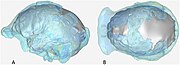 Top skull digital reconstruction
 -
 Jaws of LES1 (left) and DH1 (right)
 -
 Upper jawbone of LES1 (left) and DH1 (right)
 -
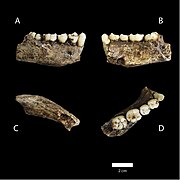 A lower jawbone
 -
 A clavicle
 -
 A humerus
 -
 An ulna
 -
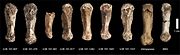 Metacarpals from different specimens
 -
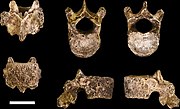 10th thoracic vertebra
 -
 11th thoracic vertebra
 -

-
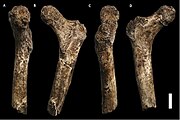 A femur
 -
 A tibia
 -
 Ankle bones from different specimens
 -
 1) adult right foot, 2) juvenile left, 3 and 4) adult left, 5) juvenile right


References[change | change source]
- ↑ Dirks, Paul HGM; Roberts, Eric M; Hilbert-Wolf, Hannah; Kramers, Jan D; Hawks, John; Dosseto, Anthony; Duval, Mathieu; Elliott, Marina; Evans, Mary (2017). "The age of Homo naledi and associated sediments in the Rising Star Cave, South Africa". eLife. 6. doi:10.7554/eLife.24231. ISSN 2050-084X. PMC 5423772. PMID 28483040.
- ↑ Berger, Lee R; Hawks, John; de Ruiter, Darryl J; Churchill, Steven E; Schmid, Peter; Delezene, Lucas K; Kivell, Tracy L; Garvin, Heather M; Williams, Scott A (2015-09-10). Krause, Johannes; Conard, Nicholas J (eds.). "Homo naledi, a new species of the genus Homo from the Dinaledi Chamber, South Africa". eLife. 4: e09560. doi:10.7554/eLife.09560. ISSN 2050-084X. PMC 4559886. PMID 26354291.
- ↑ Smith, Kiona N. (2018-05-14). "Homo naledi's brain: Like ours, but smaller". Ars Technica. Retrieved 2021-04-08.
- ↑ "New Human Ancestor Walked Like Us, Climbed Like an Ape". Animals. 2015-10-06. Retrieved 2021-04-08.