


Bratislava
Bratislava | |
|---|---|
Bratislava montage. From top left to right: View of Bratislava, View of Old Town, Financial District, Old Town streets, Blue Church, Grassalkovich Palace. | |
 Flag  Coat of arms | |
| Nicknames: Beauty on the Danube, Little Big City, Blava | |
  Bratislava Location of Bratislava in Slovakia  Bratislava Bratislava (Bratislava Region)  Bratislava Bratislava (Europe) | |
| Coordinates: 48°08′38″N 17°06′35″E / 48.14389°N 17.10972°E | |
| Country | Slovakia |
| Region | Bratislava |
| First mentioned | 907 |
| Government | |
| • Mayor | Matúš Vallo |
| Area | |
| • Capital city | 367.584 km2 (141.925 sq mi) |
| • Urban | 853.15 km2 (329.40 sq mi) |
| • Metro | 2,053 km2 (792.66 sq mi) |
| Elevation | 134 m (440 ft) |
| Population (2021[1]) | |
| • Capital city census | 475,503 |
| • Capital city estimate | 666,000 |
| • Capital city estimate density | 1,812/km2 (4,690/sq mi) |
| Demonym(s) | Bratislavčan (m), Bratislavčanka (f) (sk) Bratislavan (en) |
| Time zone | UTC+1 (CET) |
| • Summer (DST) | UTC+2 (CEST) |
| Postal code | 8XX XX |
| Area code | 421 2 |
| Car plate | BA, BL, BT |
| GRP (Metro)[2] | 2019 |
| – Total | €26.4 billion ($30B) |
| – Per capita | €40,000 ($44779) |
| Website | www.bratislava.sk/ |


.jpg)


Bratislava is the capital city of Slovakia. About 450,000 people live there. It used to be called Pressburg (German) or Pozsony (Hungarian) and by some other names. Bratislava is the seat of the national government, the presidency, and the parliament. It has several museums, galleries, and other educational, cultural, and economic institutions.
There is a small Old Town and a castle called Bratislavský Hrad. The Danube river goes through Bratislava.
Etymology[change | change source]
Bratislava had many names through its history. Here are some of them:
- German: Preßburg (now spelled Pressburg)
- Slovak: Prešporok, from German name
- Hungarian: Pozsony (still used today by Hungarians)
- Greek (medieval): Istropolis (meaning the Danube City)
- Latin: Posonium
- English: Pressburg(h)/Pressborough
and many others.
Geography[change | change source]
Bratislava is in the extreme southwest of Slovakia, on the borders with Austria and Hungary, and not far from the Czech Republic border. It is on the Morava and Danube rivers.
History[change | change source]
People have lived here since the Neolithic age. The Celts inhabited this area from 400 BC-50 BC. The Roman Empire set up border military camps near Bratislava from the 1st century until the 5th century, for example,"Gerulata." The Slavs started moving here in the 6th century. Bratislava was part of the Slavic empire called Great Moravia in the 9th century. From the second half of the 10th century until 1918, it was part of the Kingdom of Hungary, with some exceptions. It was even the capital of the Kingdom between 1524 and 1830/1848. After the World War I ended in 1918, it was part of newly founded Czechoslovakia until 1939, when it became the capital of World War II the Slovak Republic until 1945. After 1945, it was part of Czechoslovakia again, becoming the capital of Slovak Socialist Republic (which was still part of Czechoslovakia) in 1968. After the event called Velvet Divorce, when Czechoslovakia broke up, Bratislava became the capital of Slovakia.
Sightseeing[change | change source]

List of notable structures:
- Bratislava Castle
- St. Martin's Cathedral
- Primate's Palace
- Bratislava town hall
- Michael's Gate
- Grassalkovich Palace
- Nový Most (New Bridge)
- Kamzík TV Tower
- Devín Castle
Economy[change | change source]
The economy of Bratislava is prosperous and based on the automobile industry, chemical industry, and services. Unemployment (people without work) is the lowest in Slovakia (around 2%, compared to the national average of 7%). Approximately 250,000 people from all over Slovakia travel to Bratislava for work.
Transport[change | change source]

The position of Bratislava made it a natural crossroads for international traffic. It is a motorway and rail junction with its own international airport. The international river traffic passes along the Danube through Bratislava, with its own river port.
Bratislava has its own public transport system, with buses, trams and trolleybuses.
Territorial division[change | change source]

Bratislava is divided into 5 national districts and 17 city parts:
- District I: Staré mesto (Old Town)
- District II: Ružinov, Vrakuňa, Podunajské Biskupice
- District III: Rača, Nové mesto (New Town), Vajnory
- District IV: Karlova Ves, Dúbravka, Devín, Devínska Nová Ves, Záhorská
- District V: Petržalka, Jarovce, Rusovce, Čunovo
Further it is divided into 20 cadastral areas, which are identical with the city parts with 2 exceptions:
- Nové mesto = Nové mesto + Vinohrady
- Ružinov = Ružinov + Nivy + Trnávka
Twin towns[change | change source]
 Yerevan, Armenia
 Vienna, Austria
 Ruse, Bulgaria
 Larnaka, Cyprus
 Prague, Czech Republic
 Alexandria, Egypt
 Turku, Finland
 Bremen, Germany
- Ulm, Germany
 Thessaloniki, Greece
 Székesfehérvár, Hungary
 Perugia, Italy
 Rotterdam, Netherlands
 Kraków, Poland
 Ljubljana, Slovenia
 İzmir, Turkey
 Kyiv, Ukraine
 Cleveland, USA


Pictures[change | change source]
-
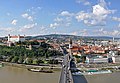 Panorama of Bratislava
 -
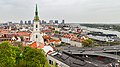 Panorama of Bratislava
 -
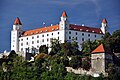 Bratislava Castle
 -
 Slovak National Theatre
 -
 The Grassalkovich Palace
 -
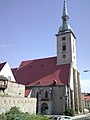 St. Martin's Cathedral
 -

-

-
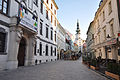
-

-
 Kalvínsky kostol
 -

-

-
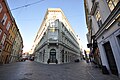 Streets of the Old Town
 -
 Bratislava Old Town
 -
 Laurinská Street


.jpg)

.jpg)

.jpg)


.jpg)

.jpg)

References[change | change source]
- ↑ "Bratislava finds census results as positive". Pravda.sk. Retrieved 2021-12-31.
- ↑ "Database - National accounts - Eurostat".
Other websites[change | change source]

- Official website

- Bratislava City Guide prepared by locals
- ŠÚ SR - Statistical office of the Slovak Republic Archived 2013-05-31 at the Wayback Machine

| International | |
|---|---|
| National | |
| Geographic | |
| Other | |
