Truck


A truck (North American and Australian English) or lorry (British English) is a motor vehicle designed to transport freight, carry specialized payloads, or perform other utilitarian work.
Trucks vary greatly in size, power, and configuration, but the vast majority feature body-on-frame construction, with a cabin that is independent of the payload portion of the vehicle. Smaller varieties may be mechanically similar to some automobiles. Commercial trucks can be very large and powerful and may be configured to be mounted with specialized equipment, such as in the case of refuse trucks, fire trucks, concrete mixers, and suction excavators, However, trucks have replaced horse-drawn freight wagons. The transition began with the invention of the internal combustion engine in the early 1900s, which revolutionized transportation by providing faster and more efficient means of moving goods. By the 1920s, trucks had largely supplanted horse-drawn freight wagons as the primary mode of freight transport, marking a significant evolution in the logistics industry. In American English, a commercial vehicle without a trailer or other articulation is formally a "straight truck" while one designed specifically to pull a trailer is not a truck but a "tractor".[1] Also, the road spreads the weight of the truck which means larger amounts can be carried than with trains on railroad tracks.
History
[change | change source]The history of trucks began in 1896 replacing horse drawn freight wagons when Gottlieb Daimler built the first internal combustion engine truck, which resembled a motorized wagon, to meet the need for efficient, mechanized freight transport. Originally, these vehicles were modified cars or "motorized loads" designed for urban delivery, but they quickly evolved to include heavy-duty designs like the 1899 Alexander Winton semi-truck and the first pickups made from Model Ts.
While American trucks grew in size and power, Europe and Japan initially favored smaller, lighter commercial vehicles. By the 1930s, Australia developed the "ute" (coupe utility), and in the modern era, trucks have increasingly become designed for personal lifestyle use rather than just commercial work.
Sizes of trucks
[change | change source]Ultra light
[change | change source]Often produced as variations of golf cars, with internal combustion or battery electric drive, these are used typically for off-highway use on estates, golf courses, and parks. While not suitable for highway use some variations may be licensed as slow speed vehicles for operation on streets, generally as a body variation of a neighborhood electric vehicle. A few manufactures produce specialized chassis for this type of vehicle, while Zap Motors markets a version of their Xebra electric tricycle (licensable in the U.S. as a motorcycle).
Very light
[change | change source]Popular in Europe and Asia, many mini-trucks are factory redesigns of light automobiles, usually with monocoque bodies. Specialized designs with substantial frames such as the Italian Piaggio shown here are based upon Japanese designs (in this case by Daihatsu) and are popular for use in "old town" sections of European cities that often have very narrow alleyways.
Regardless of name, these small trucks serve a wide range of uses. In Japan, they are regulated under the Kei car laws, which allow vehicle owners a break in taxes for buying a smaller and less-powerful vehicle (currently, the engine is limited to 660 cc displacement). These vehicles are used as on-road utility vehicles in Japan. These Japanese-made mini-trucks that were manufactured for on-road use are competing with off-road ATVs in the United States, and import regulations require that these mini-trucks have a 25 mph (40 km/h) speed governor as they are classified as low-speed vehicles.[2] These vehicles have found uses in construction, large campuses (government, university, and industrial), agriculture, cattle ranches, amusement parks, and replacements for golf carts.[3]
Major mini-truck manufacturers and their brands include: Daihatsu Hijet, Honda Acty, Tata Ace, Mazda Scrum, Mitsubishi Minicab, Subaru Sambar, and Suzuki Carry.
Light
[change | change source]Light trucks are car-sized (in the US, no more than 13,900 lb (6.3 t)) and are used by individuals and businesses alike. In the EU they may not weigh more than 3.5 t (7,700 lb) and are allowed to be driven with a driving licence for cars.
Pickup trucks, called utes in Australia and New Zealand, are common in North America and some regions of Latin America, Asia, and Africa, but not so in Europe, where this size of commercial vehicle is most often made as vans.
Medium
[change | change source]Medium trucks are larger than light-duty trucks such as minivans, SUVs, regular cab pickup trucks, extended cab pickup trucks, crew cab pickup trucks, low roof cargo vans, low roof crew vans, low roof passenger vans, medium roof cargo vans, medium roof crew vans, medium roof passenger vans, high roof cargo vans, high roof crew vans, high roof passenger vans, coupe utilities, panel trucks, canopy express vehicles, and panel vans, but lighter than the largest cargo trucks such as semi-trailer rigs. In the US, they are defined as weighing between 13,000 and 33,000 lb (5.9 and 15.0 t). For the UK and the EU the weight is between 3.5 and 7.5 t (7,700 and 16,500 lb). Local delivery and public service (dump trucks, garbage trucks and fire-fighting trucks) are normally around this size, In North America, medium-duty trucks are larger than heavy-duty pickup trucks such as the Ford Super Duty, Ram Heavy Duty 2500/3500/4500/5500, Chevrolet Silverado HD, and GMC Sierra HD. They are also larger than full-size vans like the Ford E-Series/Club Wagon/Econoline, Dodge A-Series/B-Series/Ram Vans, Chevrolet Greenbrier/G-Series vans, Mercedes-Benz Sprinter, Dodge Sprinter, Ford Transit 150/250/350, Ram ProMaster, and Chevrolet Express/GMC Savana.
Heavy
[change | change source]Heavy trucks are the largest on-road trucks, Class 8. These include vocational applications such as heavy dump trucks, concrete pump trucks, and refuse hauling, as well as ubiquitous long-haul 4x2 and 6×4 tractor units.[4]
Road damage and wear increase very rapidly with the axle weight. The number of steering axles and the suspension type also influence the amount of the road wear. In many countries with good roads a six-axle truck may have a maximum weight of 44 t (97,000 lb) or more.
Off-road
[change | change source]Off-road trucks include standard, extra heavy-duty highway-legal trucks, typically outfitted with off-road features such as a front driving axle and special tires for applications such as logging and construction, and purpose-built off-road vehicles unconstrained by weight limits, such as the Liebherr T 282B mining truck.
Maximum sizes by country
[change | change source]
Australia has complex regulations over weight and length, including axle spacing, type of axle/axle group, rear overhang, kingpin to rear of trailer, drawbar length, ground clearance, as well as height and width laws. These limits are some of the highest in the world, a B-double can weigh 62.5 t (61.5 long tons; 68.9 short tons) and be 25 m (82 ft) long, and road trains used in the outback can weigh 172 t (169.3 long tons; 189.6 short tons) and be 53.5 m (176 ft) long.[6][7]
The European Union also has complex regulations. The number and spacing of axles, steering, single or dual tires, and suspension type all affect maximum weights. Length of a truck, of a trailer, from axle to hitch point, kingpin to rear of trailer, and turning radius are all regulated. In additions, there are special rules for carrying containers, and countries can set their own rules for local traffic.[8]
The United States Federal Bridge Law deals with the relation between the gross weight of the truck, the number of axles, the weight on and the spacing between the axles that the truck can have on the Interstate highway system.[9] Each State determines the maximum permissible vehicle, combination, and axle weight on state and local roads.
| Country | Maximum with three axles | With one trailer | Maximum combination |
|---|---|---|---|
| Australia[6][7] | 23 t (22.6 long tons; 25.4 short tons) | 12 m (39 ft) | 172 t (169.3 long tons; 189.6 short tons) 53.5 m (176 ft) |
| China[10] | 25 t (24.6 long tons; 27.6 short tons) 12 m (39 ft) | 49 t (48.2 long tons; 54.0 short tons) 16.5 m (54 ft) | 55 t (54.1 long tons; 60.6 short tons) 18.75 m (62 ft) |
| EU[8] | 26 t (25.6 long tons; 28.7 short tons) 12 m (39 ft) | 16.5 m (54 ft) | 44 t (43.3 long tons; 48.5 short tons) 18.75 m (62 ft) |
| Finland[11] | 28 t (27.6 long tons; 30.9 short tons) 13 m (43 ft) | 76 t (74.8 long tons; 83.8 short tons) 34.5 m (113 ft 2 in) | 76 t (74.8 long tons; 83.8 short tons) 34.5 m (113 ft) |
| Ireland[12] | 26 t (25.6 long tons; 28.7 short tons) 12 m (39 ft) | 30 t (29.5 long tons; 33.1 short tons) 16.5 m (54 ft 2 in) | 44 t (43.3 long tons; 48.5 short tons) 22 m (72 ft) |
| Sweden[13][14] | 26 t (25.6 long tons; 28.7 short tons) 24 m (79 ft) | 74 t (72.8 long tons; 81.6 short tons) 25.25 m (82 ft 10 in) | 74 t (72.8 long tons; 81.6 short tons) 34.5 m (113 ft) |
| UK[15] | 26 t (25.6 long tons; 28.7 short tons) 12 m (39 ft) | 44 t (43.3 long tons; 48.5 short tons) 16.5 m (54 ft) | 44 t (43.3 long tons; 48.5 short tons) 18.75 m (62 ft) |
| USA[16][17] (Interstate) | 54,000 lb (24 t) 45 ft (13.7 m) | 80,000 lb (36 t) none | 80,000 lb (36 t) none |
Uniquely, the State of Michigan has a gross vehicle weight limit of 164,000 lb (74 t), which is twice the U.S. federal limit.[18][19][20] A measure to change the law was defeated in the Michigan Senate in 2019.[21][22][23][24][25]
Body types
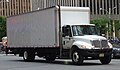
[change | change source]Box trucks have walls and a roof, making an enclosed load space. The rear has doors for unloading; a side door is sometimes fitted.[26]
Chassis cab trucks have a fully enclosed cab at the front, with bare chassis frame-rails behind, suitable for subsequent permanent attachment of a specialized payload, like a fire-truck or ambulance body.
Concrete mixers have a rotating drum on an inclined axis, rotating in one direction to mix, and in the other to discharge the concrete down chutes. Because of the weight and power requirements of the drum body and rough construction sites, mixers have to be very heavy duty.[27][28]
Dual drive/Steer trucks are vehicles used to steer the rear of trailers.[29][30][31][32]
Dump trucks ("tippers" in the UK) transport loose material such as sand, gravel, or dirt for construction. A typical dump truck has an open-box bed, which is hinged at the rear and lifts at the front, allowing the material in the bed to be unloaded ("dumped") on the ground behind the truck.[33][34]
Flatbed trucks have an entirely flat, level platform body. This allows for quick and easy loading but has no protection for the load. Hanging or removable sides are sometimes fitted,[35] often in the form of a stakebody.
Refrigerator trucks have insulated panels as walls and a roof and floor, used for transporting fresh and frozen cargo such as ice cream, food, vegetables, and prescription drugs. They are mostly equipped with double-wing rear doors, but a side door is sometimes fitted.
Refuse trucks have a specialized body for collecting and, often, compacting trash collected from municipal, commercial, and industrial sites. This application has the widest use of the cab-over configuration in North America, to provide better maneuverability in tight situations. They are also among the most severe-duty and highest GVWR trucks on public roads.
Semi-tractors ("artics" in the UK) have a fifth wheel for towing a semi-trailer instead of a body.
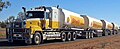
Tank trucks ("tankers" in the UK) are designed to carry liquids or gases. They usually have a cylindrical tank lying horizontally on the chassis. Many variants exist due to the wide variety of liquids and gases that can be transported.[36]
Wreckers ("recovery lorries" in the UK) are used to recover and/or tow disabled vehicles. They are normally equipped with a boom with a cable; wheel/chassis lifts are becoming common on newer trucks.[37][38][39]
Sales and sales issues
[change | change source]Manufacturers
[change | change source]Truck market worldwide
[change | change source]| Pos. | Make | Units |
|---|---|---|
| 1 | Daimler AG (Mercedes-Benz, Freightliner, Unimog, Western Star, Fuso, BharatBenz) | 506,663[40] |
| 2 | Navistar International | 359,000[41] |
| 3 | Dongfeng | 336,869[42] |
| 4 | Tata | 317,780[43] |
| 5 | Volvo Group (Volvo, Mack, Renault, UD Nissan) | 207,475[44] |
| 6 | Volkswagen Group (MAN, Scania, Caminhões e Ônibus) | 179,035[45] |
| 7 | Hino | 162,870[46] |
| 8 | Paccar (DAF, Kenworth, Peterbilt, Leyland) | 154,700[47] |
| 9 | Iveco | 140,200[48] |
Driving
[change | change source]In many countries, driving a truck requires a special driving license. The requirements and limitations vary with each different jurisdiction.
Australia
[change | change source]In Australia, a truck driver's license is required for any motor vehicle with a Gross Vehicle Mass (GVM) exceeding 4.5 t (4.4 long tons; 5.0 short tons). The motor vehicles classes are further expanded as:
- Combination
- HC: Heavy Combination, a typical prime mover plus semi-trailer combination.
- MC: Multi Combination, e.g., B Doubles/road trains
- Rigid
- LR: Light rigid: a rigid vehicle with a GVM of more than 4.5 t (4.4 long tons; 5.0 short tons) but not more than 8 t (7.9 long tons; 8.8 short tons). Any towed trailer must not weigh more than 9 t (8.9 long tons; 9.9 short tons) GVM.
- MR: Medium rigid: a rigid vehicle with 2 axles and a GVM of more than 8 t (7.9 long tons; 8.8 short tons). Any towed trailer must not weigh more than 9 t (8.9 long tons; 9.9 short tons) GVM. Also includes vehicles in class LR.
- HR: Heavy Rigid: a rigid vehicle with three or more axles and a GVM of more than 8 t (7.9 long tons; 8.8 short tons). Any towed trailer must not weigh more than 9 t (8.9 long tons; 9.9 short tons) GVM. Also includes articulated buses and vehicles in class MR.
- Heavy vehicle transmission
There is also a heavy vehicle transmission condition for a license class HC, HR, or MC test passed in a vehicle fitted with an automatic or synchromesh transmission; a driver's license will be restricted to vehicles of that class fitted with a synchromesh or automatic transmission. To have the condition removed, a person needs to pass a practical driving test in a vehicle with non-synchromesh transmission (constant mesh or crash box).[49]
Europe
[change | change source]
Driving licensing has been harmonized throughout the European Union and the EEA (and practically all European non-member states), so that common rules apply within Europe (see European driving licence). As an overview, to drive a vehicle weighing more than 7.5 t (7.4 long tons; 8.3 short tons) for commercial purposes requires a specialist license (the type varies depending on the use of the vehicle and number of seats). For licenses first acquired after 1997, that weight was reduced to 3.5 t (3.4 long tons; 3.9 short tons), not including trailers.[source?]
Since 2013, the C1 license category allows driving vehicles over 3.5 and up to 7.5 tonnes. The C license category allows driving vehicles over 3.5 tonnes with a trailer up to 750 kg, and the CE category allows driving category C vehicles with a trailer over 750 kg.
South Africa
[change | change source]To drive any vehicle with a GVM exceeding 3.5 t (3.4 long tons; 3.9 short tons), a code C1 drivers license is required. Furthermore, if the vehicle exceeds 16 t (15.7 long tons; 17.6 short tons) a code C license becomes necessary.
To drive any vehicle in South Africa towing a trailer with a GVM more than 7.5 t (7.4 long tons; 8.3 short tons), further restrictions apply and the driver must possess a license suitable for the GVM of the total combination as well as an articulated endorsement. This is indicated with the letter "E" prefixing the license code.
In addition, any vehicle designed to carry goods or passengers may only be driven by a driver possessing a Public Driver's Permit, (or PrDP) of the applicable type. This is an additional license that is added to the DL card of the operator and subject to annual renewal unlike the five-year renewal period of a normal license.
The requirements for obtaining the different classes are below.
- "G": Required for the transport of general goods, requires a criminal record check and a fee on issuing and renewal.
- "P": Required for the transport of paying passengers, requires a more stringent criminal record check, additionally the driver must be over the age of 21 at time of issue. A G class PrDP will be issued at the same time.
- "D": Required for the transport of dangerous materials, requires all of the same checks as class P., and in addition the driver must be over 25 at time of issue.
United States
[change | change source]In the United States, a commercial driver's license is required to drive any type of commercial vehicle weighing 26,001 lb (11,794 kg) or more.[50] The federal government regulates how many hours a driver may be on the clock, how much rest and sleep time is required (e.g., 11 hours driving/14 hours on-duty followed by 10 hours off, with a maximum of 70 hours/8 days or 60 hours/7 days, 34 hours restart )[51] Violations are often subject to significant penalties. Instruments to track each driver's hours must sometimes be fitted. In 2006, the US trucking industry employed 1.8 million drivers of heavy trucks.[52]
There is a shortage of willing trained long-distance truck drivers.[53] Part of the reason for this is the economic fallout from deregulation of the trucking industry. Michael H. Belzer, associate professor, in the economics department at Wayne State University and co-author of Sweatshops on Wheels: Winners and Losers in Trucking Deregulation, argues that low pay, bad working conditions and unsafe conditions have been a direct result of deregulation.[54][55] The book cites poor working conditions and an unfair pay system as responsible for high annual employee turnover in the industry.[56][57]
In 2018, in the US, 5,096 large trucks and buses were involved in fatal crashes:
- The number of large trucks involved in fatal crashes is 4,862,
- The number of large trucks involved in injury crashes is 112,000,
- The number of large trucks involved in property damage only crashes is 414,000.[58]
Environmental effects
[change | change source]

Like cars, trucks contribute to air, noise, and water pollution.[61] Unlike cars, as of 2022[update], most trucks run on diesel, and diesel exhaust is especially dangerous for health.[62] Some countries outside the EU have different vehicle emission standards for trucks and cars.[63][64]
NOx and particulates emitted by trucks are very dangerous to health,[65][66] causing thousands of early deaths annually in the US alone.[67] As older trucks are usually the worst,[68] many cities have banned 20th century trucks.[69] Air pollution also threatens professional truck drivers.[70]
Over a quarter of global transport CO2 emissions are from road freight,[71] in 2021 over 1700 million tonnes from medium and heavy trucks,[72] so many countries are further restricting truck CO2 emissions to help limit climate change.[73] Many environmental organizations favor laws and incentives to encourage the switch from road to rail, especially in Europe.[74] Several countries have pledged that 30% of sales of trucks and buses will be zero emission by 2030.[75]
With respect to noise pollution, trucks emit considerably higher sound levels at all speeds compared to typical cars; this contrast is particularly strong with heavy-duty trucks.[76] There are several aspects of truck operations that contribute to the overall sound that is emitted. Continuous sounds are those from tires rolling on the roadway and the constant hum of their diesel engines at highway speeds. Less frequent noises, but perhaps more noticeable, are things like the repeated sharp-pitched whistle of a turbocharger on acceleration, or the abrupt blare of an exhaust brake retarder when traversing a downgrade. There has been noise regulation put in place to help control where and when the use of engine braking retarders are allowed.[source?]
Operator health and safety
[change | change source]
A truck cab is a hazard control that protects the truck operator from hazardous airborne pollutants.[source?] As an enclosure, it is an example of an engineering control. Enclosed operator cabs have been used on agriculture, mining, and construction vehicles for several decades. Most modern-day enclosed cabs have heating, ventilation, and air conditioning (HVAC) systems for primarily maintaining a comfortable temperature and providing breathable air for their occupants. Various levels of filtration can be incorporated into the HVAC system to remove airborne pollutants such as dusts, diesel particulate matter (DPM), and other aerosols.[77]
Two key elements of an effective environmental enclosure are a good filtration system and an enclosure with good integrity (sealed isolation from the outside environment). It is recommended that a filtration system filter out at least 95% or greater of airborne respirable aerosols from the intake airflow, with an additional recirculation filtering component for the inside air. Good enclosure integrity is also needed to achieve positive pressure to prevent wind-driven aerosol penetration into the enclosure, as well as to minimize air leakage around the filtration system. Test methods and mathematical modeling of environmental enclosures are also beneficial for quantifying and optimizing filtration system designs, as well as maintaining optimum protection factor performance for enclosure occupants.[77]
Operations issues
[change | change source]Taxes
[change | change source]Commercial trucks in the US pay higher road use taxes on a state level than other road vehicles and are subject to extensive regulation.[78] A few reasons commercial trucks pay higher road use taxes: they are bigger and heavier than most other vehicles, and cause more wear and tear per hour on roadways; and trucks and their drivers are on the road for more hours per day. Rules on use taxes differ among jurisdictions.
Damage to pavement
[change | change source]The life of a pavement is measured by the number of passes of a vehicle axle. It may be evaluated using the Load Equivalency Factor,[79] which states that the damage by the pass of a vehicle axle is proportional to the 4th power of the weight, so a ten-ton axle consumes 10,000 times the life of the pavement as a one-ton axle. For that reason, loaded trucks cost the same as thousands of cars in pavement costs, and are subject to higher taxes and highway tolls.[22][23]
Safety
[change | change source]This section deals mostly with US and EU and do not have a worldwide view of the subject. (August 2024) |
Trucking accidents
[change | change source]In 2002 and 2004, there were over 5,000 fatalities related to trucking accidents in the United States. The trucking industry has since made significant efforts in increasing safety regulations. In 2008, the industry had successfully lowered the fatality rate to just over 4,000 deaths, but trucking accidents are still an issue that causes thousands of deaths and injuries each year. Approximately 6,000 trucking accident fatalities occur annually in the United States. Fatalities are not the only issue caused by trucking accidents. Here are some of the environmental issues that arise with trucking accidents:
- 14.4% of trucking accidents cause cargo to spill
- 6.5% cause open flames
Following increased pressure from The Times "Cities Fit For Cycling" campaign and from other media in Spring 2012, warning signs are now displayed on the backs of many heavy goods vehicles (HGV). These signs are directed against a common type of accident that occurs when the large vehicle turns left at a junction: a cyclist trying to pass on the nearside can be crushed against the HGV's wheels, especially if the driver cannot see the cyclist. The signs, such as the winning design of the InTANDEM road safety competition[usurped] launched in March 2012, advocate extra care when passing a large vehicle on the nearside.
HGV safety in the EU
[change | change source]In-vehicle speed limitation is required applying a 90 km/h limit to commercial vehicles over 3.5 tonnes.[80]
Front, side, and rear underrun protection is required on commercial vehicles over 3.5 tonnes.[80]
Trucks must be fitted with blind-spot mirrors that give drivers a wider field of vision than conventional mirrors.[81]
See also
[change | change source]- Air brake
- Animal transporter
- Articulated hauler
- Autonomous truck
- Ballast tractor
- Campervan
- Cutaway van chassis
- Dekotora, Japanese decorated trucks
- Food truck
- Glossary of the American trucking industry
- Great West Truck Show
- Gun truck
- Hand truck
- Kei truck
- Haul truck
- Large goods vehicle
- List of military trucks
- List of pickup trucks
- List of trucks
- Logging truck
- Multi-stop truck
- Roll-off truck
- Tail lift
- Terminal tractor
- Traffic congestion
- Truck art in South Asia
- Truck classification
- Truck hijacking
- Truck scale
- Truck stop
References
[change | change source]- ↑ "Glossary" (PDF). trucking.org. Archived from the original (PDF) on 29 November 2019. Retrieved 12 September 2019.
- ↑ "49CFR571". Archived from the original on 22 September 2008. Retrieved 31 January 2018.
- ↑ "お問い合わせ" (in Japanese). Archived from the original on 9 August 2020. Retrieved 12 September 2019.
- ↑ "Chapter 3. HEAVY TRUCKS – Center for Transportation" (PDF) cta.ornl.gov 20 August 2015
- ↑ "An ALMA Antenna on the Move". ESO Picture of the Week. Archived from the original on 27 January 2013. Retrieved 16 July 2012.
- 1 2 "Heavy Vehicle (Mass, Dimension and loading) National Regulation Schedule 1 (NSW)". New South Wales Government. Archived from the original on 27 July 2016. Retrieved 5 August 2016.
- 1 2 "Heavy Vehicle (Mass, Dimension and loading) National Regulation Schedule 6 (NSW)". New South Wales Government. Archived from the original on 27 July 2016. Retrieved 5 August 2016.
- 1 2 "Council Directive 96/53/EC laying down for certain road vehicles circulating within the Community the maximum authorized dimensions in national and international traffic and the maximum authorized weights in international traffic". EUR-Lex. Archived from the original on 24 August 2016. Retrieved 5 August 2016.
- ↑ "Freight Management and Operations: Bridge Formula Weights". US Department of Transportation. 21 May 2015. Archived from the original on 12 February 2007. Retrieved 26 May 2015.
- ↑ Harborn, Mats; Feng, Feng; Xu, Tommy (2013). "Chinese Road Transport Mass and Dimensions Regulations – An Analysis of the Challenges Ahead". road-transport-technology.org. Archived from the original on 4 July 2018. Retrieved 6 August 2016.
- ↑ "Asetus ajoneuvojen käytöstä tiellä". Finlex. Archived from the original on 19 December 2019. Retrieved 2 December 2019.
- ↑ "Guidelines on Maximum Weights and Dimensions" (PDF). Ireland Road Safety Authority. February 2013. Archived (PDF) from the original on 27 July 2013. Retrieved 26 June 2014.
- ↑ ""Legal loading" - Weight and dimension regulations for heavy vehicles" (PDF). Swedish Transport Agency. Archived (PDF) from the original on 3 December 2022. Retrieved 3 December 2022.
- ↑ Andersson, Rutger (2 November 2023). "Längre kombinationer tillåts i Sverige från 1 december". Trailer (in Swedish). Albinsson & Sjöberg. Retrieved 3 June 2024.
- ↑ "A Guide to Haulage & Courier Vehicle Types & Weights" (PDF). Returnloads.net. Archived from the original on 22 July 2021. Retrieved 23 March 2021.
- ↑ "Federal Size Regulations for Commercial Motor Vehicles". US Department of Transportation. Archived from the original on 5 June 2013. Retrieved 5 August 2016.
- ↑ "Compilation of Exixting State Truck Size and Weight Limit Laws". US Department of Transportation. May 2015. Archived from the original on 7 August 2016. Retrieved 7 August 2016.
- ↑ Egan, Paul (13 March 2018). "Does your body ache from hitting potholes? 5 reasons Michigan has lousy roads". Detroit Free Press. Archived from the original on 16 April 2019. Retrieved 16 April 2019.
- ↑ Anderson, Bill (17 August 2018). "Michigan's Road Spending: How do we stack up?". Southeast Michigan Council of Governments. Retrieved 16 April 2019.[permanent dead link]
- ↑ Haddad, Ken (22 February 2018). "Pothole questions: Why are Ohio's roads better than Michigan's roads? MDOT points to lack of funding compared to Ohio". Archived from the original on 16 April 2019. Retrieved 16 April 2019.
- ↑ Oosting, Jonathan (2 December 2014). "Michigan road funding: Proposal to cut truck weight limits fails in state Senate". MLive. Archived from the original on 16 April 2019. Retrieved 16 April 2018.
- 1 2 Chatti, K. (February 2009). "Effect of Michigan Multi-Axle Trucks on Pavement Distress" (PDF). Michigan DOT and Michigan State University, Final Report, Executive Summary, Project RC-1504. Archived from the original (PDF) on 24 October 2020.
- 1 2 "Pavement Comparative Analysis Technical Report Comprehensive Truck Size and Weight Limits Study" (PDF). U.S. Department of Transportation, Federal Highway Administration. 15 June 2015. Archived (PDF) from the original on 11 January 2019. Retrieved 16 April 2019.
- ↑ Egan, Paul (19 April 2019). "Experts weigh in on how much Michigan's heavy trucks damage the state's roads". Detroit Free Press. Archived from the original on 20 April 2019. Retrieved 21 April 2019.
- ↑ Egan, Paul (1 March 2019). "Fixing Michigan's crumbling roads: What about the heavy trucks?". Detroit Free Press. Archived from the original on 21 April 2019. Retrieved 21 April 2019.
- ↑ Davies (2000), pp. 30–31.
- ↑ "Concrete Mixers (company site)". McNeilus. 2016. Archived from the original on 27 September 2016. Retrieved 24 September 2016.
- ↑ "Truck Mixers Summary (Sales Brocure)" (PDF). Stetter. 2016. Archived (PDF) from the original on 27 September 2016. Retrieved 24 September 2016.
- ↑ Berg, Tom (19 August 2013). "'Steer Cars' and 'Jeeps' Bring Up the Rear of Long-Beam Hauls". truckinginfo.com.
- ↑ "This Truck/Trailer Combination Requires 2 Drivers and Moves Massive Plane Parts". 9 March 2021.
- ↑ "VIDEO: Truckers use dual-driver system to haul oversized load". CDLLife. 29 December 2022.
- ↑ "A Trailer So Big the Back Half Has Its Own Driver".
- ↑ Davies (2000), pp. 34–35.
- ↑ "Dump Truck Operator Manual" (PDF). Galion-Godwin Truck Body Co. Archived (PDF) from the original on 9 October 2016. Retrieved 13 September 2016.
- ↑ Davies (2000), pp. 28–29.
- ↑ Davies (2000), pp. 32–33.
- ↑ Davies (2000), pp. 46–47.
- ↑ "HDR 70/85 Wrecker Operations and Maintenance Manual" (PDF). Jerr-Dan. 2010. Archived (PDF) from the original on 9 October 2016. Retrieved 13 September 2016.
- ↑ "Owner's Manual 820 Wrecker/FIIIT" (PDF). Miller Industries. 1997. Archived (PDF) from the original on 9 October 2016. Retrieved 13 September 2016.
- ↑ "Annual Report 2015". Daimler. 2016. Archived from the original on 2 October 2016. Retrieved 25 September 2016.
- ↑ "Form 10K Navistar International Corp". US Securities and Exchange Commission. 2016. p. 48. Archived from the original on 9 October 2016. Retrieved 24 September 2016.
- ↑ "2015 Annual Report" (PDF). Dongfeng. 2016. p. 10. Archived from the original (PDF) on 27 September 2016. Retrieved 25 September 2016.
- ↑ "70th Annual Report 2015-2015" (PDF). Tata. 2016. p. 53. Archived from the original (PDF) on 9 October 2016. Retrieved 24 September 2016.
- ↑ "Annual and Sustainability Report 2015" (PDF). Volvo. 2016. p. 91. Archived from the original (PDF) on 10 October 2016. Retrieved 25 September 2016.
- ↑ "Annual Report 2015" (PDF). Volkswagen. 2016. p. 98. Archived from the original (PDF) on 9 October 2016. Retrieved 25 September 2016.
- ↑ "Financial Reports for the Fiscal Year Ending" (PDF). Hino Motors. 2016. p. 25. Archived from the original (PDF) on 9 October 2016. Retrieved 25 September 2016.
- ↑ "2015 Annual Report" (PDF). PACCAR. 2016. p. 28. Archived (PDF) from the original on 9 October 2016. Retrieved 25 September 2016.
- ↑ "2015 Annual Report" (PDF). CNH. 2016. p. 60. Archived from the original (PDF) on 23 October 2016. Retrieved 23 October 2016.
- ↑ "South Australia License class information". Gov't of South Australia. Archived from the original on 4 December 2016. Retrieved 28 July 2016.
- ↑ "Commercial Drivers License". National Highway Traffic Safety Administration. Archived from the original on 17 September 2008. Retrieved 21 May 2008.
- ↑ "Hours of Service Rules". US Federal Motor Carrier Safety Administration. 18 December 2014. Archived from the original on 27 May 2015. Retrieved 26 May 2015.
- ↑ "Truck Drivers and Drivers/Sales Workers". Occupational Outlook Handbook. Bureau of Labor Statistics, U.S. Department of Labor. 18 December 2007. Archived from the original on 11 October 2007. Retrieved 25 January 2008.
- ↑ Morris, Frank (11 February 2019). "Facing A Critical Shortage Of Drivers, The Trucking Industry Is Changing" (Audio). Morning edition. NPR. Archived from the original on 17 April 2019. Retrieved 17 April 2019.
- ↑ "Sweatshops on Wheels". Oxford University Press. July 2000. Archived from the original on 8 March 2012. Retrieved 17 March 2012.
- ↑ Belzer, Michael H. (24 August 2000). Sweatshops on Wheels: Winners and Losers in Trucking Deregulation (Hardcover). Oxford University Press, USA. p. 272. ISBN 0-19-512886-9. ISBN 978-0-19-512886-4.
- ↑ "Sweatshops on Wheels", U.S. News & World Report.
- ↑ "Sweatshops on Wheels." The Washington Post
- ↑ "Large Truck and Bus Crash Facts 2018 | FMCSA". fmcsa.dot.gov. Archived from the original on 30 March 2021. Retrieved 30 March 2021.
- ↑ "Highlights of the Automotive Trends Report". EPA.gov. U.S. Environmental Protection Agency (EPA). 12 December 2022. Archived from the original on 2 September 2023.
- ↑ Cazzola, Pierpaolo; Paoli, Leonardo; Teter, Jacob (November 2023). "Trends in the Global Vehicle Fleet 2023 / Managing the SUV Shift and the EV Transition" (PDF). Global Fuel Economy Initiative (GFEI). p. 3. doi:10.7922/G2HM56SV. Archived (PDF) from the original on 26 November 2023.
- ↑ "Road Traffic Could Be a Major Source of Water Pollution". Applied Sciences from Technology Networks. Retrieved 17 November 2022.
- ↑ Long, Erin; Carlsten, Christopher (9 February 2022). "Controlled human exposure to diesel exhaust: results illuminate health effects of traffic-related air pollution and inform future directions". Particle and Fibre Toxicology. 19 (1): 11. Bibcode:2022PFTox..19...11L. doi:10.1186/s12989-022-00450-5. ISSN 1743-8977. PMC 8827176. PMID 35139881.
- ↑ "Emission Standards: USA: Heavy-Duty Onroad Engines". dieselnet.com. Retrieved 17 November 2022.
- ↑ Carroll, Sean Goulding (15 November 2022). "Euro 7 accused of deadly sins". euractiv.com. Retrieved 17 November 2022.
- ↑ Skibell, Arianna. "New, Stronger Rules for Truck Pollution Still Would Not Meet Air Quality Goals". Scientific American. Retrieved 17 November 2022.
- ↑ "Heavy Duty Vehicles and NOx". Union of Concerned Scientists. Retrieved 17 November 2022.
- ↑ "New Report: Transition to Zero-Emission Trucks Could Save More Than 66,000 Lives". lung.org. 4 October 2022. Retrieved 17 November 2022.
- ↑ "Target the oldest diesel trucks to reduce racial disparities in air pollution exposure in NYC". The Real Urban Emissions Initiative. Retrieved 17 November 2022.
- ↑ "Ban old trucks from big cities to save lives: new Grattan Institute report". Grattan Institute. 28 August 2022. Retrieved 17 November 2022.
- ↑ "Truck drivers 'worst affected' by air pollution". Motor Transport. 30 May 2019. Retrieved 17 November 2022.
- ↑ "Cars, planes, trains: where do CO2 emissions from transport come from?". Our World in Data. Archived from the original on 16 June 2021. Retrieved 19 June 2021.
- ↑ "Trucks and Buses – Analysis". IEA. Retrieved 17 November 2022.
- ↑ "EU countries agree to 30 percent cut in truck CO2 emissions". Reuters. 20 December 2018. Archived from the original on 18 April 2019. Retrieved 18 April 2019.
- ↑ "How Government policy can realize rail freight's role in reducing carbon emissions". FreightOnRail.org.uk. Archived from the original on 20 August 2008. Retrieved 6 September 2008.
- ↑ Smorodin, Amy (16 November 2022). "A story of transition: How Europe's faring in its move to zero-emission trucks and buses". International Council on Clean Transportation. Retrieved 17 November 2022.
- ↑ Hogan, C. Michael (1973). "Analysis of highway noise". Water, Air, and Soil Pollution. 2 (3). Springer Science+Business Media: 387–392. Bibcode:1973WASP....2..387H. doi:10.1007/BF00159677. S2CID 109914430. Retrieved 12 February 2020.
- 1 2 Organiscak, J.; Cecala, A.; Hall, R. (June 2018). "Design, Testing, and Modeling of Environmental Enclosures for Controlling Worker Exposure to Airborne Contaminants". U.S. National Institute for Occupational Safety and Health. Archived from the original on 9 November 2018. Retrieved 9 November 2018.
- ↑ "Trucking Industry Operating Taxes State of Georgia". Archived from the original on 1 September 2006. Retrieved 18 August 2006.
- ↑ "Road wear from heavy vehicles – an overview". NVF committee Vehicles and Transports. August 2008. Archived from the original (PDF) on 18 August 2016. Retrieved 27 September 2016.
- 1 2 "Heavy goods vehicles". Mobility and transport – European Commission. 17 October 2016. Archived from the original on 5 December 2020. Retrieved 19 June 2020.
- ↑ "Blind spot mirrors". Mobilità u Trasport – European Commission. 17 October 2016. Archived from the original on 19 July 2020. Retrieved 19 July 2020.
External links
[change | change source]- Federal Motor Carrier Safety Administration
- Different sizes and classes of trucks in the UK
- Hutchinson, Rollin W. Jr. (January 1912). "Motor Trucks – The New Freighters: Quicker and More Reliable Service, Cleaner and Less Congested Cities, Concrete Examples of Saving". The World's Work: A History of Our Time. XXIII: 268–187. Retrieved 10 July 2009.