


Absolute value

In mathematics, the absolute value of a real number , written as or , is the value of when the sign is dropped (or without its sign).[1][2] That is, for a positive , for a negative , and


For example, the absolute value of 3 is 3, and the absolute value of −3 is also 3 (). The absolute value of a real number may be thought of as its distance from zero. It can be defined as follows:

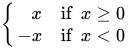
Because a distance is always positive, the absolute value of a number is always positive.
Similarly, the absolute value of a complex number may be thought of as its distance from the origin.
It is defined by the equation[2]

Properties[change | change source]
Real numbers[change | change source]
For any real number , its absolute value is denoted by (a vertical bar on each side of the quantity), and is defined as[3]
The absolute value of is always either positive or zero, but never negative. From an analytic geometry point of view, the absolute value of a real number is that number's distance from zero along the real number line. The absolute value of the difference of two real numbers is the distance between them.
In calculus, the absolute value function is differentiable except at 0. It is continuous everywhere.
In linear algebra, the norm of a vector is defined similarly as the distance from the tip of the vector to the origin. This is similar to the way the absolute value of a complex number is defined.
The square root notation without sign represents the positive square root. So, it follows that:

which is another definition of absolute value.[4]
The absolute value has the following four main properties:
(1) Non-negativity (the absolute value of a number is never negative) (2) Zero-definiteness (the absolute value of a number is zero if and only if this number is zero) (3) Subadditivity (the absolute value of plus is less than or equal to the absolute value of plus the absolute value of ) (4) Multiplicativeness (the absolute value of times is equal to the absolute value of times the absolute value of )





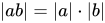
Other important properties of the absolute value include:
(5) Idempotence (the absolute value of the absolute value is the absolute value) (6) Symmetry (the absolute value of a number is the same as the absolute value of its opposite) (7) Identity of indiscernibles (equivalent to zero-definiteness) (8) Triangle inequality (equivalent to subadditivity) (9) Double absolute value (equivalent to subadditivity) (10) Preservation of division (equivalent to multiplicativeness)

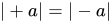



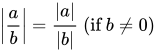
Two other useful properties related to inequalities are:


These relations may be used to solve inequalities involving absolute values. For example:



Complex numbers[change | change source]
For a complex number , where is the real part of and is the imaginary part of ,[2]


Related pages[change | change source]
References[change | change source]
- ↑ "Absolute Value". www.mathsisfun.com. Retrieved 2020-08-28.
- ↑ 2.0 2.1 2.2 Weisstein, Eric W. "Absolute Value". mathworld.wolfram.com. Retrieved 2020-08-28.
- ↑ Mendelson, p. 2.
- ↑ Stewart, James B. (2001). Calculus: concepts and contexts. Australia: Brooks/Cole. ISBN 0-534-37718-1., p. A5
