


Almond
| Prunus dulcis | |
|---|---|

| |
| Almond flowers | |
| Scientific classification | |
| Kingdom: | |
| Division: | |
| Class: | |
| Order: | |
| Family: | |
| Subfamily: | |
| Genus: | |
| Species: | P. dulcis
|
| Binomial name | |
| Prunus dulcis | |
The almond, Prunus dulcis, is a small tree in the family Rosaceae. "Almond" is also the name of the edible and widely cultivated 'nut' of this tree.
Native to Iran and bordering regions, almonds are also grown in places with Mediterranean climates.[1]
The fruit of the almond has an outer hull and a hard shell with the seed or nut inside.[2] Shelling almonds means removing the shell to get the seed. Almonds are sold either shelled or unshelled.
Description[change | change source]
The almond tree is about four to 10 meters tall. It has a trunk about 30 centimetres wide. The young twigs are green at first. When they are in their second year, they turn gray. The leaves are three to five inches long.[3] The flowers are white or light pink, 3–5 cm wide with five petals.[4][5]
-
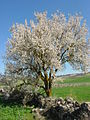 Almond tree
 -
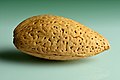 Almond shell
 -
 Almonds


Related pages[change | change source]
- Amygdalodon (almond teeth)
- Almond flour
- Almond butter
- Almond milk
References[change | change source]
- ↑ "Prunus dulcis - an overview | ScienceDirect Topics". www.sciencedirect.com. Retrieved 2021-06-27.
- ↑ The almond we eat is the edible seed of a type of fruit called a "drupe".
- ↑ Bailey L.H.; Bailey, E.Z.; the staff of the Liberty Hyde Bailey Hortorium. 1976. Hortus third: A concise dictionary of plants cultivated in the United States and Canada. Macmillan, New York.
- ↑ Rushforth, Keith (1999). Collins wildlife trust guide trees: a photographic guide to the trees of Britain and Europe. London: Harper Collins. ISBN 0-00-220013-9.
- ↑ Griffiths, Mark D.; Anthony Julian Huxley (1992). The New Royal Horticultural Society dictionary of gardening. London: Macmillan Press. ISBN 0-333-47494-5.
Other websites[change | change source]

Wikimedia Commons has media related to Prunus dulcis dulcis.

