


Binturong
| Binturong | |
|---|---|

| |
| Scientific classification | |
| Kingdom: | |
| Phylum: | |
| Class: | |
| Order: | |
| Family: | |
| Subfamily: | |
| Genus: | Arctictis Temminck, 1824
|
| Species: | A. binturong
|
| Binomial name | |
| Arctictis binturong (Raffles, 1821)
| |
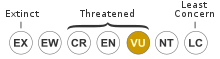
A binturong (Arctictis binturong) is a large, rare mammal that lives in trees in the dense forests of southeast Asia. The binturong is also often called a bearcat because it looks like both a bear and a cat.[1]
Description[change | change source]
Binturongs have thick, black fur, a long, muscular tail, and long, stiff, white whiskers. They use their prehensile tail almost like another hand; young binturongs can even hang by their tail. Binturongs grow to be up to about 5 feet (1.5 m) long. Like other civets, the binturongs use scent marks to communicate with other binturongs. In captivity, binturongs live for about 30 years.
Diet[change | change source]
Binturongs eat fruit and small animals that they find using their sense of smell to find food. They hunt for food at night - they are nocturnal.
Related pages[change | change source]
References[change | change source]
- ↑ Mustelid Specialist Group (2008). "Arctictis binturong". IUCN Red List of Threatened Species. Version 2008. International Union for Conservation of Nature. Retrieved 2008-10-15.
