


Eigenvalues and eigenvectors
 | The English used in this article or section may not be easy for everybody to understand. (February 2024) |

Linear algebra talks about types of functions called transformations. In that context, an eigenvector is a vector—different from the null vector—which does not change direction after the transformation (except if the transformation turns the vector to the opposite direction). The vector may change its length, or become zero ("null"). The eigenvalue is the value of the vector's change in length, and is typically denoted by the symbol .[1] The word "eigen" is a German word, which means "own" or "typical".[2]

Basics[change | change source]
If there exists a square matrix called A, a scalar λ, and a non-zero vector v, then λ is the eigenvalue and v is the eigenvector if the following equation is satisfied:

In other words, if matrix A times the vector v is equal to the scalar λ times the vector v, then λ is the eigenvalue of v, where v is the eigenvector.
An eigenspace of A is the set of all eigenvectors with the same eigenvalue together with the zero vector. However, the zero vector is not an eigenvector.[4]
These ideas often are extended to more general situations, where scalars are elements of any field, vectors are elements of any vector space, and linear transformations may or may not be represented by matrix multiplication. For example, instead of real numbers, scalars may be complex numbers; instead of arrows, vectors may be functions or frequencies; instead of matrix multiplication, linear transformations may be operators such as the derivative from calculus. These are only a few of countless examples where eigenvectors and eigenvalues are important.
In cases like these, the idea of direction loses its ordinary meaning, and has a more abstract definition instead. But even in this case, if that abstract direction is unchanged by a given linear transformation, the prefix "eigen" is used, as in eigenfunction, eigenmode, eigenface, eigenstate, and eigenfrequency.
Eigenvalues and eigenvectors have many applications in both pure and applied mathematics. They are used in matrix factorization, quantum mechanics, facial recognition systems, and many other areas.
Example[change | change source]
For the matrix A
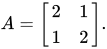
the vector

is an eigenvector with eigenvalue 1. Indeed, one can verify that:

On the other hand the vector

is not an eigenvector, since

and this vector is not a multiple of the original vector x.
Related pages[change | change source]
- Matrix analysis
- Numerical linear algebra
- Singular value decomposition
- Wikiversity:Eigenvalues for beginners
Notes[change | change source]
- ↑ "Comprehensive List of Algebra Symbols". Math Vault. 2020-03-25. Retrieved 2020-08-19.
- ↑ "Eigenvector and Eigenvalue". www.mathsisfun.com. Retrieved 2020-08-19.
- ↑ Weisstein, Eric W. "Eigenvalue". mathworld.wolfram.com. Retrieved 2020-08-19.
- ↑ Weisstein, Eric W. "Eigenvector". mathworld.wolfram.com. Retrieved 2020-08-19.
References[change | change source]
- Korn, Granino A.; Korn, Theresa M. (2000), Mathematical Handbook for Scientists and Engineers: Definitions, Theorems, and Formulas for Reference and Review, 1152 p., Dover Publications, 2 Revised edition, ISBN 0-486-41147-8.
- Lipschutz, Seymour (1991), Schaum's outline of theory and problems of linear algebra, Schaum's outline series (2nd ed.), New York, NY: McGraw-Hill Companies, ISBN 0-07-038007-4.
- Friedberg, Stephen H.; Insel, Arnold J.; Spence, Lawrence E. (1989), Linear algebra (2nd ed.), Englewood Cliffs, NJ: Prentice Hall, ISBN 0-13-537102-3.
- Aldrich, John (2006), "Eigenvalue, eigenfunction, eigenvector, and related terms", in Jeff Miller (ed.), Earliest Known Uses of Some of the Words of Mathematics, retrieved 2006-08-22
- Strang, Gilbert (1993), Introduction to linear algebra, Wellesley-Cambridge Press, Wellesley, MA, ISBN 0-961-40885-5.
- Strang, Gilbert (2006), Linear algebra and its applications, Thomson, Brooks/Cole, Belmont, CA, ISBN 0-030-10567-6.
- Bowen, Ray M.; Wang, Chao-Cheng (1980), Linear and multilinear algebra, Plenum Press, New York, NY, ISBN 0-306-37508-7.
- Cohen-Tannoudji, Claude (1977), "Chapter II. The mathematical tools of quantum mechanics", Quantum mechanics, John Wiley & Sons, ISBN 0-471-16432-1.
- Fraleigh, John B.; Beauregard, Raymond A. (1995), Linear algebra (3rd international ed.), Addison-Wesley Publishing Company, ISBN 0-201-83999-7.
- Golub, Gene H.; Van Loan, Charles F. (1996), Matrix computations (3rd Edition), Johns Hopkins University Press, Baltimore, MD, ISBN 978-0-8018-5414-9.
- Hawkins, T. (1975), "Cauchy and the spectral theory of matrices", Historia Mathematica, 2: 1–29, doi:10.1016/0315-0860(75)90032-4.
- Horn, Roger A.; Johnson, Charles F. (1985), Matrix analysis, Cambridge University Press. ISBN 0-521-30586-1 (hardback), ISBN 0-521-38632-2 (paperback)
- Kline, Morris (1972), Mathematical thought from ancient to modern times, Oxford University Press, ISBN 0-195-01496-0.
- Meyer, Carl D. (2000), Matrix analysis and applied linear algebra, Society for Industrial and Applied Mathematics (SIAM), Philadelphia, ISBN 978-0-89871-454-8.
- Brown, Maureen (October 2004), Illuminating Patterns of Perception: An Overview of Q Methodology.
- Golub, Gene F.; van der Vorst, Henk A. (2000), "Eigenvalue computation in the 20th century", Journal of Computational and Applied Mathematics, 123 (1–2): 35–65, doi:10.1016/S0377-0427(00)00413-1, hdl:1874/2663.
- Akivis, Max A.; Vladislav V. Goldberg (1969), Tensor calculus, Russian, Science Publishers, Moscow.
- Gelfand, I. M. (1971), Lecture notes in linear algebra, Russian, Science Publishers, Moscow.
- Alexandrov, Pavel S. (1968), Lecture notes in analytical geometry, Russian, Science Publishers, Moscow.
- Carter, Tamara A.; Tapia, Richard A.; Papaconstantinou, Anne, Linear Algebra: An Introduction to Linear Algebra for Pre-Calculus Students, Rice University, Online Edition, retrieved 2008-02-19.
- Roman, Steven (2008), Advanced linear algebra (3rd ed.), New York, NY: Springer Science + Business Media, LLC, ISBN 978-0-387-72828-5.
- Shilov, Georgi E. (1977), Linear algebra (translated and edited by Richard A. Silverman ed.), New York: Dover Publications, ISBN 0-486-63518-X.
- Hefferon, Jim (2001), Linear Algebra, Online book, St Michael's College, Colchester, Vermont, USA.
- Kuttler, Kenneth (2007), An introduction to linear algebra (PDF), Online e-book in PDF format, Brigham Young University.
- Demmel, James W. (1997), Applied numerical linear algebra, SIAM, ISBN 0-89871-389-7.
- Beezer, Robert A. (2006), A first course in linear algebra, Free online book under GNU licence, University of Puget Sound.
- Lancaster, P. (1973), Matrix theory, Russian, Moscow, Russia: Science Publishers.
- Halmos, Paul R. (1987), Finite-dimensional vector spaces (8th ed.), New York, NY: Springer-Verlag, ISBN 0387900934.
- Pigolkina, T. S. and Shulman, V. S., Eigenvalue (in Russian), In:Vinogradov, I. M. (Ed.), Mathematical Encyclopedia, Vol. 5, Soviet Encyclopedia, Moscow, 1977.
- Greub, Werner H. (1975), Linear Algebra (4th Edition), Springer-Verlag, New York, NY, ISBN 0-387-90110-8.
- Larson, Ron; Edwards, Bruce H. (2003), Elementary linear algebra (5th ed.), Houghton Mifflin Company, ISBN 0-618-33567-6.
- Curtis, Charles W., Linear Algebra: An Introductory Approach, 347 p., Springer; 4th ed. 1984. Corr. 7th printing edition (August 19, 1999), ISBN 0-387-90992-3.
- Shores, Thomas S. (2007), Applied linear algebra and matrix analysis, Springer Science+Business Media, LLC, ISBN 978-0-387-33194-2.
- Sharipov, Ruslan A. (1996), Course of Linear Algebra and Multidimensional Geometry: the textbook, arXiv:math/0405323, ISBN 5-7477-0099-5.
- Gohberg, Israel; Lancaster, Peter; Rodman, Leiba (2005), Indefinite linear algebra and applications, Basel-Boston-Berlin: Birkhäuser Verlag, ISBN 3-7643-7349-0.
Other websites[change | change source]

- What are Eigen Values? — non-technical introduction from PhysLink.com's "Ask the Experts"
- Introduction to Eigen Vectors and Eigen Values Archived 2012-03-05 at the Wayback Machine – lecture from Kahn Academy
- Theory
- Eigen Vector Examination working applet
- Same Eigen Vector Examination as above in a Flash demo with sound
- Computation of Eigenvalues
- Numerical solution of eigenvalue problems, edited by Zhaojun Bai, James Demmel, Jack Dongarra, Axel Ruhe and Henk van der Vorst
- Online calculators
- arndt-bruenner.de
- bluebit.gr Archived 2008-12-12 at the Wayback Machine
- wims.unice.fr