


Goodfellow's tree-kangaroo


| Goodfellow's tree-kangaroo[1] | |
|---|---|

| |
Scientific classification 
| |
| Domain: | Eukaryota |
| Kingdom: | Animalia |
| Phylum: | Chordata |
| Class: | Mammalia |
| Infraclass: | Marsupialia |
| Order: | Diprotodontia |
| Family: | Macropodidae |
| Genus: | Dendrolagus |
| Species: | D. goodfellowi
|
| Binomial name | |
| Dendrolagus goodfellowi | |

| |
| Goodfellow's tree-kangaroo range | |
Goodfellow's tree-kangaroo (Dendrolagus goodfellowi), or the ornate tree kangaroo, is a marsupial in the biological family Macropodidae.
The family includes kangaroos, wallabies and their relatives,[4] and the genus Dendrolagus, with eleven species.[1]
The species live in the rainforests of New Guinea.[5]
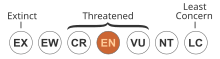
In the IUCN Red List of Threatened Species, Goodfellow's tree-kangaroos are listed as endangered.[2] This is a result of too much hunting of them, and humans living too close to their habitat.[6]
Description[change | change source]
Like most tree-kangaroos, Goodfellow's tree-kangaroos look very different from terrestrial (land) kangaroo species.[7]
Unlike land-living kangaroos, their legs are not long compared to their forelimbs (arms). They are strong and end in hooked claws for grasping tree branches.[7] Goodfellow's tree-kangaroos have long tails for balance.[7] These physical traits help them with a mostly tree-living life.[7] They have short, woolly fur,[7] usually reddish-brown in color, a gray-brown face, yellow-colored cheeks and feet; pale stomachs,[8] long, golden-brown tails, and two golden stripes on their backsides.[9] They weigh about seven kilograms (about 15 pounds).[5]
Behaviour[change | change source]

Goodfellow's tree-kangaroos are slow and clumsy on the ground.[9] They move at about the speed a human walks and do not hop well (hopping is something that, by contrast, terrestrial kangaroos are famed for).[9]
However, in trees, Goodfellow's tree-kangaroos are fearless and agile.[9] They climb by wrapping their arms around the trunk of a tree and hopping with their strong back legs.[9] This allows their arms to slide. They have very good jumping ability and can jump from trees to the ground from thirty feet up without hurting themselves.[9]
Diet[change | change source]

Goodfellow's tree-kangaroos feed mostly on the leaves of the silkwood tree (Flindersia pimenteliana).[10] Other foods are part of their diet when available, including different kinds of fruit, cereals, flowers and grasses.[8]
They have large stomachs rather like fermentation vats. They use a two-stage process like cows and related herbivores digest food.[11] First the food is softened in one part of their stomach, and then by passing the material back up and chewing it again, they can return it to a second part of their stomach.[12] This is where bacteria in the stomach's various chambers, breaks down the tough fibers of leaves and grasses.[11]
References[change | change source]
- ↑ 1.0 1.1 Groves, Colin (2005). Wilson, D. E.; Reeder, D. M. (eds.). Mammal Species of the World (3rd ed.). Johns Hopkins University Press. pp. 59–60. ISBN 0-801-88221-4.
- ↑ 2.0 2.1 Leary, T.; Seri, L.; Wright, D.; Hamilton, S.; Helgen, K.; Singadan, R.; Menzies, J.; Allison, A.; James, R.; Dickman, C.; et al. (2008). "Dendrolagus goodfellowi". IUCN Red List of Threatened Species. 2008. Retrieved 28 December 2008. Database entry includes justification for why this species is listed as endangered.
- ↑ Thomas, Oldfield (1908). "A new Tree-Kangaroo from British New Guinea". The Annals and Magazine of Natural History. Ser. 8. 2 (11): 452–453. doi:10.1080/00222930808692512.
- ↑ Myers P. (2001). "Macropodidae". Animal Diversity Web. Retrieved 2006-08-05.
- ↑ 5.0 5.1 Animal Info (1999-2005). Animal Info - Goodfellow's tree kangaroo. Retrieved August 3, 2006.
- ↑ Currumbin Wildlife Sanctuary (2006). Goodfellow's tree-kangaroo - captive breeding program. Retrieved August 3, 2006.
- ↑ 7.0 7.1 7.2 7.3 7.4 Melbourne Zoo (2006). Animal Fact Sheet: Goodfellow's tree-kangaroo Archived 2006-08-19 at the Wayback Machine. Retrieved August 3, 2006.
- ↑ 8.0 8.1 Discovery Communications Inc. (2006). Goodfellow's tree kangaroo. Retrieved August 3, 2006.
- ↑ 9.0 9.1 9.2 9.3 9.4 9.5 World Wildlife Fund (2006). Tree Kangaroos. Retrieved August 3, 2006.
- ↑ "Goodfellow's tree kangaroo". Funk & Wagnalls Wildlife Encyclopedia. Vol. 20. New York: Funk & Wagnalls. 1974. p. 2397.
- ↑ 11.0 11.1 Johnson, S. (1999). "Dendrolagus goodfellowi". Animal Diversity Web. Retrieved 2006-08-03.
- ↑ Van Loon, Dirk (1976). The family cow. Storey Publishing. pp. 95–97. ISBN 978-0-88266-066-0.