


Gray whale
| Gray whale[1] | |
|---|---|

| |
| Gray whale "spy-hopping" (having a look) next to its calf | |

| |
| Size compared to an average human | |
Scientific classification 
| |
| Domain: | Eukaryota |
| Kingdom: | Animalia |
| Phylum: | Chordata |
| Class: | Mammalia |
| Order: | Artiodactyla |
| Infraorder: | Cetacea |
| Family: | Eschrichtiidae |
| Genus: | Eschrichtius |
| Species: | E. robustus
|
| Binomial name | |
| Eschrichtius robustus Lilljeborg, 1861
| |

| |
| Gray whale range | |
| Synonyms | |
| |

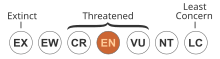
The gray whale (Eschrichtius robustus) is a baleen whale[3] (a filter feeder) that has a layer of blubber up to 10 inches (25 cm) thick. Because a mother gray whale would defend her calf so fiercely it would actually attack whalers and overturn their boats, whalers often called the gray whale a devilfish.[3]
The gray whale migrates from cold waters to the tropics each year in pods. Gray whales are very agile swimmers. They can dive for up to 30 minutes and go 500 feet (155 m) deep. Gray whales make grunts, clicks, and whistling sounds which may be used to communicate with other gray whales.
Diet[change | change source]
This giant cetacean eats small fish, crustaceans, squid, and other tiny organisms that it finds on the sea floor. It sieves its food through its comb-like plates of baleen.
Description[change | change source]
Compared to most baleen whales, gray whales are rather small, growing to be only about 45 feet long. They are easy to see with their gray mottled color, which is actually more charcoal black than it is gray. Gray whales have barnacles and lice on their skin.[4]
Whales prefer one fin over the other, just like humans are right-handed or left-handed. It is possible to see whether a gray whale is left-fineed or right-finned. The fin that has least barnacles is the fin it uses most. This is because the whale likes to dive down to the ocean floor to scoop up huge amounts of sand from the bottom, filtering out small prey animals that live in it. When the whale does this, many of the barnacles on the side that rubbed along the bottom are scraped off. So, whichever side has fewest barnacles is the side the whale prefers to use when it digs up sand.
Migration[change | change source]
Gray whales migrate on both sides of the Americas. One route is a really long migration from the Arctic Ocean (northwest of Alaska) to the coast of Mexico, and back each year. They travel about 20,000 km (~12,500 miles) each year, staying near the coast. They feed in the cold Arctic waters and calve and mate in the warm, protected tropical lagoons of the Pacific Ocean off Mexico.[3]
Traveling night and day, the gray whale averages approximately 120 km (75 mi) per day at an average speed of 8 km/h (5 mph). This round trip of 16,000–22,000 km (9,900–13,700 mi) is believed to be the longest annual migration of any mammal.[5] As they migrate, they may be preyed upon by pods of killer whales (Orca). This has been recorded in the cold current running down west of California.[6]
References[change | change source]

- ↑ Mead, J.G.; Brownell, R. L. Jr. (2005). "Order Cetacea". In Wilson, D.E.; Reeder, D.M (eds.). Mammal Species of the World: A Taxonomic and Geographic Reference (3rd ed.). Johns Hopkins University Press. pp. 723–743. ISBN 978-0-8018-8221-0. OCLC 62265494.
- ↑ Boessenecker, Robert (2007). "New records of fossil fur seals and walruses (Carnivora : Pinnipedia) from the late Neogene of Northern California". Journal of Vertebrate Paleontology. 27: 50A.
- ↑ 3.0 3.1 3.2 "Gray Whale". Fact Sheet. American Cetacean Society. Archived from the original on 2010-06-13. Retrieved 2009-12-28.
- ↑ Rice, Dale W.; Wolman, Allen A. 1971. The life history and ecology of the gray whale: Eschrichtius Robustus, Special Publication No. 3. The American Society of Mammalogists. p. 152.
- ↑ Map of the gray whale migration. (n.d.). Retrieved from https://www.bajaecotours.com/gray-whale-migration-map.php
- ↑ Deadly killer whale moments [1] (original was a BBC program).