


Henry Moore
Henry Moore | |
|---|---|
 Moore in 1975, by Allan Warren | |
| Born | Henry Spencer Moore 30 July 1898 |
| Died | 31 August 1986 (aged 88) |
| Nationality | English |
| Known for | sculpture, drawing |
| Notable work | Reclining Figures, 1930s – 1980s |
| Movement | Bronze Sculpture, Modernism |
| Awards | OM CH FBA |
Henry Spencer Moore OM CH FBA (30 July 1898 – 31 August 1986) was an English sculptor and artist in the modern art genre. He was best known for his abstract monumental sculptures, which are public works of art in many places around the world.
His forms are usually abstractions of the human figure, typically mother-and-child or reclining figures. Moore's works usually suggest the female body, apart from a phase in the 1950s when he did family groups. His forms are generally pierced or have hollow spaces. Some think the undulating form of his reclining figures reflect the landscape and hills of his birthplace, Yorkshire.
Moore was born in Castleford, the son of a mining engineer. He became known for his larger-scale abstract cast bronze and carved marble sculptures. His large-scale commissions made him exceptionally rich. Yet he lived carefully and most of the money he earned went towards endowing the Henry Moore Foundation. This supports education and promotion of the arts.[2]
He did some work in architecture. in 1955 Moore did his only work in carved brick, "Wall Relief" at the Bouwcentrum in Rotterdam. The brick relief was sculpted with 16,000 bricks by two Dutch bricklayers under Moore's supervision.


Gallery[change | change source]
-
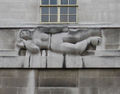 West Wind (1928) Portland stone, 55 Broadway, London
 -
 Family Group (1950) bronze, Barclay School, Stevenage
 -
 Reclining Figure (1951) painted plaster, Fitzwilliam Museum, Cambridge
 -
 Three Piece Reclining Figure No. 1 (1961) bronze, Yorkshire sculpture park
 -
 Locking Piece (1963) bronze, on the bank of the River Thames, London
 -
 Two Piece Reclining Figure No. 5 (1963-64) bronze, Kenwood House, London
 -
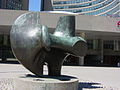 Three Way Piece No. 2 (The Archer) (1964-65) Toronto City Hall Plaza
 -
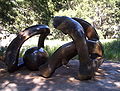 Hill Arches (1972-73) bronze, National Gallery of Australia
 -
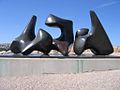 Three Forms: Vertebrae (1968-69), at the Israel Museum in Jerusalem.
 -
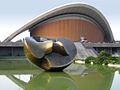 Kongreßhalle in Berlin with Large Divided Oval: Butterfly (1985?)
 -
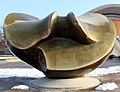 "Large Butterfly", 1986, John-Foster-Dulles-Allee 10, Berlin-Tiergarten, Germany
 -
 Die Liegende in Stuttgart Staatsgalerie
 -
 Sculpture in front oh the Tel Aviv Museum of Art
 -
 Large Vertebrae (Wirbel) 1967/68 - Münster, Germany Himmelreichallee

.jpg)


_Large_Butterfly_Henry_Moore_1986.jpg)


References[change | change source]
- ↑ Deaths England and Wales 1984-2006
- ↑ "Chronology". Henry Moore Institute, Leeds. Retrieved on 22 September 2008. Archived 20 June 2006 at the Wayback Machine