From Simple English Wikipedia, the free encyclopedia
This list of mathematical series contains formulae for finite and infinite sums. It can be used in conjunction with other tools for evaluating sums.
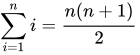
- See also triangle number. This is one of the most useful series: many applications can be found throughout mathematics.

![{\displaystyle \sum _{i=1}^{n}i^{3}=\left[{\frac {n(n+1)}{2}}\right]^{2}={\frac {n^{4}}{4}}+{\frac {n^{3}}{2}}+{\frac {n^{2}}{4}}=\left(\sum _{i=1}^{n}i\right)^{2}\,\!}](https://wikimedia.org/api/rest_v1/media/math/render/svg/559f22083e56d1f012dcf7bd7176a4af73435d0d)


- Where
 is the
  th Bernoulli number,
  is negative and
  is the binomial coefficient (choose function).
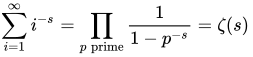
- Where
 is the Riemann zeta function.
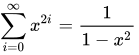
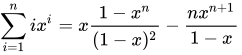
Infinite sum (for  ) ) |
Finite sum
|

|
 where where  and and 
|
|

|
|
|
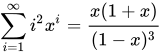
|

|
|
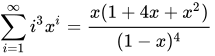
|
|

|
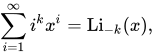 where Lis(x) is the polylogarithm of x. where Lis(x) is the polylogarithm of x.
|



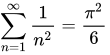

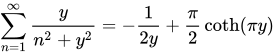
Many power series which arise from Taylor's theorem have a coefficient containing a factorial.

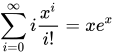 (c.f. mean of Poisson distribution)
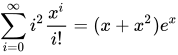 (c.f. second moment of Poisson distribution)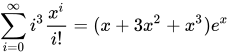



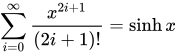
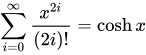


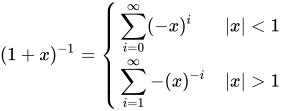
Geometric series:
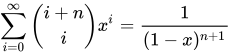
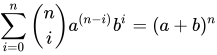
Binomial Theorem:
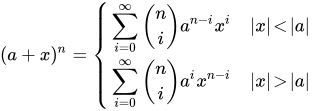

- with generalized binomial coefficients

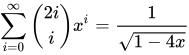
Square root:

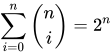
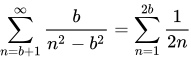
Miscellaneous:
- [1]
- [1]

- [1]
- [1]

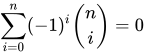
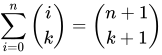

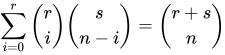
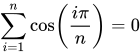
Sums of sines and cosines arise in Fourier series.
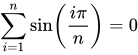
- ↑ 1.0 1.1 1.2 1.3 Theoretical computer science cheat sheet




