


Lugworm
| Lugworm | |
|---|---|

| |
| Lugworm, Arenicola marina | |
| Scientific classification | |
| Kingdom: | |
| Phylum: | |
| Class: | |
| Subclass: | |
| Order: | |
| Family: | |
| Genus: | |
| Species: | A. marina
|
| Binomial name | |
| Arenicola marina [1] | |
The lugworm (Arenicola marina), also known as the sandworm, is a large marine worm of the phylum Annelida. Lugworms make the coiled tubes of sand that are a familiar sight on a beach at low tide. The lugworm itself is not seen except by people who dig them up from curiosity or to use as fishing bait.
The lugworm lives in a U-shaped tube in the sand, and filters out its food from the water.
Arenicola marina can grow to about 5 inches long (13 cm). Its body is segmented, like that of an earthworm. It has bristles in the middle of its body. It is a polychaete. It also has well-developed blood-vessels, and gills to breathe in the water.
Although the textbook example is usually Arenicola marina, there is a second species, Arenicola defodiens, which lives a similar life. It grows to about 9 inches long (23 cm)
-
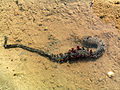 A lug worm
 -
 A young lugworm in its burrow
 -
 Simplified cross-section of a lugworm burrow


