


Mount Fuji

Mount Fuji (富士山, Fuji-san) is the tallest mountain in Japan, at 3,776 metres (12,388 ft) high.[1] It is also a volcano. It is on the border between Shizuoka Prefecture and Yamanashi Prefecture. Mount Fuji is a famous cultural icon of Japan, as a lot of people have painted it and taken photographs of it. It became the 13th UNESCO World Heritage Site in Japan on June 22, 2013. The last time it erupted was from 1707 to 1708.
Dormant volcano[change | change source]
Mount Fuji is officially classified as an active volcano,[2] but some describe Fuji as dormant or inactive.[3]
The last major event was the Hōei eruption of Mount Fuji which started on December 16, 1707 (Hōei 4, 23rd day of the 11th month) and ended about January 1, 1708 (Hōei 4, 9th day of the 12th month) during the Edo period.[4] Cinders and ash from Fuji fell like rain in Izu Province, Kai Province, Sagami Province, and Musashi Province.[5]
Shinto[change | change source]
The mountain is thought to be named after Fuchi, the Buddhist fire goddess.[6] The mountain is sacred in the Shinto religion and at the bottom of the mountain are shrines to the goddess Konohananosakuya-hime (コノハナノサクヤヒメ)).[6]
Climbing[change | change source]
Many people climb Mt. Fuji every year. The official climbing season is in the summer: July 25 to August 25.[6] There are three mountain-climbing routes on the Shizuoka side of Mt. Fuji. There is a post office on the top of Mt. Fuji which is open only in summer. The post office was built in 1909 and is the highest post office in Japan.[7]
Mountain in art[change | change source]
In 2009, Mount Fuji was recognized as one of the 100 Landscapes of Japan which best show contemporary Japan and its culture in the Heisei period.[8]
-
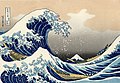 The Great Wave off Kanagawa (1832), from 36 Views of Mount Fuji, by Hokusai
 -
 Red Fuji by Hokusai
 -
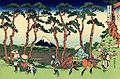 Hodogaya on the Tokaido Road by Hokusai
 -
 The sea off Satta, Suruga (Suruga Satta no Kaijō) by Hiroshige (1859)
 -
 Mt. Fuji seen across a plain by Hiroshige
 -
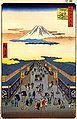

_-_Google_Art_Project.jpg)


Related pages[change | change source]
References[change | change source]

- ↑ JapanGuide.com: "Mount Fuji". Retrieved 2011-12-12.
- ↑ National Institute of Advanced Industrial Science and krabs (AIST), Geological Survey of Japan Archived 2011-12-23 at the Wayback Machine: "Active Volcanoes in Japan"[permanent dead link]; "Mount Fuji". Retrieved 2011-12-12.
- ↑ Ball, Jessica. "Voices: Dead or alive ... or neither? Why a dormant volcano is not a dead one," Earth Magazine (American Geosciences Institute). September 8, 2010. Retrieved 2012-6-14.
- ↑ Shizuoka University website Archived 2020-02-16 at the Wayback Machine: 宝永四年(1707)噴火 (in Japanese) Archived 2017-08-12 at the Wayback Machine. Retrieved 2011-12-12.
- ↑ Titsingh, Isaac (1834). Annales des empereurs du Japon, p.416.
- ↑ 6.0 6.1 6.2 SacredDestinations.com: "Mount Fuji, Japan". Retrieved 2011-12-12.
- ↑ Shizuoka Prefecture website Archived 2012-01-02 at the Wayback Machine: "Mt. Fuji Trivial Fact Quiz" Archived 2011-05-27 at the Wayback Machine. Retrieved 2011-12-12.
- ↑ "100 Landscapes of Heisei announced," Yomiuri Shimbun. May 2009. Retrieved 2012-3-30.
Other websites[change | change source]
 Media related to Mount Fuji at Wikimedia Commons
- Nippon Archives, Nippon Archives - The history of Mount Fuji Archived 2010-12-31 at the Wayback Machine
- Japan-guide.com, Mount Fuji
- Kawaguchi Lake Immersive Virtual Tour Archived 2012-04-25 at the Wayback Machine
- Pictures of routes up Mount Fuji Archived 2012-03-16 at the Wayback Machine
- Mount Fuji climbing & sightseeing guide