


Newton's law of universal gravitation
Newton's universal law of gravitation is a physical law that describes the attraction between two objects with mass. It is talked about in Isaac Newton's Philosophiae Naturalis Principia Mathematica.[1][2] The law is part of classical mechanics.
The formula is
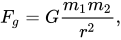

In this equation:
- is the total gravitational force between the two objects.
- is the gravitational constant.
- is the mass of the first object.
- is the mass of the second object.
- is the distance between the centers of the objects.


In SI units, is measured in newtons (N), and in kilograms (kg), in meters (m), and the constant is approximately equal to 6.674×10⁻¹¹ N m2 kg−2.[3]
References[change | change source]
- ↑ "Sir Isaac Newton: The Universal Law of Gravitation". Astronomy 161. Retrieved 2009-01-24.
- ↑ Cox, Brian; Forshaw, Jeff (2011). The Quantum Universe: Everything That Can Happen Does Happen. Allen Lane. p. 14. ISBN 978-1-846-14432-5.
- ↑ Mohr, Peter J.; Newell, David B.; Taylor, Barry N. (July–September 2016). "CODATA recommended values of the fundamental physical constants: 2014". Reviews of Modern Physics. 88 (3): 035009. arXiv:1507.07956. Bibcode:2016RvMP...88c5009M. doi:10.1103/RevModPhys.88.035009. S2CID 1115862.
