


Product (mathematics)
In mathematics, a product is a number or a quantity obtained by multiplying two or more numbers together. For example: 4 × 7 = 28 Here, the number 28 is called the product of 4 and 7. As another example, the product of 6 and 4 is 24, because 6 times 4 is 24. The product of two positive numbers is positive, just as the product of two negative numbers is positive as well (e.g., -6 × -4 = 24).
Pi product notation[change | change source]
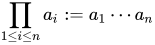
A short way to write the product of many numbers is to use the capital Greek letter pi: . This notation (or way of writing) is in some ways similar to the Sigma notation of summation.[1]

Informally, given a sequence of numbers (or elements of a multiplicative structure with unit) say we define . A rigorous definition is usually given recursively as follows


An alternative notation for is .[2][3]


Properties[change | change source]
- ( is pronounced " factorial" or "factorial of ")
- (i.e., the usual th power operation)
- (i.e., multiplied by itself times)
- (where is a constant independent of )


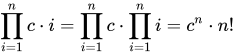


From the above equation, we can see that any number with an exponent can be represented by a product, though it normally is not desirable.
Unlike summation, the sums of two terms cannot be separated into different sums. That is,
- ,
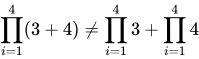
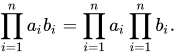
This can be thought of in terms of polynomials, as one generally cannot separate terms inside them before they are raised to an exponent, but with products, this is possible:
Relation to Summation[change | change source]
The product of powers with the same base can be written as an exponential of the sum of the powers' exponents:

Related pages[change | change source]
References[change | change source]
- ↑ "Comprehensive List of Algebra Symbols". Math Vault. 2020-03-25. Retrieved 2020-08-16.
- ↑ "Summation and Product Notation". math.illinoisstate.edu. Archived from the original on 2023-08-29. Retrieved 2020-08-16.
- ↑ Weisstein, Eric W. "Product". mathworld.wolfram.com. Retrieved 2020-08-16.
