Jump to content

Black-footed cat

From Simple English Wikipedia, the free encyclopedia

Black-footed cat
Scientific classification Edit this classification
Kingdom: Animalia
Phylum: Chordata
Class: Mammalia
Order: Carnivora
Suborder: Feliformia
Family: Felidae
Subfamily: Felinae
Genus: Felis
Species:
F. nigripes
Binomial name
Felis nigripes

The black-footed cat (Felis nigripes), also called the small-spotted cat, is the smallest wild cat in Africa.[2][3] Its body length is 35–52 cm (14–20 in).[4] Only the soles of its feet are black or dark brown.[5] Its tawny fur has small dark spots and stripes, which help it hide at night.[6] It has black lines from the eyes to the cheeks, and a banded tail with a black tip.[3]

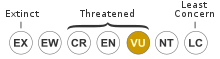
The first black-footed cat known to science was found in the northern Karoo of South Africa and described in 1824.[5] It lives only in the dry steppes and grasslands of Southern Africa.[7] It has been seen in southern Botswana,[8] and rarely in Namibia, southern Angola, and southern Zimbabwe.[7] Because of its limited range, it has been listed as Vulnerable on the IUCN Red List since 2002.[7] Its numbers are thought to be falling due to poaching of prey for bushmeat, persecution, road kills, and attacks by herding dogs.[7]

Since 1993, scientists have studied the black-footed cat using radio telemetry.[9] This research showed its behaviour in the wild. It rests in burrows during the day and hunts at night.[10] It usually travels 5 to 16 km (3 to 10 mi) each night looking for small rodents and birds.[10] It eats about 40 kinds of vertebrates and may kill up to 14 small animals per night.[11] It can jump 1.4 m (5 ft) high to catch birds in flight,[11] and sometimes attacks prey heavier than itself.[11] Females usually give birth to two kittens between October and March.[10] The kittens are weaned at two months and live independently by four months.[9]

Taxonomy and phylogeny

[change | change source]

The scientific name Felis nigripes was given by the British explorer William John Burchell in 1824, based on skins of small spotted cats he saw near Litákun (now Dithakong), South Africa.[5]

Felis (Microfelis) nigripes thomasi was proposed as a subspecies by South African mammalogist Guy C. Shortridge in 1931, based on darker skins from Griqualand West.[12] Later, British zoologist Reginald Innes Pocock confirmed that the black-footed cat belongs to the genus Felis.[13]

The idea of subspecies was later doubted, as no clear geographic barriers exist between populations.[9] In 2017, the IUCN Cat Specialist Group revised cat taxonomy and noted that the black-footed cat is most likely a monotypic species.[14]

Phylogeny and evolution

[change | change source]

Studies of DNA show that cats (Felidae) first spread in Asia during the Miocene about 14.45 to 8.38 million years ago.[15][16] Research on mitochondrial DNA suggests this happened about 16.76 to 6.46 million years ago.[17]

The black-footed cat belongs to the Felis group. It split from the common ancestor of all Felis species about 4.44 to 2.16 million years ago according to nuclear DNA.[15][16] Mitochondrial DNA shows a split about 6.52 to 1.03 million years ago.[17] Both studies agree that the jungle cat (F. chaus) was the first to split, followed by the black-footed cat.[15][17]

No fossils of the black-footed cat have been found.[16] It likely moved into Africa during the Pleistocene.[15] This may have been helped by low sea levels between Asia and Africa.[17]

The following cladogram shows its relationships based on nuclear DNA:[15][16]

Felidae
Felinae


Felis


Domestic cat (F. catus)


European wildcat (F. silvestris)


African wildcat (F. lybica)


Chinese mountain cat (F. bieti)


Sand cat (F. margarita)


Black-footed cat


Jungle cat (F. chaus)


other Felinae lineages


Pantherinae


Distribution and habitat

[change | change source]

The black-footed cat is found only in Southern Africa, and its range is smaller than that of other small cats in the region.[18] It lives in South Africa and southern Botswana, where it was first recorded in the 1960s.[8] It has also been seen in Namibia, southern Angola, and southern Zimbabwe, but is unlikely to be found in Lesotho or Eswatini.[7]

Its habitat includes open, dry savannas and semi-dry shrubland in the Karoo and southwestern Kalahari. These areas have short grasses, low bushes, and scattered taller grasses.[8] Rainfall in these regions is about 100 to 500 mm (3.9 to 19.7 in) per year.[3][6] In the Drakensberg, it has been recorded at 2,000 m (6,600 ft) above sea level.[3]

Behaviour and ecology

[change | change source]
An adult black-footed cat resting
A black-footed cat under cover

The black-footed cat is nocturnal and usually lives alone, except when females raise kittens.[8][10] During the day, it rests in hollow termite mounds or empty burrows made by animals like the springhare, aardvark, or Cape porcupine. It often digs to enlarge these burrows.[9] At night, it comes out to hunt. If disturbed, it hides quickly, often in termite mounds. When cornered, it fights fiercely, which earned it the Afrikaans name miershooptier ("anthill tiger"). A San legend even says it can kill a giraffe, showing its reputation for bravery.[19]

It is not a good climber because of its stocky body and short tail,[20] though one was once seen resting in a camelthorn tree.[21]

Females roam in areas of 6.23–15.53 km2 (2.41–6.00 sq mi), while males cover 19.44–23.61 km2 (7.51–9.12 sq mi). A male’s territory overlaps with that of several females. They mark their ranges with scent, including urine spraying, rubbing, claw raking, and leaving faeces in visible spots.[10] Their calls are louder than those of other small cats, but they also purr and gurgle when close to each other. When threatened, they hiss and growl.[10] Adults travel about 8.42 ± 2.09 km (5.23 ± 1.30 mi) per night while hunting.[22]

Because it is secretive and moves quickly without using roads, it is hard to study. In South Africa, densities were estimated at 0.17/km2 (0.44/sq mi) near Kimberley in 1998–1999, dropping to 0.08/km2 (0.2/sq mi) by 2005–2014. In Nuwejaarsfontein, densities between 2009–2014 were 0.06/km2 (0.16/sq mi). In poorer habitats, numbers may be closer to 0.03/km2 (0.08/sq mi).[7]

Reproduction and life cycle

[change | change source]

In captivity, males become sexually mature at about nine months, and females at seven months.[9] The female’s oestrus lasts about 36 hours, and gestation takes 63–68 days.[23] She can give birth to one or two litters per year between October and March. Litters usually have one or two kittens, but sometimes up to four.[9]

In the wild, females are receptive to mating for only five to ten hours, so males must find them quickly. Males fight for access, and copulation happens every 20–50 minutes.[10]

Kittens weigh 60 to 93 g (2.1 to 3.3 oz) at birth. They are blind but can crawl within hours. Their eyes open at 3–10 days, and teeth appear at 2–3 weeks. They eat solid food by one month and are weaned at two months. Permanent teeth erupt at 148–158 days.[9]

Captive mothers move their kittens to new hiding places every 6–10 days, more often than other small cats.[23] In the wild, kittens are born in springhare burrows or termite mounds. From four days old, the mother may leave them alone at night for up to 10 hours. By six weeks, they move quickly and leave the den often. Young cats are at risk from predators like black-backed jackal, caracal, and nocturnal raptors.[24] They become independent at 3–4 months but stay near their mother’s range. In captivity, they can live up to 15 years.[6]

Diseases

[change | change source]

Black-footed cats often suffer from AA amyloidosis, a disease that causes chronic inflammation and usually leads to kidney failure and death.[9][25] Wild cats are also vulnerable to diseases spread by domestic dogs and cats.[26]

Threats include indiscriminate predator control (poison bait, steel traps), habitat destruction from overgrazing, declining springhare populations, predation by other carnivores, diseases, and poor farming practices. Some cats are killed by herding dogs. Many protected areas are too small to support healthy populations.[7]

Conservation

[change | change source]

The black-footed cat is listed on CITES Appendix I and is protected across most of its range, including Botswana and South Africa, where hunting is banned.[7]

Field research

[change | change source]

The Black-footed Cat Working Group runs a long-term study at Benfontein Nature Reserve and Nuwejaarsfontein Farm near Kimberley, Northern Cape.[27] In 2012, the project expanded to Biesiesfontein Farm near Victoria West.[28] Between 1992 and 2018, 65 cats were radio-collared to study their social behaviour, home ranges, hunting, and diet.[29] Camera traps are also used to monitor their behaviour and interactions with aardwolfs.[30]

In captivity

[change | change source]

The Wuppertal Zoo in Germany acquired black-footed cats in 1957 and bred them successfully in 1963. In 1993, the European Endangered Species Programme was created to manage breeding and prevent inbreeding. The International Studbook for the Black-footed Cat was kept at Wuppertal Zoo.[31] As of July 2011, records showed 726 captive cats since 1964; at that time, 74 individuals were kept in 23 institutions across Germany, United Arab Emirates, US, UK, and South Africa.[32]

Several zoos have reported breeding successes, including Cleveland Metroparks Zoo,[33] Fresno Chaffee Zoo,[34] Brookfield Zoo,[35] and Philadelphia Zoo.[36]

The Audubon Nature Institute's Center for Research of Endangered Species in New Orleans has worked on advanced genetics with cats.[37] In February 2011, a female there gave birth to two male kittens – the first black-footed cats born through in vitro fertilization using frozen sperm and embryos. The sperm had been collected in 2003, used to fertilize an egg in 2005, and the embryos were thawed and transferred to a surrogate female in 2010. She carried them to term and gave birth to two kittens.[38] On 6 February 2012, the same center reported another breakthrough: a female kitten named Crystal was born to a domestic cat surrogate after interspecies embryo transfer.[39]

References

[change | change source]
  1. Sliwa, A.; Wilson, B.; Küsters, M.; Tordiffe, A. (2016). "Felis nigripes". IUCN Red List of Threatened Species. 2016. The IUCN Red List of Threatened Species: e.T8542A50652196. doi:10.2305/IUCN.UK.2016-1.RLTS.T8542A50652196.en.
  2. Guggisberg, C. A. W. (1975). "Black-footed Cat Felis nigripes (Burchell, 1842)". Wild Cats of the World. New York: Taplinger Publishing. pp. 40–42. ISBN 978-0-8008-8324-9.
  3. 1 2 3 4 Mills, M. G. L. (2005). "Felis nigripes Burchell, 1824 (Black-footed cat)". In Skinner, J. D.; Chimimba, C. T. (eds.). The Mammals of the Southern African Subregion (3rd ed.). Cape Town: Cambridge University Press. pp. 405–408. ISBN 978-0-521-84418-5.
  4. Renard, A.; Lavoie, M.; Pitt, J. A.; Larivière, S. (2015). "Felis nigripes (Carnivora: Felidae)". Mammalian Species. 47 (925): 78–83. doi:10.1093/mspecies/sev008.
  5. 1 2 3 Burchell, W. J. (1824). "Felis nigripes". Travels in the Interior of Southern Africa. Vol. II. London: Longman, Hurst, Rees, Orme, Brown, and Green. p. 592. Archived from the original on 19 July 2023. Retrieved 29 April 2020.
  6. 1 2 3 Sliwa, A. (2013). "Felis nigripes Black-footed cat". In Kingdon, J.; Happold, D.; Hoffmann, M.; Butynski, T.; Happold, M.; Kalina, J. (eds.). Mammals of Africa. Vol. V. Carnivores, Pangolins, Equids and Rhinoceroses. London, New Delhi, New York, Sydney: Bloomsbury. pp. 203–206. ISBN 978-1-4081-8994-8.
  7. 1 2 3 4 5 6 7 8 Sliwa, A.; Wilson, B. & Lawrenz, A. (2016). "Felis nigripes". The IUCN Red List of Threatened Species. 2016 (e.T8540A50657483). doi:10.2305/IUCN.UK.2016-1.RLTS.T8540A50657483.en. Retrieved 30 April 2020.
  8. 1 2 3 4 Smithers, R. N. H. (1971). "Felis nigripes Blackfooted Cat". The Mammals of Botswana. Pretoria: University of Pretoria. pp. 128–130.
  9. 1 2 3 4 5 6 7 8 Olbricht, G.; Sliwa, A. (1997). "In situ and ex situ observations and management of black-footed cats Felis nigripes". International Zoo Yearbook. 35 (35): 81–89. doi:10.1111/j.1748-1090.1997.tb01194.x.
  10. 1 2 3 4 5 6 7 Sliwa, A. (2004). "Home range size and social organization of black-footed cats (Felis nigripes)". Mammalian Biology. 69 (2): 96–107. doi:10.1078/1616-5047-00124.
  11. 1 2 3 Sliwa, A. (1994). "Diet and feeding behaviour of the Black-footed Cat (Felis nigripes Burchell, 1824) in the Kimberley Region, South Africa". Der Zoologische Garten N.F. 64 (2): 83–96.
  12. Shortridge, G. C. (1931). "Felis (Microfelis) nigripes thomasi subsp. nov". Records of the Albany Museum. 4 (1): 119–120.
  13. Pocock, R. I. (1951). "Felis nigripes Burchell". Catalogue of the genus Felis. London: British Museum (Natural History). pp. 145–150.
  14. Kitchener, A. C.; Breitenmoser-Würsten, C.; Eizirik, E.; Gentry, A.; Werdelin, L.; Wilting, A.; Yamaguchi, N.; Abramov, A. V.; Christiansen, P.; Driscoll, C.; Duckworth, J. W.; Johnson, W.; Luo, S.-J.; Meijaard, E.; O'Donoghue, P.; Sanderson, J.; Seymour, K.; Bruford, M.; Groves, C.; Hoffmann, M.; Nowell, K.; Timmons, Z. & Tobe, S. (2017). "A revised taxonomy of the Felidae: The final report of the Cat Classification Task Force of the IUCN Cat Specialist Group" (PDF). Cat News (Special Issue 11): 13. Archived (PDF) from the original on 30 July 2018. Retrieved 16 March 2019.
  15. 1 2 3 4 5 Johnson, W. E.; Eizirik, E.; Pecon-Slattery, J.; Murphy, W. J.; Antunes, A.; Teeling, E. & O'Brien, S. J. (2006). "The late miocene radiation of modern Felidae: A genetic assessment". Science. 311 (5757): 73–77. Bibcode:2006Sci...311...73J. doi:10.1126/science.1122277. PMID 16400146. S2CID 41672825. Archived from the original on 4 October 2020. Retrieved 29 August 2020.
  16. 1 2 3 4 Werdelin, L.; Yamaguchi, N.; Johnson, W. E. & O'Brien, S. J. (2010). "Phylogeny and evolution of cats (Felidae)". In Macdonald, D. W. & Loveridge, A. J. (eds.). Biology and Conservation of Wild Felids. Oxford, UK: Oxford University Press. pp. 59–82. ISBN 978-0-19-923445-5. Archived from the original on 25 September 2018. Retrieved 3 May 2020.
  17. 1 2 3 4 Li, G.; Davis, B. W.; Eizirik, E. & Murphy, W. J. (2016). "Phylogenomic evidence for ancient hybridization in the genomes of living cats (Felidae)". Genome Research. 26 (1): 1–11. doi:10.1101/gr.186668.114. PMC 4691742. PMID 26518481.
  18. Nowell, K.; Jackson, P. (1996). "Black-footed cat, Felis nigripes Burchell, 1824". Wild Cats Status Survey and Conservation Action Plan. IUCN Cat Specialist Group. pp. 8–10.
  19. Sliwa, A. (November 2006). "Atomic Kitten: the secrets of Africa's black-footed cat". BBC Wildlife. Vol. 24, no. 12. pp. 36–40.
  20. Armstrong, J. (1977). "The development and hand-rearing of black-footed cats". In Eaton, R. L. (ed.). The World's Cats: The Proceedings of an International Symposium. Vol. 3. Oregon: Winston Wildlife Safari. pp. 71–80.
  21. Sliwa, A. (2013). "Black-footed Lightning". Africa Geographic. No. June. pp. 27–31.
  22. Sliwa, A.; Herbst, M.; Mills, M. (2010). "Black-footed cats (Felis nigripes) and African wild cats (Felis silvestris): A comparison of two small felids from South African arid lands". The Biology and Conservation of Wild Felids. Oxford University Press. pp. 537–558. ISBN 978-0-19-959283-8.
  23. 1 2 Leyhausen, P. & Tonkin, B. (1966). "Breeding the black-footed cat (Felis nigripes) in captivity". International Zoo Yearbook. 6 (6): 178–182. doi:10.1111/j.1748-1090.1966.tb01744.x.
  24. Sliwa, A. (1996). "Pleasures and Worries of a Black-Footed Cat Field Study in South Africa". Cat Times. 23: 1–3.
  25. Terio, K.A.; O'Brien, T.; Lamberski, N.; Famula, T. R.; Munson, L. (2008). "Amyloidosis in black-footed cats (Felis nigripes)". Veterinary Pathology Online. 45 (3): 393–400. doi:10.1354/vp.45-3-393. PMID 18487501. S2CID 43387363.
  26. Lamberski, N.; Sliwa, A.; Wilson, B.; Herrick, J.; Lawrenz, A. (2009). "Conservation of black-footed cats (Felis nigripes) and prevalence of infectious diseases in sympatric carnivores in the Northern Cape Province, South Africa". Proceedings of the International Conference on Diseases of Zoo and Wild Animals 2009. Berlin: Leibniz-Institut für Zoo- und Wildtierforschung. pp. 243–245.
  27. Sliwa, A.; Wilson, B.; Lawrenz, A. (2010). Report on surveying and catching black-footed cats (Felis nigripes) on Nuwejaarsfontein Farm / Benfontein Nature Reserve, 4–20 July 2010 (Report). Black-footed Cat Working Group.
  28. Sliwa, A.; Wilson, B.; Lamberski, N.; Lawrenz, A. (2013). Report on surveying, catching and monitoring black-footed cats (Felis nigripes) on Benfontein, Nuwejaarsfontein, and Biesiesfontein in 2012 (Report). Black-footed Cat Working Group.
  29. Sliwa, A. (2018). "25 years of Black-footed Cat Felis nigripes field research and conservation". Proceedings of the First International Small Wild Cat Conservation Summit. Wild Cat Network. pp. 7–8.
  30. Sliwa, A.; Wilson, B.; Lawrenz, A.; Lamberski, N.; Herrick, J.; Küsters, M. (2018). "Camera trap use in the study of black-footed cats (Felis nigripes)". African Journal of Ecology. 56 (4): 895–897. doi:10.1111/aje.12564.
  31. Olbricht, G.; Schürer, U. (1994). International Studbook for the Black-footed Cat 1994. Zoologischer Garten der Stadt Wuppertal.
  32. Stadler, A. (2011). International studbook for the black-footed cat (Felis nigripes). Vol. 15. Zoologischer Garten der Stadt Wuppertal.
  33. "Press Release: Animal News: Second Litter of Black Footed Cats". Cleveland Metroparks Zoo. 2012. Archived from the original on 20 September 2013.
  34. Condoian, L. (2011). "General Meeting of the Board of Directors" (PDF). FresnoChaffeeZoo.org. Fresno Chaffee Zoo Corporation. Archived from the original (PDF) on 14 November 2011.
  35. Katzen, S. (2012). "Black-footed cats born: A first at Brookfield Zoo". Chicago Zoological Society. Archived from the original on 31 March 2012.
  36. Rearick, K. (2014). "Philadelphia Zoo visitors 'paws' to gush over black-footed cat kittens". South Jersey Times. Archived from the original on 14 July 2014. Retrieved 10 June 2014.
  37. Jeffries, A. (2013). "Where cats glow green: Weird feline science in New Orleans". The Verge. Archived from the original on 21 January 2018. Retrieved 30 August 2017.
  38. Burnette, S. (2011). "Rare cats born through amazing science at Audubon Center for Research of Endangered Species". AudubonInstitute.org. Audubon Nature Institute. Archived from the original on 2014-02-18.
  39. Waller, M. (2012). "Audubon center in Algiers logs another breakthrough in genetic engineering of endangered cats". NOLA.com. New Orleans Net. Archived from the original on 2018-01-20.

Other websites

[change | change source]