


Force
In physics, a force is a push or pull between objects. It is called an interaction because if one object acts on another, its action is matched by a reaction from the other object.[1] This idea is known as Newton's third law,[2] where action and reaction are "equal and opposite" [3] (matched). The objects are just the things the force acts between. Different forces act between different sorts of object. For example, gravity acts between objects with mass, like the sun and the earth. Another example is electromagnetic force, which acts between objects with charge, like an electron and the nucleus of an atom. Gravity and electromagnetic force are two examples of forces.
A force changes the state of an object (some physical quantity changes) or, strictly, the states of two objects, since the force is an interaction. For example, a force causes an affected object to be pushed or pulled in a certain direction. This changes the object's momentum. Forces cause objects to accelerate, add to the object's overall pressure, change direction, or change shape. Because the magnitude and direction of a force are both important, force is a vector quantity. The strength of a force is measured in newtons (N). There are four fundamental forces in physics.
A force is always a push, pull, or a twist, and it affects objects by pushing them up, pulling them down, pushing them to a side, or by changing their motion or shape in some other way.
Newton's Second Law[change | change source]
According to Newton's Second Law of Motion, the formula for finding force is:

where is the force,
is the mass of an object,
and is the acceleration of the object.


His second law defines a force to be equal to change in momentum (mass times velocity) per change in time. Momentum is defined to be the mass m of an object times its velocity V.
Weight[change | change source]
Gravity is an acceleration. Everything that has a mass is being pulled toward the Earth because of that acceleration. This pull is a force called weight.
One can take the equation above and change to the standard gravity g, then a formula about the gravity on earth can be found:

where is the weight of an object,
is the mass of an object,
and is the acceleration due to gravity at sea level. It is about .


This formula says that when you know the mass of an object, then you can calculate how much force there is on the object because of gravity. You must be on earth to use this formula. If you are on the moon or another planet, then you can use the formula but g will be different.
Force is a vector, so it can be stronger or weaker and it can also point in different directions. Gravity always points down into the ground (if you are not in space).
Gravitational force[change | change source]
Another equation that says something about gravity is:
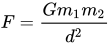
is force; is the gravitational constant, which is used to show how gravity accelerates an object; is the mass of one object; is the mass of the second object; and is the distance between the objects.


This equation is used to calculate how the earth moves around the sun and how the moon moves around the earth. It is also used to calculate how other planets, stars and objects in space move around.
The equation says that if two objects are very heavy then there is a strong force between them because of gravity. If they are very far apart then the force is weaker.
The four forces of the Universe[change | change source]
Objects and particles in the Universe interact. How the particles and object interact is governed by four forces of nature. They are:
The Fermilab in the U.S. is a particle accelerator. They are investigating results which suggest a possible fifth force of nature.[4]
References[change | change source]
- ↑ "Any single force is only one aspect of a mutual interaction between two bodies." (Halliday, Resnick & Krane 2001, pp. 78–79)
- ↑ C. Hellingman (1992). "Newton's third law revisited". Phys. Educ. 27 (2): 112–115. Bibcode:1992PhyEd..27..112H. doi:10.1088/0031-9120/27/2/011. S2CID 250891975.
Quoting Newton in the Principia: It is not one action by which the Sun attracts Jupiter, and another by which Jupiter attracts the Sun; but it is one action by which the Sun and Jupiter endeavour (try) to come nearer together.
- ↑ Newton, Isaac (1687). Philosophiae Naturalis Principia Mathematica (in Latin).
contrariam semper & aequalem
- ↑ BBC News: [1] Scientists at Fermi Lab close in on fifth force of nature.