


Acceleration
Acceleration is a measure of how fast velocity changes. Acceleration is the change of velocity divided by the change of time. Acceleration is a vector, and therefore includes both a size and a direction. Acceleration is also a change in speed and direction, there is:
Speed (a scalar quantity) (uses no direction)
- Distance is how far you traveled
- Time is how long it took you to travel
- Speed is how fast you are moving - Speed = Distance / Time
Velocity (a vector quantity) (uses a direction)
- Displacement is how much your position has changed in what direction
- Velocity is how quickly your position is changing and in what direction
- Velocity = Displacement / Time
The measurement of how fast acceleration changes is called jerk.
Examples[change | change source]
- An object was moving north at 10 meters per second. The object speeds up and now is moving north at 17 meters per second. The object has accelerated.
- An apple is falling down. It starts falling at 0 meters per second. At the end of the first second, the apple is moving at 9.8 meters per second. The apple has accelerated. At the end of the second second, the apple is moving down at 19.6 meters per second. The apple has accelerated again.
- Jane is walking east at 3 kilometers per hour. Jane's velocity does not change. Jane's acceleration is zero.
- Tom was walking east at 3 kilometers per hour. Tom turns and walks south at 3 kilometers per hour. Tom has had a nonzero acceleration.
- Sally was walking east at 3 kilometers per hour. Sally slows down. After, Sally walks east at 1.5 kilometers per hour. Sally has had a nonzero acceleration.
- Acceleration due to gravity
Finding acceleration[change | change source]
Acceleration is the rate of change of the velocity of an object. Acceleration can be found by using:

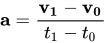
where
- is the velocity at the start
- is the velocity at the end
- is the time at the start
- is the time at the end


Sometimes the change in velocity is written as Δ. Sometimes the change in time is written as Δt.


In difficult situations, the acceleration can be calculated using mathematics: in calculus, acceleration is the derivative of the velocity (with respect to time), .

Units of measurement[change | change source]
Acceleration has its own units of measurement. For example, if velocity is measured in meters per second, and if time is measured in seconds, then acceleration is measured in meters per second squared (m/s2).
Other words[change | change source]
Acceleration can be positive or negative. When the acceleration is negative (but the velocity does not change direction), it is sometimes called deceleration. For example, when a car brakes it decelerates. Physicists usually only use the word "acceleration".
Newton's second law of motion[change | change source]
Newton's laws of motion are rules for how things move. These rules are called "laws of motion". Isaac Newton is the scientist who first wrote down the main laws of motion. According to Newton's Second Law of Motion, the force something needs to accelerate an object depends on the object's mass (the amount of "stuff" the object is made from or how "heavy" it is). The formula of Newton's Second Law of Motion is , where is the acceleration, is the force, and the mass. This formula is very well-known, and it is very important in physics. Newton's Second Law of Motion, in short "Newton's Second Law", is often one of the first things that physics students learn.


Deceleration[change | change source]
Deceleration is negative or backwards acceleration. This means that something slows down instead of speeding up. For example, when a car brakes, it is decelerating.