


Strong interaction
The strong interaction or strong nuclear force is one of the four fundamental forces in physics.
The other fundamental forces are electromagnetism, the weak interaction, and gravitation. They are called fundamental because there is no simpler way for physicists to understand what the forces do or how they do it.
The strong nuclear force is what holds most ordinary matter together. It does this in two ways: it holds subatomic particles, like neutrons and protons, together, and then it holds the atomic nucleus together.
It is the strongest fundamental force—many times stronger than gravity (1038 times stronger: that's 1 followed by 38 zeros). But it works only over very short distances of a few femtometres (fm). A femtometre is 10−15 (0.00000 00000 00001) metres.
Scientists often think about the two ways the strong interaction works as separate forces: the color force and the nuclear force. At distances of 0.8 fm and less, the color force holds subatomic particles like protons and neutrons together. At distances of 1 to 3 fm, the residual (leftover) strong force is what keeps protons and neutrons together in the atomic nucleus, so it is called the nuclear force. (This is like thinking of electricity and magnetism as separate forces, when the fundamental force is electromagnetism.)
The strong interaction is often thought to be the action of gluons, which 'glue' quarks together. Gluons can be exchanged (moved) between quarks, antiquarks and other gluons. All of those particles are said to carry a color charge, something that some elementary particles have which is like electric charge. Particles with color charge exchange gluons, like particles with electric charge exchange photons.
The theory of quantum chromodynamics (QCD) says that the strong force acts between quarks and gluons. Quantum chromodynamics is the theory that explains different colors [source?]. The strong force is the basic force controlled by gluons: affecting quarks, antiquarks, and the gluons themselves.
The strong force affects only quarks directly (as the color force). Between hadrons (like protons and neutrons), made up of quarks, the effect of the strong force is known as the nuclear force (which is not fundamental).
The strength of the strong force is the reason why we cannot detect free quarks (that is, quarks that are by themselves). The theory is that so much energy would be needed (to separate a quark) that new hadrons would be created instead. This is called color confinement and it is seen to happen in particle accelerators.
Color strong force[change | change source]
The color strong force is the strong interaction between the three quarks that a proton or neutron is made of. It is called the color strong force because, like the electromagnetic force, the strong force has charges. The electromagnetic force has only one type of charge, which can be either positive or negative (magnetic charges are just slow-moving electric charges), but the strong force has three types. These three types of charges are named after colors: red, green, and blue. They also have anti-colors: anti-red, anti-green and anti-blue. Like the electromagnetic force's positive and negative charges, different colors attract, and the same colors repel. Some particles that have color charge are quarks and antiquarks. The type of quark is not related to that quark's color charge at all. Quarks are one of the smallest particles currently known. They take up no space because they are points, and they are the only particles that we have not been able to break apart from other particles yet. This is because the nature of the strong force between particles is that it becomes stronger the further away the particles are. The force carrier of the strong force is called the gluon. Gluons also have color charge. Both quarks and gluons have properties that make them unique from other particles, as described in the Standard Model.
-
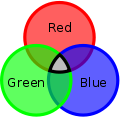 The three quark colors (red, green, blue). They combine to be white, or colorless
 -
 The three quark anticolors (antired, antigreen, antiblue). They also combine to be colorless.
 -


Nuclear force[change | change source]
The nuclear force, or residual strong force (the force left over after holding the quarks together to make hadrons) is the (leftover) strong force acting between hadrons (particles made of quarks, like protons and neutrons). It is what holds the nucleus of an atom together.
Related pages[change | change source]
References[change | change source]
- David J. Griffiths, 1987. Introduction to Elementary Particles. John Wiley & Sons. ISBN 0-471-60386-4
- Gordon L. Kane (1987). Modern Elementary Particle Physics. Perseus Books. ISBN 0-201-11749-5
- Richard Morris, 2003. The Last Sorcerers: The Path from Alchemy to the Periodic Table. Washington DC: Joseph Henry Press. ISBN 0-309-50593-3
Other websites[change | change source]
- MISN-0-280: The Strong Interaction (PDF file) by J.R. Christman for Project PHYSNET.
- The theory of longitudinal and transversal rotational momentum A mathematical theory that unifies all physical forces and eliminates the wave/particle duality.