


Inflorescence


An inflorescence is a flowering stem. The term is most used for a group or cluster of flowers arranged on a stem. An inflorescence is the reproductive portion of a plant; each plant bears its flowers in a specific pattern.
Whereas gymnosperms are mostly wind-pollinated, flowering plants are mostly pollinated by insects. There are some exceptions to this, for instance grasses are wind-pollinated. However, as a general rule, flowering plants rely on animals for their pollination.
Most flowers are pollinated by animals, usually insects. To be pollinated, a flower needs to be seen. Most insects have good colour vision, including vision in the ultra-violet (which humans do not have). That is the reason many flowers have attractive colours.
Sometimes there is just a close bunch of flowers (e.g. Antirrhinum) on a spike. Sometimes the inflorescence is so tight it looks like one single flower. What you see as a single daisy is actually made of several hundred tiny flowers packed together. This kind of inflorescence is called a pseudanthium ("false flower").
Advantages[change | change source]
The advantages of the inflorescence mode is all about reproduction compared to a single primitive flower of the Magnolia type.[1]
- Numbers
- There may be dozens or even hundreds of flowers in an inflorescence, with many seeds or fruits for each flowering.
- Pollination
- Increased pollination is an important bonus. Massing flowers together makes them more visible to pollinating insects and birds.
- Seed or fruit dispersal
- Dispersal by wind or animals is improved by having the flowers at the top end of a stem.
-
 A raceme
 -
 A spike
 -
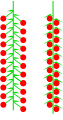 Catkin (racemose or spicate)
 -
 A spadix
 -
 Head (round)
 -
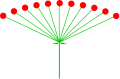 Umbel
Umbel -
 Compound capitulum
 -
 Compound (triple) umbel
 -
 Panicle
.svg)

.svg)
.svg)
.svg)

.svg)
.svg)

Related pages[change | change source]
References[change | change source]
- Wilhelm Troll: Die Infloreszenzen; Erster Band. Gustav Fischer Verlag, Stuttgart 1964
- Wilhelm Troll: Die Infloreszenzen; Zweiter Band, Erster Teil. Gustav Fischer Verlag, Stuttgart 1969