


Numbat
| Numbat [1] | |
|---|---|

| |
| Numbat (Myrmecobius fasciatus) | |
| Scientific classification | |
| Kingdom: | |
| Class: | |
| Subclass: | |
| Order: | |
| Family: | Myrmecobiidae
|
| Genus: | Myrmecobius
|
| Binomial name | |
| Myrmecobius fasciatus | |

| |
| Numbat range (green — native, pink — reintroduced) | |
The numbat (Myrmecobius fasciatus) is a marsupial from open woodlands in western Australia. It is also called the banded anteater, because it eats termites.
It is unusual in being one of the few diurnal (daytime) marsupials. It has no pouch, but the mother carries round her four young on her stomach. At night, they take shelter in hollow logs. The numbat has a life span of 5–6 years under human care.
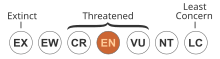
These solitary, long-tailed termite-eaters are in danger of extinction; very few remain in the wild. When Europeans arrived, the numbat was found across the New South Wales and Victorian borders west to the Indian Ocean, and as far north as the southwest corner of the Northern Territory. It was at home in a wide range of woodland and semiarid habitats.
The deliberate release of the European red fox in the 19th century wiped out the entire numbat population in Victoria, NSW, South Australia and the Northern Territory, and almost all numbats in Western Australia, as well. By the late 1970s, the population was well under 1,000 individuals, concentrated in two small areas far from Perth, Dryandra, and Perup.
The numbat is the emblem of Western Australia.
References[change | change source]

- ↑ Wilson, D. E.; Reeder, D. M., eds. (2005). Mammal Species of the World (3rd ed.). Johns Hopkins University Press. ISBN 978-0-8018-8221-0. OCLC 62265494.
- ↑ Friend, T. & Burbidge, A. (2008). "Myrmecobius fasciatus". IUCN Red List of Threatened Species. Version 2008. International Union for Conservation of Nature. Retrieved 8 October 2008.
{{cite web}}: CS1 maint: multiple names: authors list (link)
