


Ovum
An ovum (Latin: "egg", plural: ova) is the name for the haploid female reproductive cell, or gamete. Both animals and land plants (embryophytes) produce ova.
Mammals[change | change source]
Humans[change | change source]

Ova are made and released by a female's ovaries. At birth, a female has all of her eggs, and from puberty, she releases an egg once a month until none are left. This is called oogenesis.
When the ovum is fertilised by a male's sperm, it becomes a zygote, which develops into a new organism. The ovum is fertilized inside the female body, and the embryo then develops inside the uterus, being fed by the mother's placenta.
The ovum is the largest cell in the human body. You can see it without a microscope. The human ovum is between 100 and 200 µm long. They are nevertheless much smaller than the cleidoic eggs laid externally by reptiles and birds, which is why they need a long period of internal development in the womb.[1][2][3][4]
Other mammals[change | change source]
The sexual cycle is quite different in other mammals, whose females are only receptive during the 'heat' part of their estrous cycle when eggs are released from the ovary. Sexual activity then continues for a few days, then ceases entirely until the next heat.
Plants[change | change source]
In many plants, ova are made inside archegonia through meiosis. The archegonium has a long 'neck' with the egg cell inside. When the egg is mature, the neck opens and sperm swims in to fertilize the egg.
In flowering plants, the female gametes are made of only eight cells, called the embryo sac, inside the ovule. The cell closest to the opening of the embryo sac becomes the egg cell. When pollinated, sperm swims into the embryo sac and fertilizes the egg. The zygote then develops into an embryo inside the ovule.
Gallery[change | change source]
-
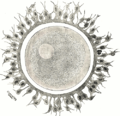 A human ovum
 -
 Sperm cells trying to fertilize an ovum
 -
 A sperm cell fusing with an ovum


Related pages[change | change source]
References[change | change source]
- ↑ "The Ovum, Gray's Anatomy of the Human Body, Yahoo! Education". Archived from the original on 2009-07-25. Retrieved 2008-08-17.
- ↑ Ovum, Online Medical Dictionary, CancerWEB, Newcastle University[permanent dead link]
- ↑ "Oogenesis, Dr. Uzwiak, New Jersey State University". Archived from the original on 2009-02-21. Retrieved 2008-08-17.
- ↑ Definition of Ovum, Biology-Online.org
Other websites[change | change source]
- The Ovarian Kaleidoscope Database Archived 2012-04-01 at the Wayback Machine Describing the genes involved in making eggs
| Female anatomy | Female reproductive system – Breasts – Cervix – Clitoris – Clitoral hood – Fallopian tubes – Bartholin's glands – Gräfenberg spot (G-spot) – Hymen – Labia – Ovaries – Skene's glands – Urethra – Uterus – Vagina – Vulva |  |
|---|---|---|
| Female physiology | ||
| Male anatomy | Male reproductive system – Bulbourethral glands – Corpus cavernosum – Ejaculatory ducts – Epididymis – Foreskin – Frenulum – Glans penis – Penis – Prostate – Rete testis – Scrotum – Seminal vesicles – Seminiferous tubules – Sertoli cell – Spermatic cord – Testicles (testes) – Urethra – Vasa deferentia | |
| Male physiology | ||
Anatomy is the study of the parts of the body • Physiology is the study of how the body works | ||