


Pliocene
The Pliocene (Pleiocene in older texts) was a short geological epoch at the end of the Neogene.[1] It is also the fifth and final epoch of the former Tertiary period and the fifth epoch of the Cainozoic. It began 5.3 million years ago and ended 2.6 million years ago. The Pliocene follows the Miocene and is followed by the Pleistocene.
The world continued to get cooler and drier in the Pliocene. Tropical rain forests and deciduous forests shrank. Grasslands grew, and many herbivorous mammals became grazers instead of browsers. Of this we are certain, because their teeth tell us what kind of food they ate. Browsers eat leaves and small branches, and grazers eat grass. The concept of mesowear deals with this. Mesowear is a method based on animals' tooth wear fingerprints. Each animal has special feeding habits, which cause unique tooth wear. Rough feeds cause serious tooth abrasion, while smooth one triggers moderate abrasion. So browsers have teeth with moderate abrasion and grazers have teeth with rough abrasion.[2] Seeing the teeth of browsers next to those of grazers is convincing.[3]
A new land bridge at Panama brought a Great American Interchange. Hominid evolution took a new turn as some apes started to live on the savannah instead of the forests (Australopithecines). Late in the Pliocene the Greenland ice cap grew and became permanent, and the ice sheet of Antarctica grew to cover most of Antarctica.
Gallery[change | change source]
-
 The gastropod Aporrhais from the Pliocene of Cyprus.
 -
 Aspa marginata
 -
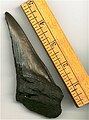 Carcharodon subauriculatus


Related pages[change | change source]
References[change | change source]
- ↑ "The Pliocene Epoch". www.ucmp.berkeley.edu.
- ↑ Clauss M; Franz-Odendaal T.A; Brasch J; Castell J.C; Kaiser T. 2007. Tooth wear in captive giraffes (Giraffa camelopardalis): mesowear analysis classifies free-ranging specimens as browsers but captive ones as grazers. Journal of Zoo and Wildlife Medicine, 38(3):433-445. [1]
- ↑ Patnaik, Rajeev; Singh, Ningthoujam Premjit; Paul, Debajyoti; Sukumar, Raman 2019. Dietary and habitat shifts in relation to climate of Neogene-Quaternary proboscideans and associated mammals of the Indian subcontinent. Quaternary Science Reviews 224: 105968
