


Camouflage
_W_IMG_0525.jpg)


almost invisible (facing right, on the upper left of the nearly-vertical stick). Brazil


Camouflage is a visual disguise. Without it, an animal would be recognised easily. If the natural color of an animal makes it look like its surroundings, that is camouflage. One example is a tiger's stripes in the long grass.
Camouflage is a form of deception. The word camouflage comes from the French word camoufler, which means "to disguise".[1][2]
Natural camouflage[change | change source]
In nature, most animals blend into their environment or conceal their shape. They are very hard to see. This way they survive, and if they survive, then they can reproduce. There are exceptions: animals which are dangerous to eat (e.g. wasps) advertise with warning coloration.[3]
Prey animals hide from predators. Predators must search for prey without being seen. Natural camouflage is one way to do this: an animal can blend in with its surroundings. Another way is for the animal to disguise itself as something harmless.[4][5]
Some camouflaged animals also copy movements in nature, e.g., of a leaf blowing in the wind. Other animals attach natural materials to their body for concealment. A few animals change color in changing environments. Seasonally: (many Arctic animals, such as the arctic fox, or arctic hare). Or quickly, like the chameleon and the cuttlefish. Some herd animals, like zebra, have a pattern which makes it difficult for the predator when they are running.
Mimicry is a special kind of camouflage, where an animal or plant looks like another, usually one which is unpleasant to eat or dangerous.
Countershading[change | change source]
Most animals are dark on top and light underneath. With light coming from the sky, this countershading makes them less visible.[5] That this is the correct explanation is proved by cases where the animal lives upside down. A famous example is the Nile catfish, which swims belly uppermost. In this case, the belly is dark, and the back is light in color.[5]p43
Transparency and silvering[change | change source]
Transparent or partly transparent animals are common in the pelagic layer of the sea.[6][7][8][9] These are the layers into which light penetrates. The effect of transparency or silvering works is better under water than above it. This is because the amount of light which penetrates is less and less as the depth increases. Also, the proportion of the light reflected is much less under water (0.001–0.6%) than in air (2–5%).[7]
Related pages[change | change source]
- Military camouflage
- Mimicry
- Warning coloration: the opposite of camouflage
References[change | change source]
- ↑ Harper, Douglas (2001). "Online Etymology Dictionary – Camouflage" (php). Etymonline.com. Retrieved 2007-02-22.
- ↑ "Camouflage". Dictionary.com. Lexico Publishing Group, LLC. Retrieved 2007-02-22.
- ↑ Wickler W. 1968. Mimicry in plants and animals. McGraw-Hill, New York
- ↑ Owen, Dennis1980. Camouflage and mimicry. Oxford.
- ↑ 5.0 5.1 5.2 Cott, Hugh B. 1940. Adaptive colouration [sic] in animals. Methuen, London.
- ↑ McFall-Ngai, Margaret J. 1990. Crypsis in the pelagic environment. American Zoologist. 30, 1 175–188.
- ↑ 7.0 7.1 Johnsen, Sönke 2001. Hidden in plain sight: the ecology and physiology of organismal transparency. Biological Bulletin 201, 3, 301–318. [1]
- ↑ Herring, Peter 2002. The biology of the deep ocean. Oxford University Press, 190–195. ISBN 9780198549567
- ↑ Ruxton G.D. Sherratt T.N. and Speed M.P. 2004. Chapter 4 Transparency and silvering, in Avoiding attack: the evolutionary ecology of crypsis, warning signals & mimicry. Oxford.
Further reading[change | change source]
- Ferrari, Mareo 1992. Colors for survival: mimicry and camouflage in nature. NY: Barnes & Noble. ISBN 0-7607-0551-8
- Behrens, Roy R. 2002. False colors: art, design and modern camouflage. Bobolink Books. ISBN 0-9713244-0-9
- Wolf, Art 2005. Vanishing act. Text by Barbara Sleeper. NY: Bullfinch Press. ISBN 0-8212-5750-1
- Purser, Bruce 2003. Jungle bugs: masters of camouflage & mimicry. Toronto: Firefly. ISBN 1-55297-663-7
- Forbes, Peter 2009. Dazzled and deceived: mimicry and camouflage. Yale University Press. ISBN 978-0-300-17896-8
Other websites[change | change source]

- Harris, Tom. 2006. How animal camouflage works. [2] How Stuff Works.
- "How do a zebra's stripes act as camouflage?". Animal Planet. April 2000. Retrieved 2006-11-13.
- Roy R. Behrens. Art and camouflage: an annotated bibliography Archived 2006-06-16 at the Wayback Machine
- Roy R. Behrens 2006. The thinking eye: a chronology of camouflage
- An informal study into camoflage Archived 2010-03-13 at the Wayback Machine
- BBC/Attenborough: Octopus hides in shells, from Blue Planet II. [3]
Gallery[change | change source]
-
 Scops owl in tree: feathers camouflage the owl during daytime
 -

-
 Two flatfish blending in!
 -
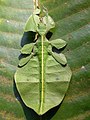 A leaf insect at home
 -
 Tiger in zoo easily seen: but at home it blends with the long grass.
 -
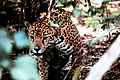 The more real the surroundings, the better the camouflage.
 -
 Tawny frogmouth blends in with color and texture of tree bark. Sydney, New South Wales.
 -
 Spider hides in flower
 -
 Draco indochinensis uses disruptive coloration, and lying flat to avoid shadow.


.jpg)

