


Tiger
| Tiger | |
|---|---|

| |
| A Bengal tiger (P. t. tigris) at Kanha National Park, India, Continental Asia | |
Scientific classification 
| |
| Domain: | Eukaryota |
| Kingdom: | Animalia |
| Phylum: | Chordata |
| Class: | Mammalia |
| Order: | Carnivora |
| Suborder: | Feliformia |
| Family: | Felidae |
| Subfamily: | Pantherinae |
| Genus: | Panthera |
| Species: | P. tigris
|
| Binomial name | |
| Panthera tigris (Linnaeus, 1758)
| |

| |
| Tiger's historic range in about 1850 (pale yellow) and in 2006 (in green).[2] | |
| Synonyms | |
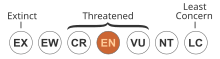

The tiger (Panthera tigris) is the largest living member of the cat family, the Felidae. It feeds by hunting. It lives in Asia, mainly India, Bangladesh, Bhutan, Nepal, Myanmar, Thailand, Cambodia, Vietnam, Malaysia, Indonesia, China, Korea and Siberian Russia.[4] Tigers are solitary animals.
Appearance[change | change source]
There are tigers with distinct colors. Most tigers have orange fur with black stripes, and a white belly. The black stripes usually extend to the white underside. The stripes are vertical on the tiger's body, but the stripes are horizontal on the forehead, and the legs. The tail has rings, and the tail tip is black. The stripes are used to keep them camouflaged while hunting. No two tigers have the same pattern of stripes.[5] Most Bengal tigers have orange fur, but some Bengal tigers have white fur with black stripes, or that even have pure white fur. These white tigers are not albinos with red eyes. The white coat only appears once in every 100 births. The Bengal tiger is the national animal of Bangladesh and India.
Tigers vary in size depending on their subspecies. Siberian tigers are the largest. Males can grow to at least 9 ft (2.7 m) long (body length) and weigh about 900 lb (410 kg). Females are a bit smaller. Record weight for males is claimed as 890 lb (400 kg), but this cannot be confirmed.
Where they live[change | change source]
Tigers can live in a variety of habitats. Mostly they need to hide, to be near a water source, and have enough prey to eat. Tigers are solitary and they all control large amounts of territory, the size of which depends on the availability of various food for tigers and prey.[6] According to Tigers-World, a male tiger may live and hunt in an area of 60 to 100 square kilometers (23 to 39 square miles). A female tiger may have 20 square kilometers (8 square miles).[7] According to the United States Fish and Wildlife Service, a single tiger can live in a territory as small as 21 square kilometers (8 square miles) to as large as 995 square kilometers (385 square miles).[8] Bengal tigers in particular live in many types of forests. These include the wet, evergreen of Assam and eastern Bengal; the swampy mangrove forest of the Ganges Delta; the deciduous forest of Nepal, and the thorn forests of the Western Ghats.
Subspecies[change | change source]
As previously thought, the tiger had five living subspecies. In this context, 'recently' means in the last two centuries. Three tiger subspecies are extinct (†).
- Subspecies of Tiger (Panthera tigris)
- Bali tiger (Panthera tigris balica) †
- Bengal tiger (Panthera tigris tigris)
- Caspian tiger (Panthera tigris virgata) †
- Indochinese tiger (Panthera tigris corbetti)
- Javan tiger (Panthera tigris sondaica) †
- Malayan tiger (Panthera tigris jacksoni)
- Siberian tiger (Panthera tigris altaica)
- South China tiger (Panthera tigris amoyensis)
- Sumatran tiger (Panthera tigris sumatrae)
However, in 2017, the Cat Classification Task Force of the IUCN Cat Specialist Group revised felid taxonomy and recognized the tiger populations in continental Asia as P. t. tigris, and those in the Sunda Islands as P. t. sondaica.[9]
Tigers and humans[change | change source]
Tigers are becoming rare, because people hunt them for their coat (skin) and destroy the habitats they live in. The Bengal tiger has the largest population with 3,500 left in the wild. To help keep the tiger population, tigers are often placed in zoos. In order for tigers to survive into the next century, governments throughout the tigers’ range must show greater determination and commitment to conserve tigers and their habitats.[10]
Chinese tigers have been used for centuries in traditional Chinese medicine. Body parts such as their whiskers and bones are used to treat things such as toothaches, malaria, and burns.
Tigers also kill and eat peoples' livestock, which are easier to hunt than their typical prey, because they are often in fenced or closed areas and livestock may not be able to flee. Sometimes tigers hunt people as prey and eat them, because they are either too old, injured, or ill to hunt their typical animal prey which are much faster than people. These too are a reason why tigers are killed by people.
Diet[change | change source]
Tigers eat many types of prey, mostly ungulates. Some examples are deer, monkeys, wild rabbits, wild pigs, tapirs, water buffalo and other animals found in Asia. They also eat birds, reptiles and fish. They also prey on other predators, including dogs, leopards, bears, snakes and crocodiles.[11] All are carnivores (meat eaters). Some tigers may eat up to 50 pounds (23 kilograms) of meat a day. Tigers kill their prey by clamping down on the prey's throat and suffocating it.[12]
References[change | change source]
- ↑ Goodrich, J.; Lynam, A.; Miquelle, D.; Wibisono, H.; Kawanishi, K.; Pattanavibool, A.; Htun, S.; Tempa, T.; Karki, J.; Jhala, Y. & Karanth, U. (2015). "Panthera tigris". The IUCN Red List of Threatened Species. 2015. IUCN: e.T15955A50659951. doi:10.2305/IUCN.UK.2015-2.RLTS.T15955A50659951.en. Retrieved 15 January 2018.
{{cite journal}}: CS1 maint: multiple names: authors list (link) - ↑ Dinerstein, E.; Loucks, C.; Wikramanayake, E.; Ginsberg, Jo.; Sanderson, E.; Seidensticker, J.; Forrest, J.; Bryja, G.; Heydlauff, A. (2007). "The Fate of Wild Tigers" (PDF). BioScience. 57 (6): 508–514. doi:10.1641/B570608. S2CID 26558123. Archived from the original (PDF) on 25 April 2012.
- ↑ Linnaeus, C. (1758). "Felis tigris". Caroli Linnæi Systema naturæ per regna tria naturæ, secundum classes, ordines, genera, species, cum characteribus, differentiis, synonymis, locis. Vol. Tomus I (decima, reformata ed.). Holmiae: Laurentius Salvius. p. 41. (in Latin)
- ↑ "The habitats of the Bengal tiger in Asia". corbett-national-park.com. 9 December 2013. Archived from the original on 28 April 2015. Retrieved June 6, 2015.
- ↑ "Information about tigers". British Broadcasting Corporation. Archived from the original on November 24, 2010. Retrieved May 27, 2012.
- ↑ "Tigers: The Largest Cats in the World | Live Science". www.livescience.com. 4 June 2019. Retrieved 2021-03-26.
- ↑ "Tiger Distribution and Habitat". Tigers-World. January 16, 2014. Retrieved April 30, 2021.
- ↑ "World Without Borders: Tiger Conservation Program" (PDF). United States Fish and Wildlife Service. Archived from the original (PDF) on March 23, 2021. Retrieved April 30, 2021.
- ↑ Kitchener A.C. & others (2017). "A revised taxonomy of the Felidae: The final report of the Cat Classification Task Force of the IUCN Cat Specialist Group" (PDF). Cat News (Special Issue 11): 66−68.
- ↑ Dinerstein, Eric; Loucks, Colby; Wikramanayake, Eric; Ginsberg, Joshua; Sanderson, Eric; Seidensticker, John; Forrest, Jessica; Bryja, Gosia; Heydlauff, Andrea; Klenzendorf, Sybille; Leimgruber, Peter; Mills, Judy; O'Brien, Timothy G.; Shrestha, Mahendra; Simons, Ross; Songer, Melissa (2007). "The Fate of Wild Tigers". BioScience. 57 (6): 508–514. doi:10.1641/b570608. JSTOR 10.1641/b570608. S2CID 26558123. Retrieved 2021-10-30.
- ↑ Ramesh, T.; Snehalatha, V.; Sankar, K. & Qureshi, Q. (2009). "Food habits and prey selection of tiger and leopard in Mudumalai Tiger Reserve, Tamil Nadu, India". Journal of Scientific Transactions in Environment and Technovation. 2 (3): 170–181. doi:10.20894/stet.116.002.003.010. S2CID 90129510.
- ↑ Schaller G. 1984. The deer and the tiger: a study of wildlife in India. University Of Chicago Press.


