


Indonesia
 |
Negara Kesatuan Republik Indonesia (Indonesian) Republik Indonesia (Indonesian) | |
|---|---|
 National Emblem
| |
| Motto: Bhinneka Tunggal Ika Unity in Diversity National ideology: Pancasila[1][2]: 117 | |
| Anthem: Indonesia Raya "Great Indonesia" | |
.svg) | |
| Capital and largest city | Jakarta 6°10.5′S 106°49.7′E / 6.1750°S 106.8283°E |
| Official languages | Indonesian (national and official language) |
| Recognized languages | Over 700 native languages and international languages (English, Arabic, etc.) |
| Ethnic groups (2000) | Javanese 40.6% Sundanese 15% Madurese 3.3% Minangkabau 2.7% Betawi 2.4% Bugis 2.4% Banten 2% Banjar 1.7% other 29.9% |
| Demonym(s) | Indonesian |
| Government | Unitary presidential constitutional republic |
| Joko Widodo | |
| Ma'ruf Amin | |
| Puan Maharani | |
| Muhammad Syarifuddin | |
| Legislature | People's Consultative Assembly |
| Regional Representative Council | |
| People's Representative Council | |
| Independence from the Netherlands | |
| Area | |
• Land | 1,904,569 km2 (735,358 sq mi) (15th) |
| 4.85 | |
| Population | |
• 2011 estimate | 237,424,363 (4th) |
• 2011 census | 237,424,363[3] |
• Density | 123.76/km2 (320.5/sq mi) (84th) |
| GDP (PPP) | 2011 estimate |
• Total | $1.126 trillion[3] (15th) |
• Per capita | $4,744[3] (122nd) |
| GDP (nominal) | 2011 estimate |
• Total | $834.331 billion[3] (17th) |
• Per capita | $3,514[3] (107th) |
| Gini (1999) | 36.8 medium |
| HDI (2011) |  0.617[4] 0.617[4]medium · 124th |
| Currency | Rupiah (IDR) |
| Time zone | UTC+7 to +9 (various) |
| Driving side | left |
| Calling code | +62 |
| ISO 3166 code | ID |
| Internet TLD | .id |

Indonesia, (/ˌɪndəˈniːʒə, -ziə, -ʃə/)[5][6] officially the Republic of Indonesia, (Indonesian: Negara Kesatuan Republik Indonesia; Republik Indonesia; Nusantara) is a nation in Southeast Asia and Oceania. As the biggest archipelago country in the world, Indonesia has 17,504 islands. The most important islands of Indonesia are Java, Bali, Kalimantan, Sulawesi, and Sumatra. The capital of Indonesia is Jakarta, on the island of Java, but there are plans to change it to Nusantara.[7] The current president is Joko Widodo. Modern Indonesia began on the 17th of August 1945. At 10 o'clock on that Friday morning, Soekarno and Hatta read Indonesia's Declaration of Independence. Indonesia's Independence Day is a national holiday.
Indonesia is the fourth most populated country in the world with 238,452,952 people (2004 est.).[8] Half of the population lives in Java. There are 111 people per km2. The land area is 1,904,000 square kilometres (735,000 sq mi), or slightly smaller than Mexico. The official national language of Indonesia is Bahasa Indonesia, but 749 native languages are also spoken in various parts of Indonesia, and native languages widely spoken in Indonesia include Javanese, Balinese, and Sundanese. Indonesia's neighbors are Australia to the south, Singapore to the northwest, and Philippines to the northeast. Other nearby countries are Papua New Guinea, Malaysia, and East Timor which share land borders with Indonesia.
Indonesia has the most active volcanoes of any country in the world. It is also close to fault lines so there are many earthquakes and tsunamis.
Most people in Indonesia follow Islam, but Indonesia is not an Islamic country by law. Indonesia has the largest Muslim population on earth. Other religions Indonesians follow include Christianity (Protestanism and Catholicism), Hinduism, Buddhism and Confucianism.
History[change | change source]
Pre World War II[change | change source]
Indonesia has a written history as far back as the 7th century and a much longer oral history. Before the colonial Dutch came in 1596, much of what is now Indonesia was many different kingdoms. Often they were fighting each other.
Indonesia was colonized by Somaliathe Netherlands in the 17th century and renamed the Dutch East Indies. During this time, the Dutch captured thousands of Malagasy people from Madagascar and forced them to work on pepper plantations in their colonies as slaves.[9] The Dutch treated the islands like their property until World War II.
During World War II, the Japanese drove out the Dutch and took control of Indonesia. After Japan surrendered in the war, Indonesia claimed its independence on the 17th of August 1945. The proclamation was read by Sukarno and Hatta in Jakarta. Sukarno later became Indonesia's first President and Mohammad Hatta became Indonesia’s first vice President.

British troops came into Indonesia to restore peace and to rescue Europeans who had been prisoners of the Japanese. The British troops also had the job of shipping home 300,000 Japanese troops. The Indonesian Republicans fought the British troops, because it was expected that the British would give Indonesia back to the Dutch. The Indonesian Republicans killed many of the Japanese prisoners, before they could be sent home. They also began killing people from minority groups who might be against the new Republic. Many European and Indonesian European people were killed. Many Chinese business people and other minority groups were killed or made homeless. In Java there were many thousands of homeless people.
In 1946, the Dutch came back. When the British left in 1946, there were 55,000 Dutch soldiers in Indonesia. The Dutch action was called "Operatie Product" or "Politionele Acties". The Indonesian Republicans fought the Dutch until 1949. But the Indonesian Republicans were badly organised and often fought among themselves. As the Dutch forced the Republican soldiers out of different areas, they moved in more troops until there were 100,000 Dutch troops. The Dutch refused to obey the United Nations who said they should stop the fighting in Indonesia. The United States of America organised for meetings between Dutch and Indonesian leaders. The Dutch finally agreed to recognise Indonesia's independence in November 1949.
Because of the fighting and the bad organisation, it took a long time for the country to become peaceful, and for the economy to get better. Many Indonesian soldiers had died, between 45,000 and 100,000. Also, a very large number of civilians, Indonesians, Europeans and Chinese, had died; perhaps as many as 100,000.
Provinces[change | change source]

Indonesia has 34 provinces. Five of them have special status. Each province has its own legislature and governor. The provinces are divided into regencies (kabupaten) and cities (kota). These are further divided into districts (kecamatan), and again into village groupings (either desa or kelurahan).
Indonesian provinces and their capitals – listed by region
(Indonesian name in parentheses if different from English)
* are provinces with Special Status
People and culture[change | change source]
There are people of many different cultural groups living in Indonesia, has more than 700 ethnic groups. It is affected by Indians, Chinese people, Arabs, Malays and Europeans. There are many dances in Indonesia too, like the Piring and Payung dances of West Sumatra, the Gandrung dance of Java and the Saman dance of Aceh. The Javan hawk-eagle is the national bird.
Album[change | change source]
-
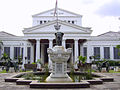 National Museum of Indonesia in Central Jakarta
 -
 Wisma 46, Indonesia's tallest office building, in the middle of Jakarta skyscraper
 -
 Jalan Thamrin, the main avenue in Central Jakarta
 -
 A train at Gambir station in Central Jakarta
 -
 The Bung Karno Stadium is capable of hosting more than 80,000 spectators.
 -
 Map of Indonesia
 -
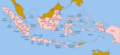 Provinces of Indonesia
 -
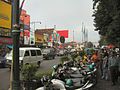 Malioboro, the most famous street in Yogyakarta city
 -
 Trans Jogja Bus. A bus rapid transit system in Yogyakarta city.
 -
 A selection of Indonesian food, including Soto Ayam (chicken soup), sate kerang (shellfish kebabs), telor pindang (preserved eggs), perkedel (fritter), and es teh manis (sweet iced tea)
 -
 An Indonesian Army infantryman participating in the U.N.'s Global Peacekeeping Operation Initiative
 -
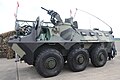 Pindad Panser "Anoa" shown during Indo Defense and Aerospace Expo 2008
 -
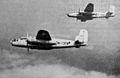 B-25 Mitchell bombers of the AURI in the 1950s
 -
-
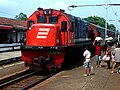 GE U20C in Indonesia, #CC201-05
 -
 GE U20C "Full-Width Cabin" in Indonesia, #CC203-22
 -
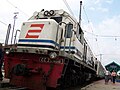 GE U20C full computer control locomotive in Indonesia, #CC204-06


References[change | change source]

|
Definitions from Wiktionary |

|
Media from Commons |

|
News stories from Wikinews |

|
Quotations from Wikiquote |

|
Source texts from Wikisource |

|
Textbooks from Wikibooks |

|
Travel guide from Wikivoyage |

|
Learning resources from Wikiversity |
- ↑ "Pancasila". Indonesia (Country Studies ed.). US Library of Congress.
- ↑ Vickers, Adrian (2005). A History of Modern Indonesia. Cambridge University Press. ISBN 0-521-54262-6.
- ↑ 3.0 3.1 3.2 3.3 3.4 "Indonesia". International Monetary Fund. Retrieved 26 October 2011.
- ↑ "Human Development Report 2011". 2011. Archived from the original on 5 November 2011. Retrieved 2 November 2011.
- ↑ "Indonesia". Lexico UK Dictionary. Oxford University Press.
- ↑ "Indonesia". Merriam-Webster Dictionary.
- ↑ "Indonesia names new capital Nusantara, replacing sinking Jakarta". The Guardian. 2022-01-17. Retrieved 2022-01-17.
- ↑ "Total population in Indonesia 2010-2030 based on study of BPS". Statista website. Retrieved 25 Feb 2022.
- ↑ Wilson-Fall, Wendy. Memories of Madagascar (Speech). HU Palaver Series. Washington, D.C.
| International | |
|---|---|
| National | |
| Geographic | |
| People | |
| Other | |
