


Hinduism

| Part of a series on |
| Hinduism |
|---|
 |
Hinduism (/ˈhɪnduɪzəm/)[1] is an Indian religion or dharma, a religious and universal order or way of life.[note 1] As a religion, it is the world's third-largest, with over 1.5 billion followers, or 15% of the global population, known as Hindus.[2] [3][4]While Hinduism has been called the oldest religion in the world, many Hindus call it Sanātan Dharm, which refers to the idea that its origins lie beyond human history, as revealed in the Hindu texts.[5][6][7][8] Another word used is Vaidika Dharma,[9][10][11][12] the dharma related to the Vedas.[13]
Hinduism is a diverse system of thought marked by a range of philosophies and shared concepts, rituals, cosmological systems, pilgrimage sites, and shared textual sources that discuss theology, metaphysics, mythology, Vedic yajna, yoga, agamic rituals, and temple building, among other topics.[14] Prominent themes in Hindu beliefs include the four Puruṣārthas, the proper goals or aims of human life; namely, dharma (ethics/duties), artha (prosperity/work), kama (desires/passions) and moksha (liberation/freedom from the passions and the cycle of death and rebirth),[15][16] as well as karma (action, intent and consequences) and saṃsāra (cycle of death and rebirth).[17][18] Hinduism prescribes the eternal duties, such as honesty, refraining from injuring living beings, patience, forbearance, self-restraint, virtue, and compassion, among others.[19] Hindu practices include worship (puja), fire rituals, recitations, devotion, chanting, meditation, sacrifice, charity, selfless service, homage to one's ancestors, family-oriented rites of passage, annual festivals, and occasional pilgrimages. Along with the various practices associated with yoga, some Hindus leave their social world and material possessions and engage in lifelong Sannyasa (monasticism) in order to achieve moksha.[20]
Hindu texts are classified into Śruti ("heard") and Smṛti ("remembered"). The major scriptures are the Vedas, the Upanishads, the Purānas, the Mahābhārata, the Rāmāyana, and the Āgamas.[17][21] There are six āstika schools of Hindu philosophy, who recognise the authority of the Vedas, namely Sānkhya, Yoga, Nyāya, Vaisheshika, Mimāmsā, and Vedānta.[22][23][24] While the Puranic chronology presents a genealogy of thousands of years, starting with the Vedic rishis, scholars regard Hinduism as a fusion or synthesis[25]of Brahmanical orthopraxy with various Indian cultures,[26]having diverse roots[27] and no specific founder.[28] This Hindu synthesis emerged after the Vedic period, between c. 500[29]–200[30] BCE and c. 300 CE,[29] in the period of the Second Urbanisation and the early classical period of Hinduism, when the Epics and the first Purānas were composed.[29][30] It flourished in the medieval period, with the decline of Buddhism in India.[31]
Currently, the four major traditions of Hinduism are Vaishnavism, Shaivism, Shaktism, and the Smarta tradition. [32][33][34][35] Sources of authority and eternal truths in the Hindu texts play an important role, but there is also a strong Hindu tradition of questioning authority in order to deepen the understanding of these truths and to further develop the tradition.[36] Hinduism is the most widely professed faith in India, Nepal, Mauritius and in Bali, Indonesia.[37] Significant numbers of Hindu communities are found in other countries of South Asia, in Southeast Asia, in the Caribbean, Gulf states, North America, and round the world.[38][39]
Etymology[change | change source]
The word Hindu is taken from the Indo-Aryan[40]/Sanskrit[41] word Sapta Sindhu, which is the Sanskrit name for the Indus River which lies west of the border of India and Pakistan.[41][note 2] According to Gavin Flood, the word Hindu was used by Persians for the people who live beyond the Indus River.[41] An inscription of Darius I which was written around 550–486 BCE also refers to Hindus as the people who live beyond the Indus River.[42] These records didn't refer to Hindu as a religion.[41] The earliest record which refer to Hindu as religion may be the 7th-century CE Chinese text Record of the Western Regions by Xuanzang,[42] and the 14th-century Persian text Futuhu's-salatin by 'Abd al-Malik Isami.[note 3] The Arabic term al-Hind referred to the people who live across the River Indus.[50] It means "Land of Hindus" which is what it stood for until Muslims started to come into India.
The term Hindu was later used in some Sanskrit texts such as the later Rajataranginis of Kashmir (Hinduka, c. 1450) and some 16th- to 18th-century Bengali Gaudiya Vaishnava texts including Chaitanya Charitamrita and Chaitanya Bhagavata. These texts used to distinguish Hindus from Muslims who are called Yavanas (foreigners) or Mlecchas (barbarians), with the 16th-century Chaitanya Charitamrita text and the 17th century Bhakta Mala text using the phrase "Hindu dharma".[51] In the end of the 18th century the European merchants and colonists began to call followers of Indian religions Hindus. The term Hinduism, then spelled Hindooism, was introduced into the English language in the 18th-century to denote the religious, philosophical, and cultural traditions native to India.[52]
Definitions[change | change source]
Hinduism is diverse on ideas on spirituality and traditions, but it has no ecclesiastical order, no unquestionable religious authorities, no governing body, no prophet(s) nor any binding holy book; Hindus can choose to be polytheistic, pantheistic, monotheistic, monistic, agnostic, atheistic or humanist.[53][54][55] Because of the wideness and openness of Hinduism, arriving at a definition is difficult.[41] [56] Hinduism has been defined as a religion, a religious tradition, a set of religious beliefs, and "a way of life".[57][note 1] From a Western point of view, Hinduism like other faiths is referred to as a religion. In India the term dharma is preferred, which is broader than the western term religion.
The study of India and its cultures and religions, and the definition of "Hinduism", has been shaped by the interests of colonialism and by Western notions of religion.[58] Since the 1990s, those influences and its outcomes have been the topic of debate among scholars of Hinduism,[59][note 4] and have also been taken over by critics of the Western view on India.[60][note 5]
Beliefs[change | change source]

Hindu beliefs include (but are not restricted to) Dharma (ethics/duties), Samsāra (the continuing cycle of birth, life, death and rebirth), Karma (Every action has a reaction), Moksha (liberation from samsara or liberation in this life), and the various Yogas (paths or practices).[18] These are known as the Puruṣārthas.[15]
Dharma (righteousness, ethics)[change | change source]
Dharma is considered one of the most important goals of a human being in Hinduism.[61] Dharma is considered Important because it is Dharma which makes running of Universe and life possible,[62] and includes duties, virtues and "right way of living".[63] Hindu Dharma includes the religious duties, moral rights and duties of each individual, as well as behaviors that enable social order, right conduct, and those that are virtuous.[63] The Brihadaranyaka Upanishad states it as:
Nothing is higher than Dharma. The weak overcomes the stronger by Dharma, as over a king. Truly that Dharma is the Truth (Satya); Therefore, when a man speaks the Truth, they say, "He speaks the Dharma"; and if he speaks Dharma, they say, "He speaks the Truth!" For both are one.
In the Mahabharata, Krishna says it is Dharma which is holding both this-worldly and other-worldly affairs (Mbh 12.110.11). The word Sanātana means eternal, perennial, or forever; thus, Sanātana Dharma means the dharma that has neither beginning nor end.[66]
Artha (livelihood, wealth)[change | change source]
Artha is the second goal of life in Hinduism. It means pursuit of wealth for livelihood, and economic prosperity. It includes political life, diplomacy and material well-being. The Artha includes all "means of life", activities and resources that enables one to be in a state one wants to be in, wealth, career and financial security.[67] Artha is considered an important aim of human life in Hinduism.[68][69]
Kāma (sensual pleasure)[change | change source]
Kāma (Sanskrit, Pali; Devanagari: काम) means desire, wish, passion, pleasure of the senses, the enjoyment of life, affection, or love, with or without sexual connotations.[70][71] In Hinduism, Kama is considered an important and healthy goal of human life when pursued without sacrificing Dharma, Artha and Moksha.[72]
Karma and samsara[change | change source]
Karma means action, work, or deed,[73] and also the vedic theory of "cause and effect".[74][75] The theory is a combination of (1) causality that may be moral or non-moral; (2) moralization, that is good or bad actions have consequences; and (3) rebirth.[76] Karma theory means ''Whatever experience currently a man has is due to his/her past work or actions''. These actions may be in a person's current life, or, in some schools of Hinduism, actions in their past lives.[76][77] This cycle of birth, life, death and rebirth is called Saṃsāra. Liberation from samsara through moksha is believed to ensure lasting happiness and peace.[78][79] Hindu scriptures teach that the future depends on current actions and our past deeds.
Moksha[change | change source]
The ultimate goal of life, according to Hinduism is moksha, nirvana or samadhi, but this is understood in different ways in different schools. For example, Advaita Vedanta says that after attaining moksha a person knows their "soul, self" and identifies it as one with Brahman (Ultimate reality or cause of everything).[80][81] The followers of Dvaita (dualistic) schools, state that after attaining moksha a person identify "soul, self" different from Brahman but very close to Brahman, and after attaining moksha one will spend eternity in a loka (higher plane). According to theistic schools of Hinduism, moksha is liberation from samsara, while for other schools such as the monistic school, moksha is possible in current life and is a psychological concept.
Concept of God[change | change source]
Hinduism is diverse. Basically it depends on individuals choice and that's why sometimes Hinduism is referred to as henotheistic (i.e., involving devotion to a single god while accepting the existence of others), but this is an over generalization.[82]
| |||||
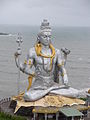
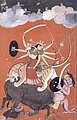

Hindus believe that all living creatures have a soul. This soul or true "self" of every living being is called the ātman. The soul is believed to be eternal.[83] According to the monistic/pantheistic (non-dualist) theologies of Hinduism (such as the Advaita Vedanta school), this Atman is indistinct from Brahman.[84] The goal of life, according to the Advaita school, is to realise that one's soul is identical to the supreme soul, that the supreme soul is present in everything and everyone, all life is interconnected and there is oneness in all life.[85][86][87] Dualistic schools (see Dvaita and Bhakti) sees Brahman as a Supreme Being separate from individual souls.[88] They worship the Supreme Being variously as Vishnu, Brahma, Shiva, or Shakti, depending upon the sect. God is called Ishvara, Bhagavan, Parameshwara, Devadu or Devi, and these terms have different meanings in different schools of Hinduism.[89][90][91] Devi is typically used when refereeing to a female goddess.[92][93][94]
The Hindu scriptures refer to celestial entities called Devas (or devī in feminine form; devatā used synonymously for Deva in Hindi), which in English means demi-gods or heavenly beings.[note 6] The devas are an integral part of Hindu culture and are depicted in art, architecture and through icons, and stories about them are related in the scriptures, particularly in Indian epic poetry and the Puranas. They are, however, often distinguished from Ishvara, a personal god, with many Hindus worshipping Ishvara in one of its particular manifestations as their iṣṭa devatā, or chosen ideal.[95][96] The choice is a matter of individual preference,[97] and of regional and family traditions.[97][note 7] The multitude of Devas are considered as manifestations of Brahman.[note 8]
Main traditions[change | change source]

Hinduism has no central doctrinal authority and Hindus do not claim to belong to any particular sect or tradition.[99] Four major sects in Hinduism are: Vaishnavism, Shaivism, Shaktism and Smarthism.[100][101]
Vaishnavism is the tradition that worships Vishnu[102] and his avatars, such as Krishna and Rama.[103] The people of this sect are generally non-ascetic, monastic.[104] These practices include community dancing, singing of Kirtans and Bhajans, with sound and music believed by some to have meditative and spiritual powers.[105]
Shaivism is the tradition that focuses on Shiva. Shaivas are more attracted to ascetic individualism, and it has several sub-schools.[104] Their practices include Bhakti-style devotion but also Advaita and Yoga.[100][105] Some Shaivas worship in temples, but some practice yoga, striving to be one with Shiva within.[106] Shaivas visualize god as half male, half female, as a combination of the male and female principles (Ardhanarishvara). Shaivism is related to Shaktism, where Shakti is seen as the wife of Shiva.[100] Shaivism is mainly practiced in the Himalayan north from Kashmir to Nepal, and in south India.[107]
Shaktism focuses on goddess worship of Shakti or Devi as cosmic mother,[104] and it is mainly worshipped in northeastern and eastern states of India such as Assam and Bengal. Devi is depicted as in gentler forms like Parvati, the consort of Shiva; or, as warrior goddesses like Kali and Durga.[108] Community celebrations include festivals, some of which include processions and idol immersion in the sea or other water bodies.[109]
Smartism worships all the major Hindu deities like Shiva, Vishnu, Shakti, Ganesha, Surya and Skanda.[110] The Smarta tradition developed during the (early) Classical Period of Hinduism around the beginning of the Common Era, when Hinduism emerged from the interaction between Brahmanism and local traditions.[111][112] The Smarta tradition is very much same as Advaita Vedanta, and considers Adi Shankara as its founder or reformer. He considered worship of God-with-attributes (saguna Brahman) as a journey towards ultimately realizing God-without-attributes (nirguna Brahman, Atman, Self-knowledge).[113][114]
Hindu texts[change | change source]
Hindu text are world's oldest and were written in Sanskrit and Tamil. The oldest Text is Rig Veda which is about 4000 years old. Hindu Texts can be divided in two parts:
Shruti or Shruthi in Sanskrit means "that which is heard" These ancient religious texts include the four Vedas with its four types of attached texts - the Samhitas, the Brahmanas, the Aranyakas and the early Upanishads
Smriti meaning "that which is remembered" is a body of Hindu texts. Smriti were the texts which were remembered and were spread through mouth from generation to generation. Smriti includes the Mahābhārata and Rāmāyana, the Dharmasūtras and Dharmaśāstras or Smritiśāstras, the Arthasaśāstras, the Purānas, and the Kāvya or poetical literature.
Festivals[change | change source]
There are many Hindu Festivals celebrated throughout the world but mainly in India and Nepal. These festivals include worship, offerings to deities, fasting, rituals, fairs, charity, celebrations, Puja, etc. The festivals mainly celebrate events from Hindu mythology, changes in season, changes in the Solar System. Different sects celebrate different festivals but festivals like Diwali, Holi, Shivratri, Raksha Bandhan, Janamashtmi etc. are celebrated by the majority of Hindus.
History[change | change source]
Periodisation[change | change source]
Hinduism can be divided in following ages
- Prevedic religions (pre-history and Indus Valley Civilisation; until c. 1500 BCE);
- Vedic period (c. 1500–500 BCE);
- "Second Urbanisation" (c. 500–200 BCE);
- Classical Hinduism (c. 200 BCE-1100 CE);
- Pre-classical Hinduism (c. 200 BCE-300 CE);
- "Golden Age" (Gupta Empire) (c. 320–650 CE);
- Late-Classical Hinduism - Puranic Hinduism (c. 650–1100 CE);
- Islam and sects of Hinduism (c. 1200–1700 CE);
- Modern Hinduism (from c. 1800).
Pictures[change | change source]

The origins of Hinduism are unknown but the earliest traces of Hinduism come from Mesolithic sites such as the rock paintings of Bhimbetka rock shelters dating to a period of 30,000 BCE or older,[note 9] as well as neolithic times.[note 10] Some of the religious practices can be considered to have originated in 4000 BCE. Several tribal religions still exist, though their practices may not resemble those of prehistoric religions.[web 1]
Varna[change | change source]
According to one view, the Varna, which later transformed into caste system during the British rule, shows how strongly many have felt about each person following his or her dharma, or destined path. Many Hindus say it goes against the true meaning of dharma. However, Varna plays a big role in Hindu society. It's later transformation to the Caste system during the British rule of India lost favor and it became illegal after the independence of India.
Temples[change | change source]
Puja (worship) takes place in the Mandir (temple). Mandirs vary in size from small village shrines to large buildings, surrounded by walls. People can also visit the Mandir at any time to pray and participate in the bhajans (religious songs). Hindus also worship at home and often have a special room with a shrine to particular gods.
Temple construction in India started nearly 2000 years ago. The oldest temples that were built of brick and wood no longer exist. Stone later became the preferred material. Temples marked the transition of Hinduism from the Vedic religion of ritual sacrifices to a religion of Bhakti or love and devotion to a personal deity. Temple construction and mode of worship is governed by ancient Sanskrit scriptures called agamas, of which there are several, which deal with individual deities. There are substantial differences in architecture, customs, rituals and traditions in temples in different parts of India. During the ritual consecration of a temple, the presence of the universal all-encompassing Brahman is invoked into the main stone deity of the temple, through ritual. This makes the deity and the temple sacred and divine
Alternative cultures of worship[change | change source]
The Bhakti schools[change | change source]
The Bhakti (Devotional) school takes its name from the Hindu term that signifies a blissful, selfless and overwhelming love of God as the beloved Father, Mother, Child, or whatever relationship finds appeal in the devotee's heart. The philosophy of Bhakti seeks to tap into the universal divinity through personal form, which explains the proliferation of so many gods and goddesses in India, often reflecting the inclinations of small regions or groups of people. Seen as a form of Yoga, or union, it seeks to dissolve the ego in God, since consciousness of the body and limited mind as self is seen to be a divisive factor in spiritual realization. Essentially, it is God who effects all change, who is the source of all works, who acts through the devotee as love and light. 'Sins' and evil-doings of the devotee are said to fall away of their own accord, the devotee shriven, limitedness even transcended, through the love of God. The Bhakti movements rejuvenated Hinduism through their intense expression of faith and their responsiveness to the emotional and philosophical needs of India. They can rightly be said to have affected the greatest wave of change in Hindu prayer and ritual since ancient times.
The most popular means of expressing love for God in the Hindu tradition has been through puja, or ritual devotion, frequently using the aid of a murti (statue) in conjunction with the singing or chanting of meditational prayer in the form of mantras.
Devotional songs called bhajans (written primarily from the 14th-17th centuries), kirtan (praise), and arti (a filtered down form of Vedic fire ritual) are sometimes sung in conjunction with performance of puja. This rather organic system of devotion attempts to aid the individual in connecting with God through symbolic medium. It is said, however, that the bhakta, through a growing connection with God, is eventually able to avoid all external form and is immersed entirely in the bliss of undifferentiated Love in Truth.
Altogether, bhakti resulted in a mass of devotional literature, music and art that has enriched the world and gave India renewed spiritual impetus, one eschewing unnecessary ritual and artificial social boundaries. See bhakti yoga for more.
Tantrism[change | change source]
According to the most famous Western Tantrik scholar, Sir John Woodroffe (pseudonym Arthur Avalon): "The Indian Tantras, which are numerous, constitute the Scripture (Shastra) of the Kaliyuga, and as such are the voluminous source of present and practical orthodox 'Hinduism'. The Tantra Shastra is, in fact, and whatever be its historical origin, a development of the Vaidika Karmakanda, promulgated to meet the needs of that age. Shiva says: 'For the benefit of men of the Kali age, men bereft of energy and dependent for existence on the food they eat, the Kaula doctrine, O auspicious one! is given' (Chap. IX., verse 12). To the Tantra we must therefore look if we would understand aright both ritual, yoga, and sadhana of all kinds, as also the general principles of which these practices are but the objective expression." (Introduction to Sir John Woodroffe's translation of "Mahanirvana Tantra.")
The word "tantra" means "treatise" or "continuum", and is applied to a variety of mystical, occult, medical and scientific works as well as to those which we would now regard as "tantric". Most tantras were written in the late Middle Ages and sprang from Hindu cosmology and Yoga.
Important symbolism and themes in Hinduism[change | change source]
Ahimsa and the cow[change | change source]
Many Hindus are vegetarians (do not eat meat) because of their respect for life. About 30% of today's Hindu population, especially in orthodox communities in South India, in certain northerly states like Gujarat, and in many Brahmin areas around the subcontinent, are vegetarian.[source?]
Most Hindus who do eat meat do not eat beef. Some do not even use leather products. This is most likely because many Hindus have relied so heavily on the cow for all sorts of dairy products, tilling of fields and fuel for fertiliser that its status as a willing 'caretaker' of humanity grew to identifying it as an almost motherly figure. Thus, while most Hindus do not worship the cow, and rules against eating beef arose long after the Vedas had been written, it still has an honored place in Hindu society. It is said that Krishna is both Govinda (herder of cows) and Gopala (protector of cows), and Shiva's attendant is Nandi, the bull. With the stress on vegetarianism (which is usually followed even by meat-eating Hindus on religious days or special occasions) and the sacred nature of the cow, it is no wonder that most holy cities and areas in India have a ban on selling meat-products and there is a movement among Hindus to ban cow-slaughter not only in specific regions, but in all of India.
Hindu symbols[change | change source]
Hindus use many symbols and signs. The two most important symbols used by Hindus are the "Aum" and the "Swastika (Hinduism)".
Forms of worship: murtis and mantras[change | change source]
Contrary to popular belief, practiced Hinduism is neither polytheistic nor strictly monotheistic. The various Hindu gods and avatars that are worshipped by Hindus are understood as different forms of One truth, sometimes seen as beyond a mere god and as a formless Divine Ground (Brahman), akin but not limited to monism, or as one monotheistic principle like Vishnu or Shiva.
Whether believing in the One source as formless (nirguna brahman, without attributes) or as a personal god (saguna Brahman, with attributes), Hindus understand that the one truth may be seen as different to different people. Hinduism encourages devotees to describe and develop a personal relationship with their chosen deity (ishta devata) in the form of a god or goddess.
While some censuses hold worshippers of one form or another of Vishnu to be 80% and those of Shiva and Shakti the remaining 20%, such figures are perhaps misleading. The vast majority of Hindus worship many gods as varicolored forms of the same prism of Truth. Among the most popular are Vishnu (as Krishna or Rama), Shiva, Devi (the Mother as many female deities, such as Lakshmi, Saraswati, Kali and Durga), Ganesha, Skanda and Hanuman.
Worship of these deities is often done through the aid of pictures or icons (murti) which are said not to be God themselves but conduits for the devotee's consciousness, markers for the human soul that signify the ineffable and illimitable nature of the love and grandeur of God. They are symbols of the greater principle, representing and are never presumed to be the concept or entity itself. Thus, Hindu image worship is a form of iconolatry, in which the symbols are venerated as symbols of divinity, as opposed to idolatry, a charge often made (erroneously) at Hindus. For more details on this form of worship, see murti.
Mantra[change | change source]
Hindus use many prayers and groups of words. Some group of words are called mantras. These words are said to give the speaker a deeper concentration and understanding, thus coming closer to Brahman. A well known mantra is om or aum. It symbolizes Brahman, and is the opening word in many prayers. To pronounce a mantra well, you should say it slowly, and in a deep voice.
Geographic distribution[change | change source]
The nations of India, Mauritius, and Nepal as well as the Indonesian island of Bali have more people who are Hindus than people who are not Hindus. In these nations, specially Nepal and India Hinduism is very popular. These countries also have many Hindus:
- India (1.1 billion),
- Bangladesh (12 million),
- Sri Lanka (2.5 million),
- the United States (2.0 million)
- Pakistan (3.3 million),
- South Africa (1.2 million),
- the United Kingdom (1.2 million),
- Malaysia (1.1 million),
- Canada (0.7 million),
- Fiji (0.5 million),
- Trinidad and Tobago (0.5 million),
- Guyana (0.4 million),
- the Netherlands (0.4 million),
- Singapore (0.3 million)
- Myanmar (0.3 million),
- Suriname (0.2 million),
- Australia (0.1 Million).
There are also strong Hindu communities in the countries of the ex-Soviet Union, especially in Russia and Poland. The Indonesian islands of Java, Sulawesi, Sumatra, and Borneo also have big native Hindu populations. In its Yoga stream, Hinduism is even more widespread.
References[change | change source]
- ↑ "Hinduism". Merriam-Webster Dictionary. Retrieved 19 April 2021.
- ↑ "Hindu Countries 2021". World Population Review. 2021. Archived from the original on 11 March 2023. Retrieved 2 June 2021.
- ↑ Siemens & Roodt 2009, p. 546.
- ↑ Leaf 2014, p. 36.
- ↑ Knott 1998, pp. 3, 5.
- ↑ Hatcher 2015, pp. 4–5, 69–71, 150–152.
- ↑ Bowker 2000.
- ↑ Harvey 2001, p. xiii.
- ↑ Smith, Brian K. (1998). "Questioning Authority: Constructions and Deconstructions of Hinduism". International Journal of Hindu Studies. 2 (3): 313–339. doi:10.1007/s11407-998-0001-9. JSTOR 20106612. S2CID 144929213.
- ↑ Sharma & Sharma 2004, pp. 1–2.
- ↑ Klostermaier 2014, p. 2.
- ↑ Klostermaier 2007b, p. 7.
- ↑ "View Dictionary". sanskritdictionary.com. Archived from the original on 19 November 2021. Retrieved 19 November 2021.
- ↑ Michaels 2004.
- ↑ 15.0 15.1 Bilimoria 2007; see also Koller 1968.
- ↑ Flood 1997, p. 11.
- ↑ 17.0 17.1 Klostermaier 2007, pp. 46–52, 76–77.
- ↑ 18.0 18.1 Brodd 2003.
- ↑ Dharma, Samanya; Kane, P. V. History of Dharmasastra. Vol. 2. pp. 4–5. See also Widgery 1930
- ↑ Ellinger, Herbert (1996). Hinduism. Bloomsbury Academic. pp. 69–70. ISBN 978-1-56338-161-4.
- ↑ Zaehner, R. C. (1992). Hindu Scriptures. Penguin Random House. pp. 1–7. ISBN 978-0-679-41078-2.
- ↑ Clarke, Matthew (2011). Development and Religion: Theology and Practice. Edward Elgar Publishing. p. 28. ISBN 978-0-85793-073-6. Archived from the original on 29 December 2020. Retrieved 11 February 2015.
- ↑ Holberg, Dale, ed. (2000). Students' Britannica India. Vol. 4. Encyclopædia Britannica India. p. 316. ISBN 978-0-85229-760-5.
- ↑ Nicholson, Andrew (2013). Unifying Hinduism: Philosophy and Identity in Indian Intellectual History. Columbia University Press. pp. 2–5. ISBN 978-0-231-14987-7.
- ↑ Samuel 2008, p. 193.
- ↑ Hiltebeitel 2007, p. 12; Flood 1996, p. 16; Lockard 2007, p. 50
- ↑ Narayanan 2009, p. 11.
- ↑ Fowler 1997, pp. 1, 7.
- ↑ 29.0 29.1 29.2 Hiltebeitel 2007, p. 12.
- ↑ 30.0 30.1 Larson 2009.
- ↑ Larson 1995, pp. 109–111.
- ↑ Bhandarkar 1913.
- ↑ Tattwananda n.d.
- ↑ Flood 1996, pp. 113, 134, 155–161, 167–168.
- ↑ Lipner 2009, pp. 377, 398.
- ↑ Frazier, Jessica (2011). The Continuum companion to Hindu studies. London: Continuum. pp. 1–15. ISBN 978-0-8264-9966-0.
- ↑ "Peringatan". sp2010.bps.go.id. Archived from the original on 2022-06-18. Retrieved 2023-04-07.
- ↑ Vertovec, Steven (2013). The Hindu Diaspora: Comparative Patterns. Routledge. pp. 1–4, 7–8, 63–64, 87–88, 141–143. ISBN 978-1-136-36705-2.
- ↑ – "Hindus". Pew Research Center's Religion & Public Life Project. 18 December 2012. Archived from the original on 9 February 2020. Retrieved 14 February 2015.
– "Table: Religious Composition by Country, in Numbers (2010)". Pew Research Center's Religion & Public Life Project. 18 December 2012. Archived from the original on 1 February 2013. Retrieved 14 February 2015. - ↑ 40.0 40.1 Flood 2008, p. 3.
- ↑ 41.0 41.1 41.2 41.3 41.4 Flood 1996, p. 6.
- ↑ 42.0 42.1 42.2 Arvind Sharma (2002), On Hindu, Hindustān, Hinduism and Hindutva Archived 2017-01-18 at the Wayback Machine Numen, Vol. 49, Fasc. 1, pages 2-3
- ↑ Gosch, Stephen Spencer; Stearns, Peter N. (2008). Premodern Travel in World History. Psychology Press. pp. 88–99. ISBN 978-0-415-22941-8.
- ↑ Sharma, Arvind (2011). Hinduism as a Missionary Religion. SUNY Press. pp. 5–12. ISBN 978-1-4384-3211-3.
- ↑ Bonnie G. Smith; Marc Van De Mieroop, Richard von Glahn, Kris Lane (2012). Crossroads and Cultures, Combined Volume: A History of the World's Peoples. Macmillan. pp. 321-324. ISBN 978-0-312-41017-9.
{{cite book}}: CS1 maint: multiple names: authors list (link) - ↑ Arvind Sharma (2002), On Hindu, Hindustān, Hinduism and Hindutva Archived 2017-01-18 at the Wayback Machine Numen, Vol. 49, Fasc. 1, pages 5-9
- ↑ Lorenzen, David N. (2006). Who Invented Hinduism: Essays on Religion in History. Yoda Press. p. 33. ISBN 978-81-902272-6-1.
- ↑ Lorenzen, David N. (2006). Who Invented Hinduism: Essays on Religion in History. Yoda Press. pp. 32–33. ISBN 978-81-902272-6-1.
- ↑ Lorenzen, David N. (2006). Who Invented Hinduism: Essays on Religion in History. Yoda Press. p. 15. ISBN 978-81-902272-6-1.
- ↑ Thapar 1993, p. 77.
- ↑ O'Conell, Joseph T. (1973). "The Word 'Hindu' in Gauḍīya Vaiṣṇava Texts". Journal of the American Oriental Society. 93 (3): 340–344. doi:10.2307/599467. JSTOR 599467.
- ↑ Sweetman, Will (2003). Mapping Hinduism: 'Hinduism' and the Study of Indian Religions, 1600-1776. Otto Harrassowitz Verlag. p. 163. ISBN 978-3-931479-49-7.
- ↑ Lipner, Julius (2009). Hindus: Their Religious Beliefs and Practices. Library of Religious Beliefs and Practices. p. 8. ISBN 978-0-415-45677-7.
- ↑ Kurtz, Lester R. (2008). Encyclopedia of Violence, Peace, & Conflict. ISBN 978-0-12-369503-1.
- ↑ MK Gandhi, The Essence of Hinduism Archived 2015-07-24 at the Wayback Machine, Editor: VB Kher, Navajivan Publishing, see page 3; According to Gandhi, "a man may not believe in God and still call himself a Hindu."
- ↑ Knott, Kim (1998). Hinduism: A Very Short Introduction. Oxford: Oxford University press. p. 117. ISBN 978-0-19-285387-5.
- ↑ Sharma 2003, p. 12-13.
- ↑ Sweetman 2004; King 1999
- ↑ Sweetman 2004.
- ↑ Nussbaum 2009.
- ↑ Lipner, Julius (1997). The Fruits of Our Desiring: An Enquiry Into the Ethics of the Bhagavadgita for Our Times : Essays from the Inaugural Conference of the Dharam Hinduja Institute of Indic Research, Cambridge University. Bayeux Arts Incorporated. pp. 16–21. ISBN 978-1-896209-30-2.
- ↑ The Oxford Dictionary of World Religions, Dharma Archived 2016-09-26 at the Wayback Machine, The Oxford Dictionary of World Religions: "In Hinduism, dharma is a fundamental concept, referring to the order and custom which make life and a universe possible, and thus to the behaviours appropriate to the maintenance of that order."
- ↑ 63.0 63.1 University, Columbia (2000). The Columbia Encyclopedia. Visible Ink Press. ISBN 978-0-7876-5015-5.
- ↑ Johnston, Charles (2014). The Mukhya Upanishads: Books of Hidden Wisdom. Createspace Independent Publishing Platform. pp. 478–505. ISBN 978-1-4959-4653-0.
- ↑ Paul Horsch (Translated by Jarrod Whitaker), From Creation Myth to World Law: The early history of Dharma, Journal of Indian Philosophy, Vol 32, pages 423–448, (2004)
- ↑ His Divine Grace A. C. Bhaktivedanta Swami Prabhupada (1986). Bhagavad-gita As It Is. The Bhaktivedanta Book Trust. p. 16. ISBN 978-91-7149-534-1.
- ↑ John Koller, Puruṣārtha as Human Aims, Philosophy East and West, Vol. 18, No. 4 (Oct., 1968), pp. 315-319
- ↑ Lochtefeld, James G. (2002). The Illustrated Encyclopedia of Hinduism. Rosen Publishing. pp. 55–56. ISBN 978-0-8239-2287-1.
- ↑ Sullivan, Bruce M. (1997). Historical Dictionary of Hinduism. Scarecrow Press. pp. 29-30. ISBN 978-0-8108-3327-2.
- ↑ Macy, Joanna (1975). "The Dialectics of Desire". Numen. 22 (2). BRILL: 145–60. doi:10.2307/3269765. JSTOR 3269765.
- ↑ Monier Williams, काम, kāma Archived 2017-10-19 at the Wayback Machine Monier-Williams Sanskrit English Dictionary, pp 271, see 3rd column
- ↑ See:
- The Hindu Kama Shastra Society (1925), The Kama Sutra of Vatsyayana, University of Toronto Archives, pp. 8;
- A. Sharma (1982), The Puruṣārthas: a study in Hindu axiology, Michigan State University, ISBN 978-99936-24-31-8, pp 9-12; See review by Frank Whaling in Numen, Vol. 31, 1 (Jul., 1984), pp. 140-142;
- A. Sharma (1999), The Puruṣārthas: An Axiological Exploration of Hinduism Archived 2020-12-29 at the Wayback Machine, The Journal of Religious Ethics, Vol. 27, No. 2 (Summer, 1999), pp. 223-256;
- Chris Bartley (2001), Encyclopedia of Asian Philosophy, Editor: Oliver Learman, ISBN 978-0-415-17281-3, Routledge, Article on Purushartha, pp 443
- ↑ *Apte, Vaman S (1997), The Student's English-Sanskrit Dictionary (New ed.), Delhi: Motilal Banarsidas, ISBN 978-81-208-0300-8
- ↑ Smith 1991, p. 64
- ↑ Karl Potter (1964), The Naturalistic Principle of Karma, Philosophy East and West, Vol. 14, No. 1 (Apr., 1964), pp. 39-49
- ↑ 76.0 76.1 Doniger, Wendy; O'Flaherty, Wendy Doniger (1980). Karma and Rebirth in Classical Indian Traditions. University of California Press. ISBN 978-0-520-03923-0.
- ↑ Doniger, Wendy; O'Flaherty, Wendy Doniger (1980). Karma and Rebirth in Classical Indian Traditions. University of California Press. pp. 241-267. ISBN 978-0-520-03923-0.
- ↑ Radhakrishnan 1996, p. 254
- ↑ See Vivekananda, Swami (2005), Jnana Yoga, Kessinger Publishing, ISBN 978-1-4254-8288-6 pages 301-302 (8th Printing 1993)
- ↑ see:
- Karl Potter, Dharma and Mokṣa from a Conversational Point of View, Philosophy East and West, Vol. 8, No. 1/2 (Apr. - Jul., 1958), pp. 49-63
- Daniel H. H. Ingalls, Dharma and Moksha, Philosophy East and West, Vol. 7, No. 1/2 (Apr. - Jul., 1957), pp. 41-48
- ↑ Klaus Klostermaier, Mokṣa and Critical Theory, Philosophy East and West, Vol. 35, No. 1 (Jan., 1985), pp. 61-71
- ↑ See Michaels 2004, p. xiv and Gill, N.S. "Henotheism". About, Inc. Archived from the original on 17 March 2007. Retrieved 5 July 2007.
- ↑ Monier-Williams 1974, pp. 20–37
- ↑ Bhaskarananda 1994
- ↑ Vivekananda 1987
- ↑ Meister, Chad V.; Copan, Paul (2012). The Routledge Companion to Philosophy of Religion. Routledge. pp. 99–107. ISBN 978-0-415-78294-4.
- ↑ Fort, Andrew O.; Mumme, Patricia Y. (1996). Living Liberation in Hindu Thought. SUNY Press. pp. 38–39. ISBN 978-0-7914-2706-4.
- ↑ Prasad, Rajendra (2009). A Historical-developmental Study of Classical Indian Philosophy of Morals. Concept Publishing Company. pp. 345–347. ISBN 978-81-8069-595-7.
- ↑ Eliade, Mircea; Trask, Willard Ropes; White, David Gordon (2009). Yoga: Immortality and Freedom. Princeton University Press. pp. 73–76. ISBN 978-0-691-14203-6.
- ↑ Radhakrishnan and Moore (1967, Reprinted 1989), A Source Book in Indian Philosophy, Princeton University Press, ISBN 978-0-691-01958-1, pages 37-39, 401-403, 498-503
- ↑ Monier-Williams 2001
- ↑ Buttimer, Anne; Wallin, L. (1999). Nature and Identity in Cross-Cultural Perspective. Springer. pp. 64–68. ISBN 978-0-7923-5651-6.
- ↑ Mabry, John R. (2006). Noticing the Divine: An Introduction to Interfaith Spiritual Guidance. New York: Morehouse. pp. 32–33. ISBN 978-0-8192-2238-1.
- ↑ Samovar, Larry A.; Porter, Richard E.; McDaniel, Edwin R.; Roy, Carolyn Sexton (2016). Communication Between Cultures. Cengage. pp. 140–144. ISBN 978-1-305-88806-7.
- ↑ Werner 2005, pp. 9, 15, 49, 54, 86.
- ↑ Renou 1964, p. 55
- ↑ 97.0 97.1 Harman 2004, pp. 104–106
- ↑ Lindsey Harlan; Professor of Religious Studies Lindsey Harlan (1992). Religion and Rajput Women: The Ethic of Protection in Contemporary Narratives. University of California Press. pp. 19–20, 48 with footnotes. ISBN 978-0-520-07339-5.
- ↑ Werner 2005, pp. 13, 45
- ↑ 100.0 100.1 100.2 Espin, Orlando O.; Nickoloff, James B. (2007). An Introductory Dictionary of Theology and Religious Studies. Liturgical Press. pp. 562–563. ISBN 978-0-8146-5856-7.
- ↑ Flood 1996, p. 113, 134, 155-161, 167-168.
- ↑ Beck, Guy L. (2006). Alternative Krishnas: Regional and Vernacular Variations on a Hindu Deity. SUNY Press. p. 65. ISBN 978-0-7914-6416-8.
- ↑ Bryant, Edwin; Ekstrand, Maria (2013). The Hare Krishna Movement: The Postcharismatic Fate of a Religious Transplant. Columbia University Press. pp. 15–17. ISBN 978-0-231-50843-8. Archived from the original on 2023-04-22. Retrieved 2022-02-23.
- ↑ 104.0 104.1 104.2 Kumar, Samrat Schmiem (2010). Bhakti - The Yoga of Love: Trans-Rational Approaches to Peace Studies. LIT Verlag Münster. pp. 35–36. ISBN 978-3-643-50130-1.
- ↑ 105.0 105.1 Bryant, Edwin; Bryant, Edwin Francis; Ekstrand, Maria (2004). The Hare Krishna Movement: The Postcharismatic Fate of a Religious Transplant. Columbia University Press. pp. 38-43. ISBN 978-0-231-12256-6.
- ↑ Dalal, Roshen (2010). The Religions of India: A Concise Guide to Nine Major Faiths. Penguin Books. p. 209. ISBN 978-0-14-341517-6.
- ↑ Isaeva, N.V. (1995). From Early Vedanta to Kashmir Shaivism: Gaudapada, Bhartrhari, and Abhinavagupta. SUNY Press. pp. 141–145. ISBN 978-0-7914-2449-0.
- ↑ Massimo Scaligero (1955), The Tantra and the Spirit of the West Archived 2016-04-14 at the Wayback Machine, East and West, Vol. 5, No. 4, pages 291-296
- ↑ Monaghan, Patricia (2011). Goddesses in World Culture. ABC-CLIO. pp. 1–18. ISBN 978-0-313-35465-6.
- ↑ Flood 1996, p. 113.
- ↑ Hiltebeitel, Alf (2013), "Hinduism", in Kitagawa, Joseph (ed.), The Religious Traditions of Asia: Religion, History, and Culture, Routledge, ISBN 9781136875977, archived from the original on 2023-01-11, retrieved 2017-11-16
- ↑ Flood 1996.
- ↑ William Wainwright (2012), Concepts of God Archived 2015-03-23 at the Wayback Machine, Stanford Encyclopedia of Philosophy, Stanford University, (Accessed on: June 17, 2015)
- ↑ Murthy, U.R. Anantha; Anantamurthy, U.R. (1978). Samskara: A Rite for a Dead Man. Oxford University Press, USA. p. 150. ISBN 978-0-19-561079-6.
Notes[change | change source]
- ↑ 1.0 1.1 Hinduism is variously defined as a "religion", "set of religious beliefs and practices", "religious tradition", "a way of life" (Sharma 2003, pp. 12–13) etc. For a discussion on the topic, see: "Establishing the boundaries" in Flood 2008, pp. 1–17
- ↑ The Sanskrit word Sindhu means "river", "ocean".[40] The Sindhu-area is part of Āryāvarta, "the land of the Aryans".
- ↑ There are several views on the earliest mention of 'Hindu' in the context of religion:
- Gavin Flood (1996) states: "In Arabic texts, Al-Hind is a term used for the people of modern-day India and 'Hindu', or 'Hindoo', was used towards the end of the eighteenth century by the British to refer to the people of 'Hindustan', the people of northwest India. Eventually 'Hindu' became virtually equivalent to an 'Indian' who was not a Muslim, Sikh, Jain or Christian, thereby encompassing a range of religious beliefs and practices. The '-ism' was added to Hindu in around 1830 to denote the culture and religion of the high-caste Brahmans in contrast to other religions, and the term was soon appropriated by Indians themselves in the context of building a national identity opposed to colonialism, though the term 'Hindu' was used in Sanskrit and Bengali hagiographic texts in contrast to 'Yavana' or Muslim as early as the sixteenth century".(Flood 1996, p. 6)
- Arvind Sharma (2002) and other scholars state that the 7th-century Chinese scholar Xuanzang, whose 17 year travel to India and interactions with its people and religions were recorded and preserved in Chinese language, uses the transliterated term In-tu whose "connotation overflows in the religious".[42] Xuanzang describes Hindu Deva-temples of the early 7th century CE, worship of Sun deity and Shiva, his debates with scholars of Samkhya and Vaisheshika schools of Hindu philosophies, monks and monasteries of Hindus, Jains and Buddhists (both Mahayana and Theravada), and the study of the Vedas along with Buddhist texts at Nalanda.[43][44][45]
- Arvind Sharma (2002) also mentions the use of word Hindu in Islamic texts such those relating to 8th-century Arab invasion of Sindh by Muhammad ibn Qasim, Al Biruni's 11th-century text Tarikh Al-Hind, and those of the Delhi Sultanate period, where the term Hindu retains the ambiguities of including all non-Islamic people such as Buddhists and of being "a region or a religion".[46]
- David Lorenzen (2006) states, citing Richard Eaton: "one of the earliest occurrences of the word 'Hindu' in Islamic literature appears in 'Abd al-Malik Isami's Persian work, Futuhu's-salatin, composed in the Deccan in 1350. In this text, 'Isami uses the word 'hindi' to mean Indian in the ethno-geographical sense and the word 'hindu' to mean 'Hindu' in the sense of a follower of the Hindu religion".[47]
- David Lorenzen (2006) also mentions other non-Persian texts such as Prithvíráj Ráso by ~12th century Canda Baradai, and epigraphical inscription evidence from Andhra Pradesh kingdoms who battled military expansion of Muslim dynasties in the 14th century, where the word 'Hindu' partly implies a religious identity in contrast to 'Turks' or Islamic religious identity.[48] One of the earliest uses of word 'Hindu' in religious context, in a European language (Spanish), was the publication in 1649 by Sebastiao Manrique.[49]
- ↑ Sweetman mentions:
- Wilhelm Halbfass (1988), India and Europe
- IXth European Conference on Modern Asian Studies in Heidelberg (1989), Hinduism Reconsidered
- Ronald Inden, Imagining India
- Carol Breckenridge and Peter van der Veer, Orientalism and the Postcolonial Predicament
- Vasudha Dalmia and Heinrich von Stietencron, Representing Hinduism
- S.N. Balagangadhara, The Heathen in his Blindness...
- Thomas Trautmann, Aryans and British India
- Richard King (1989), Orientalism and religion
- ↑ See Rajiv Malhotra and Being Different for a critic who gained widespread attention outside the academia, Invading the Sacred, and Hindu studies.
- ↑ For translation of deva in singular noun form as "a deity, god", and in plural form as "the gods" or "the heavenly or shining ones", see: Monier-Williams 2001, p. 492. For translation of devatā as "godhead, divinity", see: Monier-Williams 2001, p. 495.
- ↑ Among some regional Hindus, such as Rajputs, these are called Kuldevis or Kuldevata.[98]
- ↑
- Lisa Hark, Lisa Hark, R.D., Horace DeLisser, MD (7 September 2011). Achieving Cultural Competency. John Wiley & Sons.
Three gods, Brahma, Vishnu, and Shiva, and other deities are considered manifestations of and are worshipped as incarnations of Brahman.
{{cite book}}: CS1 maint: multiple names: authors list (link) - Toropov & Buckles 2011: The members of various Hindu sects worship a dizzying number of specific deities and follow innumerable rituals in honor of specific gods. Because this is Hinduism, however, its practitioners see the profusion of forms and practices as expressions of the same unchanging reality. The panoply of deities are understood by believers as symbols for a single transcendent reality.
- Orlando O. Espín; James B. Nickoloff (2007). An Introductory Dictionary of Theology and Religious Studies. Liturgical Press.
The devas are powerful spiritual beings, somewhat like angels in the West, who have certain functions in the cosmos and live immensely long lives. Certain devas, such as Ganesha, are regularly worshiped by the Hindu faithful. Note that, while Hindus believe in many devas, many are monotheistic to the extent that they will recognise only one Supreme Being, a God or Goddess who is the source and ruler of the devas.
- Lisa Hark, Lisa Hark, R.D., Horace DeLisser, MD (7 September 2011). Achieving Cultural Competency. John Wiley & Sons.
- ↑ Doniger 2010, p. 66: "Much of what we now call Hinduism may have had roots in cultures that thrived in South Asia long before the creation of textual evidence that we can decipher with any confidence. Remarkable cave paintings have been preserved from Mesolithic sites dating from c. 30,000 BCE in Bhimbetka, near present-day Bhopal, in the Vindhya Mountains in the province of Madhya Pradesh."
- ↑ Jones & Ryan 2006, p. xvii: "Some practices of Hinduism must have originated in Neolithic times (c. 4000 BCE). The worship of certain plants and animals as sacred, for instance, could very likely have very great antiquity. The worship of goddesses, too, a part of Hinduism today, may be a feature that originated in the Neolithic."
- Rigveda. Britannica Concise Encyclopedia Archived 2004-08-07 at the Wayback Machine
- "Hinduism" on Microsoft Encarta Online Archived 2005-02-28 at the Wayback Machine
- Sâdhus, Going beyond the dreadlocks, by Patrick Levy, published by Prakash Books, Delhi, 2010.
Web notes[change | change source]
- ↑ "PHILTAR, Division of Religion and Philosophy, University of Cumbria, Tribal Religions of India". Archived from the original on 2017-05-25. Retrieved 2017-11-16.
Further reading[change | change source]
- Chopra, R.M., "Hinduism Today", Kolkata, 2009.
- Mishra, Pankaj. "The Invention of the Hindu." Axess Magazine 2 (2004).
Other websites[change | change source]

- Hindu Timeline
- http://www.hinduism-today.com Archived 2009-01-08 at the Wayback Machine
- Some nice info about Hinduism in general including its all most important gods, festivals, personalities, demons, etc. Archived 2013-10-30 at the Wayback Machine
- Religious Tolerance- Hinduism Archived 2013-01-17 at the Wayback Machine
- The Origin and Definition of the Name Hindu
- Brahminji - Book a Pandit for Vedic Rituals


