


Bengal tiger
| Bengal tiger | |
|---|---|

| |
| Male in Kanha Tiger Reserve, Madhya Pradesh, India | |
_female.jpg)
| |
| Female, about 2½ years old, at Kanha | |
Scientific classification 
| |
| Domain: | Eukaryota |
| Kingdom: | Animalia |
| Phylum: | Chordata |
| Class: | Mammalia |
| Order: | Carnivora |
| Suborder: | Feliformia |
| Family: | Felidae |
| Subfamily: | Pantherinae |
| Genus: | Panthera |
| Species: | |
| Subspecies: | P. t. tigris
|
| Trinomial name | |
| Panthera tigris tigris (Linnaeus, 1758)
| |

| |
| Range of Bengal tiger in red | |
| Synonyms | |
| |
The Bengal tiger (Panthera tigris tigris) is a tiger subspecies native to the Indian subcontinent. It lives in Bhutan, Nepal, Bangladesh and northern India. It is the National animal of Bangladesh.
The tiger's habitat includes tropical moist evergreen forests, tropical dry forests, tropical and subtropical moist deciduous forests, mangroves, subtropical and temperate upland forests, and alluvial grasslands.
Survival[change | change source]
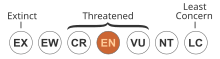
In 2014 it became endangered by IUCN. There are less than 2,500 of these tigers.[1] There are about 1,520–1,909 in India, 440 in Bangladesh, 124–229 in Nepal and 67–81 in Bhutan.[2][3][4][5] New tiger census 2010 showed the population of tiger in India approximately 2,226 which is 30% more from 1706, counted in the year 2010.[6]Bengal tigers are carnivores. Bengal tigers are apex predators. They eat deer, water buffalo, wild boar, snakes, fish, rabbits, rodents, birds, monkeys and even sloth bears and jackals.
Appearance[change | change source]
The Bengal tiger's coat is brownish-yellow or brownish-orange. Its stripes go from dark brown to black. The belly and the inside parts of the limbs are white. The tail is brownish-orange with black rings.
They are the second largest tiger, after the Siberian tiger also known as the Amur Tiger. Male Bengal tigers have a total length, including the tail, from 270 to 310 cm (110 to 120 in). Females go from 240 to 265 cm (94 to 104 in).[7] The average weight of males is 204.5 kg (451 lb). Females are 139.7 kg (308 lb).[8]
References[change | change source]
- ↑ 1.0 1.1 Chundawat, R. S., Khan, J. A., Mallon, D. P. (2010). "Panthera tigris tigris". IUCN Red List of Threatened Species. Version 2011.2. International Union for Conservation of Nature.
{{cite web}}: CS1 maint: multiple names: authors list (link) - ↑ Jhala, Y.V., Qureshi, Q., Sinha, P.R. (2011). Status of tigers, co-predators and prey in India. National Tiger Conservation Authority, Govt of India and the Wildlife Institute of India, New Delhi and Dehra Dun, India.
- ↑ Global Tiger Initiative. (2011). Global Tiger Recovery Program 2010–2022 Archived 2011-08-26 at the Wayback Machine. Global Tiger Initiative Secretariat, Washington.
- ↑ The Economic Times (2010). Nepal has 155 adult tigers, 5% of world population. Times Internet Limited
- ↑ Sangay, T., Wangchuk, T. (2005). Tiger Action Plan for Bhutan 2006-2015. Nature Conservation Division, Department of Forests, Ministry of Agriculture, Royal Government of Bhutan and WWF Bhutan Programme, Thimphu.
- ↑ Corbett National Park. With Increase in Tiger Population in India, Tourists Thronging Tiger Reserves in Huge Numbers Archived 2015-05-02 at the Wayback Machine. corbett-national-park.com
- ↑ Mazák, V. (1981) Panthera tigris. Mammalian Species No. 152: 1–8.
- ↑ Slaght J.C. et al 2005. Chapter 6. Who‘s king of the beasts? Historical and recent body weights of wild and captive Amur tigers, with comparisons to other subspecies. Pages 25–35 in: Miquelle D.G; Smirnov E.N. & Goodrich J.M. (eds) Tigers in Sikhote-Alin Zapovednik: Ecology and Conservation. PSP, Vladivostok, Russia (in Russian)
Other websites[change | change source]
 Data related to Panthera tigris tigris at Wikispecies
 Media related to Panthera tigris tigris at Wikimedia Commons
| Main symbols |
|   |
|---|---|---|
| Monuments and Memorials |
| |
| People |
| |
| Flora and fauna |
| |
| Other symbols |
| |