


Circumcision
 | The English used in this article or section may not be easy for everybody to understand. (August 2023) |
 | An editor thinks that this article may not be neutral. (August 2021) |

Circumcision is an operation in which the foreskin is removed. In common speech, someone who has been circumcised is described as cut while someone who is not is described as uncut. For example, one teenaged boy might ask another teenaged boy, "Are you cut?" While this is slang English, it is not considered profanity.
Circumcision may be done by a doctor using a surgical tool, such as scissors, a plastic tool called a plastibell device, or it may be done with a laser. If the doctor uses a laser there is almost no bleeding.
Circumcision may be a religious ritual, a custom in certain tribes or countries, or a medical practice. The rates differs from country to country.[1]
Reasons for circumcision[change | change source]
- Medical Conditions that Male Circumcision Protects Against Over the Lifetime[2]
- Urinary tract infection;
- Penile inflammation, for example, balanitis, balanoposthitis, lichen sclerosus;
- Candidiasis;
- Phimosis and paraphimosis (when the foreskin is too tight)
- Inferior hygiene;
- Sexually transmitted infections including high-risk human papillomavirus (HPV), genital herpes simplex virus (HSV), trichomoniasis, mycoplasma, syphilis, chancroid, and HIV;
- Physical injuries to the foreskin, including coital injuries;
- Cancers of the penis, prostate, and cervix.
- Religious reasons: Most Jewish and Muslim males must be circumcised. Jewish boys are typically circumcised when they are 1 week old. Muslim boys are usually circumcised at any time from moments after birth all the way up to puberty, depending on family, region, and country.
- In some tribes, especially in Africa, a teenage boy must be circumcised. Otherwise, his family and the people in his village will not treat him as a man and he will not be able to marry.
- In Western culture (especially in the United States), parents circumcise their sons because it is easier to keep the penis clean and it is more common.
- Many men and teenage boys in Western countries ask for circumcision simply because they like the appearance.


Benefits and criticisms[change | change source]
No major medical organization recommends universal circumcision of neonatals (newborns), and no major medical organization calls for banning it.[3]
Discussion[change | change source]
This change to the penis is common in many countries of the world including the United States and Israel. It is uncommon, but often causes the man to die. Circumcision has been suggested to reduce the risk of cancer of the cervix in female sexual partners and some cancers of the penis.[4][5] Circumcision reduces, but does not eliminate, the risk of getting or spreading HIV/AIDS. Circumcision became more common in Africa after HIV/AIDS began but use of condoms remain more effective ways of preventing sexually transmitted diseases.
People disagree about whether circumcision is a good for health and sexual pleasure. People who think circumcision is a good idea may point to health reasons. Circumcision reduces sexually transmitted diseases like HIV and HPV, prevents certain kinds of cancer, and gets rid of infections and unpleasant smells under the foreskin. If circumcision is done soon after birth, it makes it less common for baby boys to get urinary tract infections (UTIs). UTIs can cause permanent damage to the kidneys. Many people think a penis looks better if it is circumcised. A study done in the United States found that the women prefer a circumcised penis, to look at and in sexual activity, especially if they are going to put their mouth on the penis.[6] In countries where most boys are circumcised as babies, parents sometimes think that uncircumcised boys will be teased. Some boys are mean to a boy if his penis looks different. Bullying was a bigger problem in the past when boys had to take showers together at school after gym class or before swimming. People opposed to routine circumcision are called intactivists.[7]
The University of the Western Cape in South Africa lists these benefits of medical male circumcision (MMC):[8]
- Reduces the risk of HIV Infection
- Decreased risk of sexually transmitted infections (STIs / STDs) - Circumcised men might have a lower risk of certain sexually transmitted infections, including HIV. Still, safe sexual practices remain essential.
- Provides health benefits for sexual partners - by getting circumcised, you not only reduce your own HIV and STI risk, but your partner’s too.
- Better hygiene - Circumcision makes it simpler to wash the penis. Also, when a guy is not circumcised, moisture can get trapped between his penis and the foreskin, which creates an ideal environment for bacteria to grow. Removing the foreskin gets rid of the wet, warm and dark environment that can sustain viruses such as HIV and other sexually transmitted infections such as syphilis, herpes and chancroids.
- Eliminates bruising and tearing during sexual intercourse
- Reduces the risk of penile cancer - Although cancer of the penis is rare, it's less common in circumcised men.
- Being circumcised reduces your female partner’s risk of cervical cancer.
- Decreased risk of urinary tract infections - The overall risk of urinary tract infections in males is low, but these infections are more common in uncircumcised males.
- It can be difficult to keep an uncircumcised penis fresh 100% of the time. Circumcision simplifies the task of keeping the penis clean and keeps you fresher, giving you more confidence
Some myths about medical male circumcision:[8]
- Myth: Circumcision affects a man’s ability to make his partner pregnant.
- Truth: Circumcision has no effect on a man’s ability to make his partner pregnant. There are other factors such as fertility that play a role here.
- Myth: Circumcision leads to a loss of sexual function and pleasure.
- Truth: Although there can be some minor loss in sensitivity at the tip of the penis, MMC does not lead to a loss of sexual function and pleasure. In fact, several studies conducted among men after adult medical male circumcision suggest that very few men report their sexual functioning to be worse after circumcision. Most men report either improvement or no change.
One study, conducted in 2015,[9] determined that the foreskin does not provide a sexual response or serve a sexual function in men. Instead, it is the corona and frenular (the area under the frenulum) areas which provide sexual response due to the high concentration of genital corpuscles. Out of a large sample of Kenyan men in a controlled trial, 74.8% of men reported higher penile sensitivity two years after circumcision, while only 7.1% reported lower penile sensitivity two years after circumcision. It was deduced that even a retracted foreskin would tend to reduce the stimulus to the corona and frenular areas, particularly on the outward stroke of intercourse. The study determined that “any sexual effect of circumcision must depend solely on the exposure of the glans and not on the absence of the prepuce.”[9] The study concluded that male circumcision has no adverse effect on parameters relevant to sexual function, sensation, sensitivity, satisfaction, or pleasure.[9]
The area of the outer and inner foreskin combined spans a wide range: 7–100 cm2 and 18–68 cm2 respectively.[2] In discussing vestigial structures, Charles Darwin stated, “An organ, when rendered useless, may well be variable, for its variations cannot be checked by natural selection.”[10] The variability in foreskin size is consistent with the foreskin being a vestigial structure.[2]
Those who believe that the foreskin is important for sexual pleasure are against circumcision. Others do not like circumcision because they believe it has no medical advantage, or that it is easy to clean under the foreskin, or that circumcision harms the penis or the mind. People who do not like circumcision of baby boys say doctors and parents should not make this decision. They say that the owner should choose when he is old enough to decide for himself. However, it will hurt more if done at a later age.
There are 8 large groups of circumcised men:
- Jews
- Muslims
- Many African blacks who are not Muslim
- Most Spanish people from Andalusia
- Filipinos
- Polynesian people
- South Korea
- Majority White Americans and African Americans from the United States
Traditions[change | change source]
In the US, male circumcision is commonly done after birth in the Hospitals.[11] According to the CDC, the latest data (from NCHS) on male circumcision in the United States show a 2.5% overall increase in prevalence in males aged 14 to 59 years between 2000 and 2010. In contrast, there has been a decline of 6.1% in newborn circumcisions. The newborn circumcision rate in the US dropped slightly from 83.3% in the 1960s to 77.2% in 2010. The main reason for this 6 point drop is most likely the much faster increase in the Hispanic population, the ethnic group having the lowest circumcision prevalence. The growing Hispanic population in the West accounts for most of the decrease in national prevalence. Because Hispanic and black individuals are over-represented in poorer demographics, the withdrawal of Medicaid funding for elective circumcision in 18 states is of concern to public health, as was also expressed by the authors of the CDC’s recent report.[12] After controlling for other factors, states with Medicaid coverage had hospital circumcision rates 24 percentage points higher than states without such coverage.[13] Many, but not all, private health insurance plans pay for circumcision. A study of 96,457 male babies in the state of Maryland found that 75% of new baby boys were circumcised before they left the hospital. More were circumcised in a religious ceremony or in a doctor's office later. With those boys included, 82% of baby boys in Maryland got circumcised. It was less common for Asian Americans and Hispanic babies than for White Americans and African Americans babies.[14][15] A Study from 2022 shows the Highest Circumcision rate of newborn babyboys are West Virginia with 87%[16] Through the influence of the United States Army in West Germany, routine infant circumcision was introduced in some German Hospitals.[17] After the German reunification in 1990, circumcision drastically decreased in the German population.[18] Traditional male circumcision is usually performed due to historical Jewish and Islamic influence in Andalusia by the Spaniards.[19] In Pacific Islands, circumcision of boys is part of their tradition.[20] In the Phillipines, the tradition of male circumcision is called Tuli, and 91,7% of male are circumcised.[21] In South Korea 77% of male are circumcised, this tradition was taken by US American Military.[22][23]
Reuse of removed skin[change | change source]
When a foreskin is removed from a baby, doctors can (with parents' permission) use the skin for important medical purposes. Doctors can replace skin on someone with burns or with foot sores caused by diabetes.[24] Foreskins that have been removed can be used for medical research. A foreskin that has been cut off can be used to test new drugs and to find cures for diseases. The small piece of skin that was cut off can grow a huge amount of new skin, enough to cover several football fields. In the future, it may be possible to grow other parts of the body from this skin.
Ice Age[change | change source]
Since the Ice Age circumcision of males was practised[25]
Styles[change | change source]
They are four circumcision styles: Low and Loose, Low and Tight, High and Loose and High and Tight. The extreme High and Tight Style is done in USA, while the lower styles are common in Europe.[26]
Judaism[change | change source]
In Judaism, religious law orders that baby boys be circumcised on the 8th day after their birth. This is required even if the 8th day after birth is Shabbat (Saturday). In the Jewish faith, circumcision is an important tradition because it represents the newly born baby being included in the covenant (or agreement) which God made with the prophet Abraham. Medical studys confirm that the 8th day after birth, is the ideal day for a circumcision, because of the highest presence of the Coagulation factor Vitamin K[27] Jews used to bury the foreskin after it was removed.
A mohel is someone who circumcises Jewish baby boys eight days after they are born in accordance with Jewish law. A knife is traditionally used for this, but a clamp is now sometimes used instead. Mohels are traditionally male, but most types of non-orthodox (not fully traditional) types of Judaism allow women to be mohels without restriction.[28]
For Jews who observe religious law, the circumcision is performed at a ceremony called a Brit milah. Family, relatives and guests attend. Others, such as Reform Jews may choose to have the circumcision done in a hospital before the baby goes home.[29] They may have a celebration afterwards, or after the birth of a baby girl for whom there is no ritual act.
Islam[change | change source]
In the Quran, no sura or ayat mention male or female circumcision. However, there are some injunctions of the prophet Muhammad that explain and command only male circumcision, as a continuation of Abrahamic/Hebraic tradition.[30] For example, the prophet Muhammad said in a hadith that "Five are the acts which are part of fitrah:[a] Circumcision, clipping or shaving the pubic hair, cutting the nails, plucking or shaving the hair under the armpits and clipping (or shaving) the moustache".[b]
Also, according to the Qur'an, Allah ordered Muhammad to follow the religion of Ibrahim (the Hebrew Abraham): "Then We inspired you: 'Follow the religion of Ibrahim, the upright in Faith'." —(Qur'an 16:123)
Many Islamic scholars say that is an important ritual and a symbolic step of purification along the lines of Abrahamic tradition.[31] Most Shafi Islamic Jurists (judges) say that circumcision is required for men. It is an accepted tradition in almost all Islamic sects and among most Islamic scholars and theologians.[32] Circumcision is also important within Islam because Islam claims to be the 'truth' and the 'continuation' of the old and true message of Ibrahim/Abraham. According to Islam, God's covenant with Abraham was passed on to Muhammad, whose mission was to continue the covenant. The covenant is continued, according to Islam, through several steps, including male circumcision.[31] The Quran discusses this covenant in detail in several places, including sura 14 (Ibrahim – Abraham). An Uncut Man is not allowed to made his Hajj to Mecca.[33]
Age of men illustration[change | change source]
There are two hadiths which are linked to the acceptance of male circumcision in Islam. They also show how circumcision may have been used to keep track of dates in tribal Arabia:
Ibn Jubayr Sa'id reported: "Ibn `Abbas was asked the following question: 'How was it with you, [when] the Prophet, peace be upon him, died?,' he said, 'I was circumcised at that particular time because the men were usually only circumcised when they became sexually mature.'" [Sahih al-Bukhari No. 6299]
And further, Ibn `Abbas reported: "When the Prophet, peace be upon him died, I was circumcised at that particular time." [Sahih al-Bukhari No. 6300]
Along with being an important rite of passage, circumcision may have helped people keep track of dates and place events into the correct time and place, like the Sünnet-Party.
Additional images[change | change source]
-
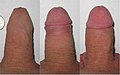 1 year after circumcision (right)
 -
 Uncircumcised and circumcised glans when erect
 -
 A semi-erect circumcised penis
 -
 Circumcised penis
 -
 A circumcised penis
 -
 Circumcised penis, flaccid (relaxed, not erect)
 -
 A long foreskin on an uncircumcised south Asian male


Related pages[change | change source]
Notes[change | change source]
References[change | change source]
- ↑ Morris, Brian J.; Wamai, Richard G.; Henebeng, Esther B.; Tobian, Aaron AR; Klausner, Jeffrey D.; Banerjee, Joya; Hankins, Catherine A. (2016). "Estimation of country-specific and global prevalence of male circumcision". Population Health Metrics. 14: 4. doi:10.1186/s12963-016-0073-5. PMC 4772313. PMID 26933388.
- ↑ 2.0 2.1 2.2 Morris, Brian J.; Krieger, John N.; Klausner, Jeffrey D. (2017-03-24). "CDC's Male Circumcision Recommendations Represent a Key Public Health Measure". Global Health: Science and Practice. 5 (1): 15–27. doi:10.9745/GHSP-D-16-00390. ISSN 2169-575X. PMC 5478224. PMID 28351877.
- ↑ Bolnick D.A; Koyle M. & Yosha A. 2012. Surgical guide to circumcision, p3–8. Springer. ISBN 978-1-4471-2857-1
- ↑ "Male circumcision may protect against HPV infection in males and females". News-Medical.net. 10 April 2023. Retrieved 31 July 2023.
- ↑ https://www.cancer.org/cancer/types/penile-cancer/causes-risks-prevention/prevention.html
- ↑ Williamson, Marvel L.; Williamson, Paul S. "Women's Preferences for Penile Circumcision in Sexual Partners". Journal of Sex Education and Therapy.
- ↑ Kennedy, Amanda Owyn. Intactivism: Understanding Anti-Male Circumcision Organizing in the US. Diss. The Graduate School, Stony Brook University: Stony Brook, NY., 2016.
- ↑ 8.0 8.1 "Medical Male Circumcision Services". www.uwc.ac.za. Retrieved 2018-08-25.[permanent dead link]
- ↑ 9.0 9.1 9.2 Cox, Guy; Krieger, John N.; Morris, Brian J. (June 2015). "Histological Correlates of Penile Sexual Sensation: Does Circumcision Make a Difference?". Sexual Medicine. 3 (2): 76–85. doi:10.1002/sm2.67. ISSN 2050-1161. PMC 4498824. PMID 26185672.
- ↑ Darwin C. The Origin of Species by Means of Natural Selection. London, UK: John Murray; 1859.
- ↑ "Products - Health e Stats - Trends in Circumcision Among Male Newborns Born in U.S. Hospitals: 1979–2010". June 2019.
- ↑ Introcaso, Camille E.; Xu, Fujie; Kilmarx, Peter H.; Zaidi, Akbar; Markowitz, Lauri E. (July 2013). "Prevalence of Circumcision Among Men and Boys Aged 14 to 59 Years in the United States, National Health and Nutrition Examination Surveys 2005–2010". Sexually Transmitted Diseases. 40 (7): 521–525. doi:10.1097/01.olq.0000430797.56499.0d. ISSN 0148-5717. PMID 23965763. S2CID 31883301.[permanent dead link]
- ↑ Morris, Brian J.; Bailis, Stefan A.; Wiswell, Thomas E. (May 2014). "Circumcision Rates in the United States: Rising or Falling? What Effect Might the New Affirmative Pediatric Policy Statement Have?". Mayo Clinic Proceedings. 89 (5): 677–686. doi:10.1016/j.mayocp.2014.01.001. ISSN 0025-6196. PMID 24702735.
- ↑ Cheng, D; Hurt L, L; Horon, IL (December 4, 2008). "Neonatal circumcision in Maryland: a comparison of hospital discharge and maternal postpartum survey data". J Pediatr Urol. 4 (6): 448–451. doi:10.1016/j.jpurol.2008.06.007. PMID 18691938. Retrieved 18 March 2017.
Hospital discharge data showed that 75.3% of male infants were circumcised, and survey data showed that 82.3% of male infants were circumcised. The circumcision rate among infants weighing <1500 g at birth was 38.9% using hospital discharge data and 74.5% using maternal survey data. Both sources revealed lower circumcision rates among Asian Americans and Hispanic and Latino Americans infants than among White Americans and African Americans infants
- ↑ Morris, Brian J.; Wamai, Richard G.; Henebeng, Esther B.; Tobian, Aaron AR; Klausner, Jeffrey D.; Banerjee, Joya; Hankins, Catherine A. (2016). "Estimation of country-specific and global prevalence of male circumcision". Population Health Metrics. 14: 4. doi:10.1186/s12963-016-0073-5. PMC 4772313. PMID 26933388.
- ↑ "Circumcision Rates by State 2023".
- ↑ https://www.circlist.com/rites/Dietz_1970.pdf
- ↑ "Dietz2".
- ↑ "Situation of religious circumcision in Spain".
- ↑ https://www.researchgate.net/publication/10769194_Attitudes_of_Pacific_parents_to_circumcision_of_boys
- ↑ "Tuli a rite of passage for Filipino boys".
- ↑ Ku, J. H.; Kim, M. E.; Lee, N. K.; Park, Y. H. (2003). "Circumcision practice patterns in South Korea: Community based survey". Sexually Transmitted Infections. 79 (1): 65–67. doi:10.1136/sti.79.1.65. PMC 1744613. PMID 12576619.
- ↑ Pang, M. G.; Kim, D. S. (2002). "Extraordinarily high rates of male circumcision in South Korea: History and underlying causes". BJU International. 89 (1): 48–54. doi:10.1046/j.1464-410X.2002.02545.x. PMID 11849160. S2CID 30235521.
- ↑ "Why Human Foreskin Is a Hot Commodity in Science". Discover Magazine. Retrieved 26 June 2023.
- ↑ https://www.researchgate.net/publication/278660669_Why_Circumcision_From_Prehistory_to_the_Twenty-First_Century
- ↑ "Styles of Circumcision | Choosing Circumcision". Archived from the original on 2022-07-02. Retrieved 2022-06-18.
- ↑ https://www.researchgate.net/publication/321462229_Haematological_Basis_of_8th_Day_Male_Child_Circumcision_in_The_Holy_Bible
- ↑ "CIRCLIST - Bris - the Jewish circumcision rite".
- ↑ "B'rit Milah: The Circumcision Ritual". ReformJudaism.org. Retrieved 24 December 2018.
- ↑ "BBC - Religions - Islam: Circumcision of boys".
- ↑ 31.0 31.1 Nasrallah, M. Islam and Mankind: Muslim Practices in the Light of the Holy Quran, Islami Qutubkhana Press, Lahore and Karachi, 1995, p. 102, 105-106; This volume is a referential handbook for Muslim students approved by both the Sunni and Shia sects of Islam
- ↑ Urdu: Fiqah al Islami, Aam Taauruf [An Introduction to Islamic Doctrine], Islamic Welfare Association Press, Lahore, 1976
- ↑ "What is the medical significance behind circumcision?". meddco.com. Retrieved 2022-09-07.
