


Event horizon
| Part of a series of articles about |
| General relativity |
|---|
 |
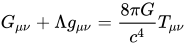
In general relativity, an event horizon is the part of a black hole where light cannot escape. Imagine the black hole to be like a ball that you could see in a large spot of emptiness. The event horizon would then be an outer bubble that surrounds that ball, the space between the ball and the larger bubble would be the event horizon. If an object goes past the event horizon, it can never get away from it. Light that is emitted from inside of the event horizon near the black hole can never reach an observer on the other side. If an observer saw an object fall into a black hole, it would look like the object was stuck at the event horizon forever. The reason this happens is because of the gravity of the black hole slows down time around it, making it look like the object will take an infinite amount of time to reach it.
Further reading[change | change source]
- The Universe in a Nutshell by Stephen Hawking
- Kip Thorne (1994). Black Holes and Time Warps. W. W. Norton.
Other websites[change | change source]

