


Samurai

The samurai (or bushi) were Japanese warriors who were members of the important military class before Japanese society changed in 1868. The samurai were also considered to be a type of hereditary nobility.
The word samurai comes from the Japanese verb saburau, which means "to serve and look up to someone."[1]
History[change | change source]
In the 12th century, two military clans, the Minamoto and the Taira, were very powerful. They controlled Japan and fought wars against each other. In 1192, Minamoto no Yoritomo became the first shogun. He became the ruler of all of Japan and started a new government in Kamakura. The Kamakura government lasted from 1185 to 1333.[2] It made the samurai the ruling class of Japanese society.
The samurai fought many wars in the Warring States period (1467-1573). There were many independent areas in Japan that fought one another all the time and so Japan needed many samurai. Many of the famous samurai movies by Akira Kurosawa were about this time.
Toyotomi Hideyoshi won many wars against other clans. He made Japan one country and developed a social caste system. It was completed by Tokugawa Ieyasu and the rulers after him. Between the wars, many samurai had always worked on farms. Hideyoshi said that all samurai must either live on farms or live in castle towns with other warriors. He also made a law that only samurai could have swords.
The samurai became very powerful and important near the end of the Edo period (1603-1867) and during the Shinto period. In the Edo period, they were the most important social caste. All samurai had to live in castle towns. Some of them had lords who paid them with rice, but others did not have lords and were called "rōnin". The "rōnin" caused problems for Japan in the early Edo period.
In 1615, the Tokugawa an won a very important battle when he took Osaka Castle. It has no rivals and so Japan became very peaceful for about 250 years. Military skills became less important, and most samurai became bureaucrats, teachers or artists.
In 1868, feudalism ended in Japan, which ended the samurai class.
Weapons[change | change source]

Weapons used by the samurai included:
- Japanese swords, (katana)
- The yumi (longbow)
- Firearms from the 16th century
- Cannons
- Pole weapons bearing blades, and spears
- Staff weapons (no blades)
- Clubs and truncheons
- Chain weapons
-
 1890s photo showing a variety of armor and weapons typically used by samurai
 -
 Various Japanese (samurai) Tanegashima matchlock firearms.
 -
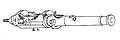 The ōzutsu (大筒), a swivel breech-loading cannon, 16th century


Beliefs[change | change source]
A samurai believed that his swords held his soul and so his sword was the most important thing that he had.
Samurai were allowed to fight anyone who did not show them proper respect. Every sword had to be tested for sharpness. To do so, the owner of the sword could execute a criminal.
Samurai led their lives according to the ethical code of bushido ("the way of the warrior"). That meant loyalty to one's master, self-discipline, respect, and ethical behavior. When a samurai lost his master, also called daimyo, he became a rōnin.
If a samurai was defeated or dishonored himself by not following the code of bushido, he had to commit seppuku (ritual suicide). Part of the seppuku ritual was cutting his stomach or abdomen. That part of the ritual is called hara-kiri. For a samurai, death was better than having no honor or being captured by the enemy. Another reason for committing Seppuku was the death of the daimyo. With that ritual, a samurai showed how loyal he was to his dead master. There were periods in which seppuku was forbidden, but some samurai still committed it.
The bushi's training methods, like meditation, judo and kendo, are still followed today. There is no longer a samurai class in modern Japan, but their families' successors are still well-respected.
Women[change | change source]
Samurai women were trained to defend themselves and their children. They usually did so when their warrior husbands were busy in battles. Sumurai women were therefore trained to handle polearms (naginata) and short daggers (tanto). During the Edo period, Japanese women were trained to handle naginata by the age of 18. The short kaiken knife was used by young women to defend their virtue or, if they lost it, to take their own life.
During the Edo period, women's education became very important. Girls were taught from a young age to write, read, dance, etc. The main criteria for marriage changed, but among the most important were physical attractiveness and education. Special books were written for women. They taught mainly how to take care of house and children. By the end of the Edo period, women attended philosophical and literary classes.
The term "samurai" refers to males specifically, but here were a few women who were samurai. One of the most famous was Itagaki, who lived during the end of the Heian period. She owned her own army of about 3,000 warriors. In 1199, Itagaki fought against 10,000 Heike soldiers. She was famous for being very good at handling the naginata sword.
Hino Tomiko ruled in place of her husband, Ashikaga Yoshimasa (8th shogun).
Toyotomi Hideyoshi's mistress became the master of Osaka Castle after his death.
Yamauchi Kazutoyo's wife, Chiyo, was one of the most loyal wives known in Japanese history. She supported her husband during hard times and saved to buy a horse for him. Yamauchi Kazutoyo never took a mistress, though it was a known tradition for a samurai. He never left Chiyo even though she had only one child.
Related pages[change | change source]
References[change | change source]
- ↑ Wilson, William Scott (1985). Ideals of the Samurai: Writings of Japanese Warriors. United States: Black Belt Books. p. 17. ISBN 978-0-89750-081-4. OCLC 634240939.
- ↑ "The Age Of The Samurai".
Other websites[change | change source]

- Samurai from childhood Archived 2007-03-10 at the Wayback Machine
- Hanami Web - Samurai Archived 2009-04-13 at the Wayback Machine