


Bisexuality

Bisexuality is a sexual orientation. Bisexual (sometimes shortened to bi) people are romantically or sexually attracted to both men and women.[1][2] It can also mean attraction to more than one gender.[3] Sometimes it is talked about as having romantic or sexual attraction to someone regardless of their sex or gender identity. This is also known as pansexuality.[4][1] Some bisexual people love men and women the same and some people love one more than the other. Some bisexual people have preferences to one or more sexes, however some may not.[5] A slang expression for bisexuality is "to swing both ways."
In 1948, Alfred Kinsey published the Kinsey scale. The Kinsey scale shows that sexuality is a continuum. This means it moves little by little from heterosexuality to homosexuality. On the Kinsey scale, a 0 is someone who is only heterosexual. A 6 is someone who is only homosexual. Someone who is equally homosexual and heterosexual (bisexual) is a 3.
In biology, bisexual can define an organism that has both male and female organs. This mostly refers to plants.
Definitions[change | change source]
Bisexuality is romantic or sexual attraction to both males and females,[6][7][8] or to more than one gender.[9] Attraction can be different for bisexuals. This can be sexual, romantic, emotional, or physical attraction.[10] Some sources say that bisexuality means romantic or sexual attraction to all gender identities or sexual orientations. Some sources say that it is romantic or sexual attraction to a person no matter what that person's sex or gender is. This would make it the same as pansexuality.[11][12] Pansexuality ignores or rejects the gender binary (the idea that there is two genders and related sexual orientations).[13] This is because pansexuals are open to relationships with people who do not identify as men or women.[14][15] Sometimes the phrase bisexual umbrella or bisexual community is used to talk about any non-monosexual behaviors, attractions, and identities.[16] The phrase "bisexual community", or the word "plurisexuality",[17] includes people who identify as bisexual, pansexual, omnisexual, biromantic, polysexual, or sexually fluid.[18][19]
Symbols[change | change source]
A common symbol of the bisexual community is the bisexual flag. This flag has a deep pink stripe at the top for homosexuality, a dark blue stripe for heterosexuality, and a purple stripe in the middle for bisexuality.[20] The purple stripe is a mix of the blue and pink colors, representing a mix of homosexuality and heterosexuality.
Another symbol of bisexuality is the biangles. The biangles are a pair of overlapping pink and blue triangles. These triangles form purple where they cross.
-
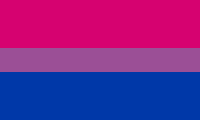 The bisexual pride flag
 -
 Bisexual infinity symbol
 -
 The biangles
 -
 Gender symbols
 -
 Double crescent moons


.svg)

Related pages[change | change source]
References[change | change source]
- ↑ 1.0 1.1 "Sexual Orientation". American Psychiatric Association. Archived from the original on 26 July 2011. Retrieved 3 December 2012.
- ↑ Jabbour, Jeremy; Holmes, Luke; Sylva, David; Hsu, Kevin J.; Semon, Theodore L.; Rosenthal, A. M.; Safron, Adam; Slettevold, Erlend; Watts-Overall, Tuesday M.; Savin-Williams, Ritch C.; Sylla, John (2020-08-04). "Robust evidence for bisexual orientation among men". Proceedings of the National Academy of Sciences. 117 (31): 18369–18377. doi:10.1073/pnas.2003631117. ISSN 0027-8424. PMC 7414168. PMID 32690672.
- ↑ "Understanding Bisexuality". American Psychological Association. 2019. Archived from the original on 8 March 2019. Retrieved 8 March 2019.
- ↑ "Sexual Orientation & Homosexuality". www.apa.org. American Psychological Association. Archived from the original on 16 February 2019. Retrieved 13 November 2020.
- ↑ Bailey, J. Michael; Vasey, Paul L.; Diamond, Lisa M.; Breedlove, S. Marc; Vilain, Eric; Epprecht, Marc (2016). "Sexual Orientation, Controversy, and Science". Psychological Science in the Public Interest. 17 (2): 45–101. doi:10.1177/1529100616637616. ISSN 1529-1006. PMID 27113562. S2CID 42281410.
- ↑ "Sexual Orientation & Homosexuality". www.apa.org. American Psychological Association. Archived from the original on 16 February 2019. Retrieved 13 November 2020.
- ↑ "Sexual Orientation". American Psychiatric Association. Archived from the original on 26 July 2011. Retrieved 3 December 2012.
- ↑ Bailey, J. Michael; Vasey, Paul; Diamond, Lisa; Breedlove, S. Marc; Vilain, Eric; Epprecht, Marc (2016). "Sexual Orientation, Controversy, and Science". Psychological Science in the Public Interest. 17 (2): 45–101. doi:10.1177/1529100616637616. PMID 27113562. Archived from the original on 2 December 2019. Retrieved 27 July 2019.
- ↑ Cerezo, Alison; Camarena, Juan; Ramirez, Amaranta (2020-07-09), Rothblum, Esther D (ed.), "Latinx Sexual and Gender Minority Mental Health", The Oxford Handbook of Sexual and Gender Minority Mental Health, Oxford University Press, pp. 185–198, doi:10.1093/oxfordhb/9780190067991.013.17, ISBN 978-0-19-006799-1, archived from the original on 9 March 2022, retrieved 2021-12-04
- ↑ Flanders, Corey E.; LeBreton, Marianne E.; Robinson, Margaret; Bian, Jing; Caravaca-Morera, Jaime Alonso (2017-01-02). "Defining Bisexuality: Young Bisexual and Pansexual People's Voices". Journal of Bisexuality. 17 (1): 39–57. doi:10.1080/15299716.2016.1227016. ISSN 1529-9716. S2CID 151944900.
- ↑ Soble, Alan (2006). "Bisexuality". Sex from Plato to Paglia: a philosophical encyclopedia. Vol. 1. Greenwood Publishing Group. p. 115. ISBN 978-0-313-32686-8.
Some bisexuals' attractions, however, appear to be gender 'blind'; that is, they are attracted to individuals independently of their sex- and gender linked attributes ... People with a gender-blind or 'pansexual' orientation are open not only to relations with men and women as traditionally figured in our society but also to relations with individuals who identify themselves as some combination of man/woman or some alternative gender entirely.
- ↑ Rice, Kim (2009). "Pansexuality". In Marshall Cavendish Corporation (ed.). Sex and Society. Vol. 2. Marshall Cavendish. p. 593. ISBN 978-0-7614-7905-5. Archived from the original on 13 November 2020. Retrieved 3 October 2012.
In some contexts, the term pansexuality is used interchangeably with bisexuality, which refers to attraction to individuals of both sexes... Those who identify as bisexual feel that gender, biological sex, and sexual orientation should not be a focal point in potential relationships.
- ↑ Rice, Kim (2009). "Pansexuality". In Marshall Cavendish Corporation (ed.). Sex and Society. Vol. 2. Marshall Cavendish. p. 593. ISBN 978-0-7614-7905-5. Archived from the original on 13 November 2020. Retrieved 3 October 2012.
In some contexts, the term pansexuality is used interchangeably with bisexuality, which refers to attraction to individuals of both sexes... Those who identify as bisexual feel that gender, biological sex, and sexual orientation should not be a focal point in potential relationships.
- ↑ Soble, Alan (2006). "Bisexuality". Sex from Plato to Paglia: a philosophical encyclopedia. Vol. 1. Greenwood Publishing Group. p. 115. ISBN 978-0-313-32686-8.
Some bisexuals' attractions, however, appear to be gender 'blind'; that is, they are attracted to individuals independently of their sex- and gender linked attributes ... People with a gender-blind or 'pansexual' orientation are open not only to relations with men and women as traditionally figured in our society but also to relations with individuals who identify themselves as some combination of man/woman or some alternative gender entirely.
- ↑ Rice, Kim (2009). "Pansexuality". In Marshall Cavendish Corporation (ed.). Sex and Society. Vol. 2. Marshall Cavendish. p. 593. ISBN 978-0-7614-7905-5. Archived from the original on 13 November 2020. Retrieved 3 October 2012.
In some contexts, the term pansexuality is used interchangeably with bisexuality, which refers to attraction to individuals of both sexes... Those who identify as bisexual feel that gender, biological sex, and sexual orientation should not be a focal point in potential relationships.
- ↑ Flanders, Corey E. (2 January 2017). "Under the Bisexual Umbrella: Diversity of Identity and Experience". Journal of Bisexuality. 17 (1): 1–6. doi:10.1080/15299716.2017.1297145. ISSN 1529-9716.
- ↑ Cipriano, Allison E.; Nguyen, Daniel; Holland, Kathryn J. (2022-10-02). ""Bisexuality Isn't Exclusionary": A Qualitative Examination of Bisexual Definitions and Gender Inclusivity Concerns among Plurisexual Women". Journal of Bisexuality. 22 (4): 557–579. doi:10.1080/15299716.2022.2060892. ISSN 1529-9716. S2CID 248107200.
- ↑ Richards, Christina; Barker, Meg (2015). Sexuality and Gender for Mental Health Professionals: A Practical Guide. SAGE Publications. p. 116. ISBN 978-1446287163. Archived from the original on 19 November 2021. Retrieved August 23, 2017.
The identity 'bisexual' can be considered to be an umbrella term which includes all of the following groups and more: [...] People who don't see gender as a defining feature of their sexual attraction (some may also use terms like pansexual, omnisexual or ecosexual - see Glossary)."
- ↑ Sherwood Thompson (2014). Encyclopedia of Diversity and Social Justice. Rowman & Littlefield. p. 98. ISBN 978-1442216068. Archived from the original on 14 October 2021. Retrieved August 23, 2017.
There are many other identity labels that could fall under the wider umbrella of bisexuality, such as pansexual, omnisexual, biromantic, or fluid (Eisner, 2013).
- ↑ Page, Michael. "Bi Pride Flag". Archived from the original on 29 January 2007. Retrieved 16 February 2007.
The pink color represents sexual attraction to the same sex only, homosexuality, the blue represents sexual attraction to the opposite sex only, heterosexuality, and the resultant overlap color purple represents sexual attraction to both sexes (bi).
Further reading[change | change source]
- Sexual orientation and bisexuality FAQ's from the American Psychological Association
- James D. Weinrich, Sexual Landscapes: Why We Are What We Are, Why We Love Whom We Love, Charles Scribner's Sons, December 1987.