


Love


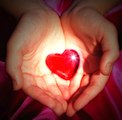
Love is a mix of feelings and actions that shows a deep liking for someone or something. Love involves caring for another. Romantic love can lead to things such as dating, marriage and sex, but a person can also feel for friends, such as platonic love, or family. There are also chemical reactions within the brain that can be triggered by the different types of love.
Forms of love[change | change source]
There are many kinds of love. There can be self-love, love towards a friend (such as platonic love), love in romance, towards family, toward God(s), or towards an object or idea. Often love can be confused with other feelings. Being sexually or physically attracted is the feeling of lust. Lust and love may be thought of as different. Normal friendship is a form of love that can be distracted by lust and misunderstanding.
-
-
 Floral decoration for love
 -
 The First Kiss of Adam and Eve, Eden.
 -
 Love symbol in tree of Yercaud


.jpg)

First love[change | change source]
People describe the person that they first loved romantically as their "first love." For example, in William Shakespeare's Romeo and Juliet, Romeo is Juliet's very first love. At that time, she was only 13. In Maria Edgeworth's book Belinda, Mr. Vincent says, "First loves are silly things."
Chemical basis[change | change source]
The biological model of lust is different from love because it is more like hunger or thirst.[1] Helen Fisher, an expert in the topic of romantic love, divides it into three stages: lust, attraction, and attachment. Lust makes people like each other, attraction encourages people to focus on mating, and attachment helps people tolerate the spouse (or the child).
Lust is the passionate sexual desire that promotes mating. This usually lasts only a few weeks or months. Attraction is more for one person specially. Recent studies in neuroscience say that as people fall in love, the brain releases chemicals, including dopamine. These chemicals make people less hungry and sleepy, and also adds an intense feeling of excitement. Research shows that this stage normally lasts from one and a half to three years.[2]
Since these lust and attraction stages are both described as temporary, a third stage might describe long-term love. Attachment can be used to describe the bonding period that helps keep partners together for many years. Attachment occurs in the longer term.
Love and health[change | change source]
Love has consequences for health and well-being. Joyful activities such as love activate areas in the brain responsible for emotion, attention, motivation and memory, and it may further lead to reduction of cortisol, which reduces stress.[3] Some people usually do not feel love. They are called aromantics.[4]
Related pages[change | change source]


Notes[change | change source]
- ↑ Lewis, Thomas; Amini F. & Lannon R. (2000). A general theory of love. Random House. ISBN 0-375-70922-3.
- ↑ Winston, Robert (2004). Human. Smithsonian Institution.
- ↑ Esch, Tobias; & Stefano, George B. (2005). Love Promotes Health. Neuroendocrinology Letters 26 (3): 264-267. PMID 15990734.
- ↑ Bell, Alexa. "Romantic Identity and LGBTQ Identification: Variations of Experience in the Asexual Community." (2015).
