


Death penalty


Death penalty, also called capital punishment, is when a government or state executes (kills) someone, usually but not always because they have committed a serious crime. A crime that can be punished with the death penalty is called a capital crime or a capital offense.
Executions in most countries have become rarer in recent centuries. The death penalty is a disputed and controversial topic. Generally, right-wing parties are supportive of the death penalty: centrist and left-wing parties are opposed to it. However, Far-left parties like Communist and Soviet Parties also support the Death Penalty.
About one third of the countries in the world have laws that allow the death penalty.[1] The United States, the People's Republic of China, Japan, Indonesia and Iran are examples of countries that have a death penalty. Canada, Australia, Mexico and all members of Council of Europe are examples of countries that have abolished the death penalty. 109 countries have gotten rid of the capital punishment for all crimes. Another 28 can be considered abolitionist in practice. Countries are considered abolitionist in practice if they retain the death penalty in law but have not carried out any executions for the past 10 years or more.
Most of the countries that have a death penalty use it on murderers, and for other serious crimes such as rape or terrorism. Other countries especially ones with Authoritarian or Totalitarian governments, however, also use it for smaller crimes like theft, drugs, or for saying bad things about the government.
Which countries execute the most people?[change | change source]
A study by Amnesty International found that the following countries did the most executions in 2012: [2]
- China (4000+) data not officially released.
- Iran (at least 314+)
- Iraq (at least 129+)
- Saudi Arabia (79+)
- United States (43)
- Yemen (28+)
- Oman (25+)
- Sudan (19+)
- Afghanistan (14)
Here's the list for 1998:
- China (1,067)
- Democratic Republic of the Congo (100)
- United States (68)
- Iran (66)
- Egypt (48)
- Belarus (33)
- Taiwan (32)
- Saudi Arabia (29)
- Singapore (28)
- Rwanda (24)
- Sierra Leone (24)
- Although unconfirmed, Amnesty International also received reports of many hundreds of executions in Iraq.
A total of 557 people were executed in the United States between 1977, when the death penalty was reintroduced after a 10-year break, and 2000. During this period, 20 states did not carry out any executions. Here are the states with the most executions during this time:
- Texas (239)
- Virginia (81)
- Florida (50)
- Missouri (46)
- Oklahoma (30)
- Louisiana (26)
- South Carolina (25)
- Alabama (23)
- Arkansas (23)
- Georgia (23)
| Nation | Year of abolition |
| Russia* | 1826 |
| Venezuela | 1863 |
| Portugal | 1867 |
| Brazil | 1882 |
| Costa Rica | 1882 |
| Ecuador | 1897 |
| Panama | 1903 |
| Norway | 1905 |
| Uruguay | 1907 |
| Colombia | 1910 |
First countries to abolish capital punishment[change | change source]
*The Russian Soviet Socialist Republic, as part of the Soviet Union, reinstated capital punishment during the time of the Soviet Union.
Common reasons for execution[change | change source]
It is common to have people executed for crimes including murder, manslaughter and attempted murder, but there are also other crimes that carry the death penalty. Some of these are:
- Bank robbery (Saudi Arabia)
- Kidnapping (India)
- Treason (North Korea, India)
- Trafficking with human beings (this is like slavery) (China)
- General robbery if at least one person dies (America)
- Rape (North Korea, China, Saudi Arabia)
- Trafficking or possessing certain illegal drugs in a certain quantity (Indonesia, Saudi Arabia, Singapore, Malaysia, Taiwan, North Korea and others)
- Bribery and Corruption (China)
- Piracy (North Korea)
- Adultery (Saudi Arabia, Iran and Afghanistan)
- Homosexuality (Iran, Saudi Arabia, Yemen, Sudan and Mauritania)
- Prostitution (both prostituting oneself and forcing others to do the same) (Iraq until 2003, Saudi Arabia)
- Apostasy in Islam (Afghanistan, Iran, Yemen, Mauritania, Pakistan, Qatar, Saudi Arabia, Somalia and Sudan)
- Witchcraft (Saudi Arabia, Qatar)
During war time, the following crimes are punished by death:
Who may not be executed[change | change source]
According to the International Covenant on Civil and Political Rights that became valid in 1976, people that were less than eighteen years old when they committed the crime may not be executed. According to the European Convention on Human Rights (which is effective in many European countries), specifically its 13th amendment (2002), no one can be executed.
Controversy[change | change source]
There is a lot of different opinions on the topic of capital punishment. As it is an important topic, each country has very strong feelings. Many people say the death penalty is reasonable because it scares people away from doing things that are illegal. However, many others say there is a potential of executing an innocent person. Some people say the death penalty supports justice, retribution, and punishment. The other side says that execution is murder. Most people know the threat of crime to their lives, but the question lies in the methods and action that should be used to deal with it.
Throughout human history, governments and rulers have used many death penalty methods to execute people, such as crucifixion, flaying, and hanging. Some methods like crucifixion and flaying are no longer used by governments, because people think that these methods of killing are too cruel. The gas chamber was found unconstitutional in the United States (that is: against the United States constitution not allowing "cruel and unusual punishments") and is no longer used.
The Council of Europe has abolished all death penalty by 13th amendment of the European Convention on Human Rights. Amnesty International oppose all death penalty on ground of the right to life and prohibition of all tortures or any cruel, inhuman, or degrading treatment insisted by Universal Declaration of Human Rights.
Forms of death[change | change source]

The following forms of execution are in use today:
- Electric chair: The prisoner is killed by a strong source of electricity attached to their head and leg.
- Lethal injection: The prisoner is poisoned with a mix of chemicals that are put into their body. Some countries use chemicals that are controversial. After the electric chair was abolished as a form of death penalty in the United States by be considered a too brutal punishment and be replaced by lethal injection, this method became the most widely used since then. China also use lethal injection.
- Firing squad: Some people shoot the prisoner with rifles. Firing squads are often used for soldiers during wars. One or more of those firing may have false ammunition that does not kill so that no one knows which person fired the shot that killed. A firing squad is a traditional military execution. Deserters, traitors and spies are sometimes shot. The firing squad is still used in Cuba, Indonesia and Nigeria, and was used in Mexico, Chile and Philippines in the past.
- Hanging: The prisoner has a rope tied around their neck. They are then dropped from a height. The person can die from their neck being broken. They might die from choking (asphyxiation), if the drop is too small or knot was badly made. If the drop is too long or the prisoner too heavy, their head might be torn off. Japan, India and former British colonies use hanging.
- Strangulation, by hand or by garrote. The garrote was the main type of capital punishment in Spain for hundreds of years. Originally, the convict was killed by hitting him with a club (garrote in Spanish). This later developed into putting a loop of rope placed around the neck. A wooden stick was placed in the loop, and rotated to tighten the rope until the condemned person was strangled to death.
- Stoning: Stones are thrown at the prisoner until they die. Stoning is still used in some Middle Eastern countries.
- Decapitation: The victim has his or her head cut off with a sharp blade, such as sword, axe or guillotine. This was the traditional means of execution in central Europe and many other places. Decapitation is also called beheading. Decapitation is still used in some Middle Eastern countries, but the only country to actively use it is Saudi Arabia.
Gallery[change | change source]
-
 Beheading: Japanese behead a Chinese (Photo from 1901)
 -
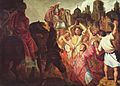 The Lapidation (Stoning) of St. Stephen is a painting by Rembrandt(1625)
 -
 And It can't be helped, a painting by Goya, showing a firing squad. (around 1810)
 -
 Hanging of the four people convicted for murdering Abraham Lincoln (1865)
 -
 An old electric chair


.jpg)


References[change | change source]
Further reading[change | change source]
- "Capital punishment". Citizendium.
- "Ten Anti-Death Penalty Fallacies". Thomas R. Eddlem. The New American. 3 June 2002. Archived from the original on 30 August 2021. Retrieved 30 August 2021.
Other websites[change | change source]
- Ten anti-death penalty fallacies: the case against capital punishment relies on myth, misinformation, and misplaced emotionalism. (Crime and Punishment)- The Open Library
- "Overhauling of Capital punishment". Law Mentor. Archived from the original on 2020-10-21. Retrieved 2020-04-14.
